
in-depth: 9 Best Android Phones of 2026, Tested and Reviewed: 2026
WIRED's 2026 Android phone guide highlights the Google Pixel 10a as the top choice for most, praising its $499 price, improved screen, and 7 years of software updates. The Google Pixel 10 series and Samsung Galaxy S26 series lead flagship recommendations, with OnePlus 15 noted for battery life. The guide emphasizes buying unlocked phones and provides key specs to consider, including display, processor, RAM, and camera features, all based on rigorous testing by Julian Chokkattu.

WIRED has released its comprehensive guide to the "9 Best Android Phones of 2026," offering an in-depth look at the top devices following extensive testing by reviewer Julian Chokkattu. Updated in March 2026, the guide aims to simplify the often-daunting process of selecting a new smartphone, covering everything from budget-friendly powerhouses to cutting-edge flagships and specialized options.
Top Picks for 2026
Leading the recommendations as the "Best Android Phone" for most users is the Google Pixel 10a, priced competitively at $499. While retaining its Tensor G4 processor and battery capacity from its predecessor, the Pixel 10a introduces notable enhancements. These include a brighter 120-Hz OLED display fortified with Gorilla Glass 7i, emergency Satellite SOS capabilities, and improved wired and wireless charging speeds. Its dual-camera system, featuring a 48-MP main sensor and a 13-MP ultrawide, consistently delivers impressive photos, complemented by a commitment to seven years of software updates and an IP68 water-resistance rating.
For users seeking the pinnacle of intelligent features, Google's Pixel 10, Pixel 10 Pro, and Pixel 10 Pro XL are highlighted as "The Smartest Smartphones." These models, currently available with discounts starting from $599 (originally $799), showcase new AI functionalities such as Auto Best Take and Camera Coach. They also support Google's innovative Pixelsnap Qi2 magnetic charging system.
Samsung’s latest offerings, the Galaxy S26, S26+, and S26 Ultra, are crowned "The Best Flagship Phones." Fresh off their debut, these devices represent the forefront of Android innovation, with the S26 model starting at $853 after a 5% discount.
Rounding out the specialized selections are the OnePlus 15 and OnePlus 15R, recognized for their industry-leading battery life. The OnePlus 15, in particular, boasts a substantial 7,300-mAh silicon-carbon battery, a new technology enabling denser yet thinner power cells.
Navigating the Purchase: When and What to Look For
According to WIRED, now is generally a favorable time to purchase a new Android phone, with recent releases from Google and Samsung, and new Motorola Razr phones expected in the spring. Shoppers hunting for the best deals are advised to target major sales events like Prime Day, Black Friday, and Cyber Monday.
Crucially, the guide advocates for buying unlocked phones. These devices offer the flexibility to switch between wireless carriers and networks, bypassing carrier-specific payment plans and simplifying the use of international SIM cards when traveling. WIRED recommends purchasing directly from manufacturers or third-party retailers to ensure an unlocked device.
Prospective buyers should prioritize several key specifications. A high-quality OLED display is standard, with modern phones offering 90-Hz or 120-Hz refresh rates for smoother visuals, and flagship models incorporating variable refresh rate LTPO panels for better battery efficiency. Processors like Qualcomm's Snapdragon 7 series (or higher), MediaTek's Dimensity 7000 series (or higher), or Google’s Tensor chip offer reliable performance, with the Snapdragon 8 Elite Gen 5 being the current 2026 flagship chip. At least 8 GB of RAM is recommended for seamless multitasking, with 12 or 16 GB potentially future-proofing devices for new AI features. Features like vapor chamber cooling are beneficial for heavy users and mobile gamers.
Battery capacity typically ranges from 4,000-mAh to 5,500-mAh, though new silicon-carbon batteries can offer significantly more. Fast charging capabilities, often requiring proprietary bricks, are also a major convenience. Software support is paramount, with Google and Samsung setting a new standard of seven years of updates, ensuring long-term security and feature access.
For cameras, the guide emphasizes reviewing actual photo quality over megapixel count, recommending versatile systems with primary wide, ultrawide, and telephoto (5X zoom) lenses. Additional features to consider include IP67 or IP68 water resistance, Qi2 wireless charging, NFC for contactless payments, and rarer inclusions like microSD card slots or headphone jacks. All new smartphones are expected to support 5G service.
How WIRED Tests Smartphones
Julian Chokkattu's testing methodology is rigorous, involving daily use of each phone with his personal SIM card for one to three weeks. Devices undergo stress tests for performance, including mobile gaming and benchmark runs like Geekbench and Antutu, with thermal monitoring. Call quality is assessed, and camera performance is meticulously compared side-by-side against competing models on color-accurate screens. This comprehensive approach ensures that both flagship and budget devices are thoroughly evaluated.
FAQ
Q: What is the best Android phone for most people in 2026?
A: The Google Pixel 10a, priced at $499, is recommended for its balanced performance, strong camera, bright 120-Hz screen, and a class-leading seven years of software support.
Q: What are the key new features in the Google Pixel 10a?
A: The Pixel 10a boasts a brighter display with Gorilla Glass 7i protection, Satellite SOS for emergencies, faster wired and wireless charging, a refined flat back design without a prominent camera bump, and new AI software features like Auto Best Take and Camera Coach.
Q: Why does WIRED recommend unlocked phones?
A: Unlocked phones provide users with significant freedom and flexibility, allowing them to choose any wireless carrier, avoid being tied to long-term contracts, and easily switch to international SIM cards when traveling abroad.
Related articles

Apple Unveils iPhone Duo: Pricey Foldable Sees Soaring Demand
Apple has officially entered the foldable smartphone arena with the long-anticipated launch of the iPhone Duo. Priced starting at a hefty $1,999, the device features a 5.4-inch outer display and a larger 7.6-inch inner
Android 17 QPR2 Beta 7.1: The Performance Relief You've Been Waiting
Android 17 QPR2 Beta 7.1: Finally Fixing the QPR1 Performance Woes Verdict: Android 17 QPR2 Beta 7.1 is a crucial and highly anticipated software update for Google Pixel users, specifically targeting and resolving the

in-depth: Chicago-Area Cops Helped HSI Spy on Minnesota Anti-ICE
Chicago-area law enforcement, including local police and HSI agents, conducted undercover surveillance on Minnesota anti-ICE activists at an April 2, 2022, talk in Chicago. This operation was part of a federal conspiracy probe into 15 Minnesota activists facing felony charges related to immigration enforcement resistance. Civil liberties advocates have condemned the surveillance as a troubling intrusion into protected political activity.

Mark Wahlberg on using AI in film ‘the right way’ and being open to
Actor Mark Wahlberg believes AI has a place in filmmaking if used responsibly for enhancement, not script generation or actor replacement. At TechCrunch Disrupt, he expressed openness to an AI likeness carrying on his legacy, managed by his family, and emphasized storytelling.
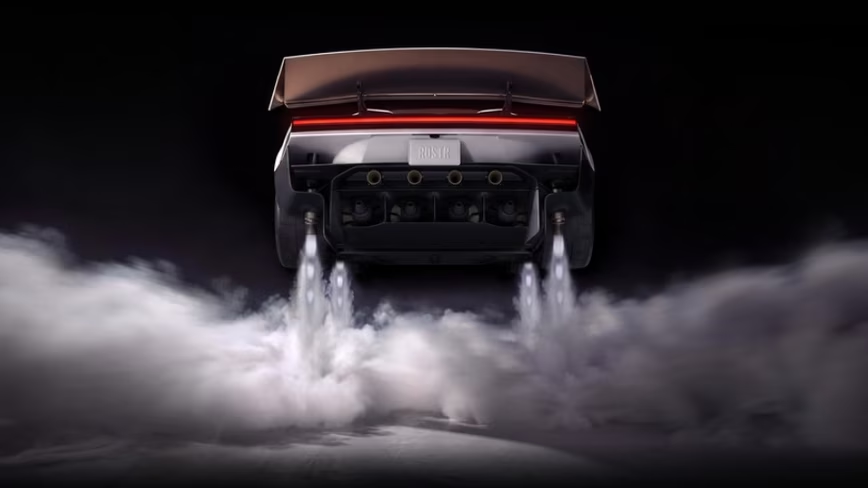
Tesla Unveils Thruster-Equipped Roadster, 2028 Production Targeted
Tesla has unveiled its second-generation Roadster, featuring cold-gas thrusters co-developed with SpaceX, enabling it to jump and flip. The electric sports car demonstrated 0-60mph in an astonishing 0.81 seconds, with production targeted for 2028. This highly anticipated reveal also serves as a key recruitment tool for Tesla's ambitious AI and robotics initiatives.

Amazon Prime Video Launches AI-Powered Prime 360 for NBA Coverage
Amazon Prime Video is elevating its NBA coverage with the introduction of Prime 360, an AI-powered replay system offering immersive, 'fly through' views of the action. Kicking off its second season, Prime Video also adds Yahoo fantasy integration and gains exclusive Eastern Conference Finals rights, expanding its tech-driven sports broadcast. The new features aim to deliver a unique and interactive viewing experience for basketball fans.