
Trump Orders Voluntary AI Model Review Before Release
President Trump has signed an executive order creating a voluntary framework for AI companies to share advanced models with the federal government before release. This initiative aims to bolster secure innovation and protect critical infrastructure, reflecting a shift from the administration's previous hands-off approach to AI safety. Companies opting for pre-release review may receive confidentiality protections.

President Donald Trump has signed an executive order establishing a “voluntary framework” for artificial intelligence (AI) companies to share their most advanced models with the federal government before public release. This initiative aims to foster secure innovation and enhance the cybersecurity of critical infrastructure, marking a significant shift in the administration's approach to AI oversight.
The order, signed Tuesday, directs several federal agencies to develop a comprehensive framework for assessing the advanced cyber capabilities of AI models. Companies would have the option to share their frontier models up to 30 days prior to their public launch. In return for their participation, these companies could receive certain confidentiality protections for their submitted models.
While the order acknowledges that the success of the U.S. AI industry is partly due to avoiding overly burdensome regulation, it simultaneously recognizes the inherent security risks posed by new AI capabilities. It also mandates the federal government to bolster its own cyber defenses against AI threats, particularly those targeting critical infrastructure sectors.
This executive action follows the last-minute postponement of an earlier planned order, which President Trump had reportedly worried might impede U.S. competitiveness with China. The previous version proposed a voluntary review window of 14 to 90 days before release, as reported by The New York Times, whereas the current order shortens that window to a maximum of 30 days.
The move reflects a notable pivot for the Trump administration, which had previously adopted a largely hands-off stance on AI safety concerns under former White House AI czar David Sacks. Prior to this order, the administration had typically downplayed the need for significant oversight.
Several leading AI firms have already signaled their willingness to engage in pre-release reviews. Google, Microsoft, and xAI agreed last month to allow pre-release scrutiny by the Commerce Department’s Center for AI Standards and Innovation (CAISI). OpenAI and Anthropic had previously committed to sharing their models with CAISI in 2024 as part of President Joe Biden's broader push for AI safety guardrails.
A key factor influencing this shift appears to be Anthropic’s limited April rollout of its powerful Mythos model. Anthropic stated that Mythos identified “thousands of high-severity vulnerabilities, including some in every major operating system and web browser.” This demonstration seemingly underscored the potential risks of advanced AI and created an opportunity to improve relations between Anthropic and the administration, following past legal disputes over AI use in autonomous weapons and mass surveillance.
Despite its voluntary nature, the order signifies a new willingness within the Trump administration to exert some level of oversight on AI companies. It explicitly states that it should not be interpreted as a form of mandatory licensing or preclearance, yet its very existence points to an evolving policy landscape.
The new order has garnered praise from various industry groups, even those traditionally advocating against state-level AI restrictions. Brad Carson, President of Americans for Responsible Innovation, stated, “The White House is officially Mythos-pilled,” emphasizing that the order demonstrates the administration’s serious approach to AI vulnerabilities. Brendan Steinhauser, CEO of the Alliance for Secure AI, expressed his group’s pleasure, echoing the sentiment that the administration is taking model risks seriously. Both Carson and Steinhauser have called upon Congress to codify mandatory protections, suggesting that voluntary frameworks may eventually lead to more stringent requirements.
FAQ
Q: What is the primary purpose of Trump's AI executive order?
A: The order aims to create a voluntary framework for AI companies to share their frontier models with the federal government before public release. This is intended to promote secure innovation and strengthen the cybersecurity of critical infrastructure by assessing the advanced cyber capabilities of these models.
Q: Is sharing AI models with the government mandatory under this order?
A: No, the framework established by the executive order is explicitly voluntary. Companies retain the discretion to choose whether or not to share their models pre-release, though participating firms may receive certain confidentiality protections.
Q: How does this order reflect a change in the Trump administration's approach to AI?
A: This order marks a significant departure from the Trump administration's previous hands-off approach and its tendency to downplay AI safety concerns. It signals a new willingness to implement oversight measures, influenced partly by recent demonstrations of AI's vulnerability-flagging capabilities, such as Anthropic's Mythos model.
Related articles

Apple Unveils iPhone Duo: Pricey Foldable Sees Soaring Demand
Apple has officially entered the foldable smartphone arena with the long-anticipated launch of the iPhone Duo. Priced starting at a hefty $1,999, the device features a 5.4-inch outer display and a larger 7.6-inch inner

DJI Solo Video Setups: Smart Choices for Lone Creators
This review delves into DJI's recommended solo video setups, highlighting the Osmo Pocket 3 Creator Combo as a top pick for its integrated camera, gimbal, and mic. It also covers stabilizers like the Osmo Mobile 8 and RS 4, and the DJI Mic Mini series for enhanced audio, providing honest pros, cons, and clear buying advice.

in-depth: Chicago-Area Cops Helped HSI Spy on Minnesota Anti-ICE
Chicago-area law enforcement, including local police and HSI agents, conducted undercover surveillance on Minnesota anti-ICE activists at an April 2, 2022, talk in Chicago. This operation was part of a federal conspiracy probe into 15 Minnesota activists facing felony charges related to immigration enforcement resistance. Civil liberties advocates have condemned the surveillance as a troubling intrusion into protected political activity.

Mark Wahlberg on using AI in film ‘the right way’ and being open to
Actor Mark Wahlberg believes AI has a place in filmmaking if used responsibly for enhancement, not script generation or actor replacement. At TechCrunch Disrupt, he expressed openness to an AI likeness carrying on his legacy, managed by his family, and emphasized storytelling.
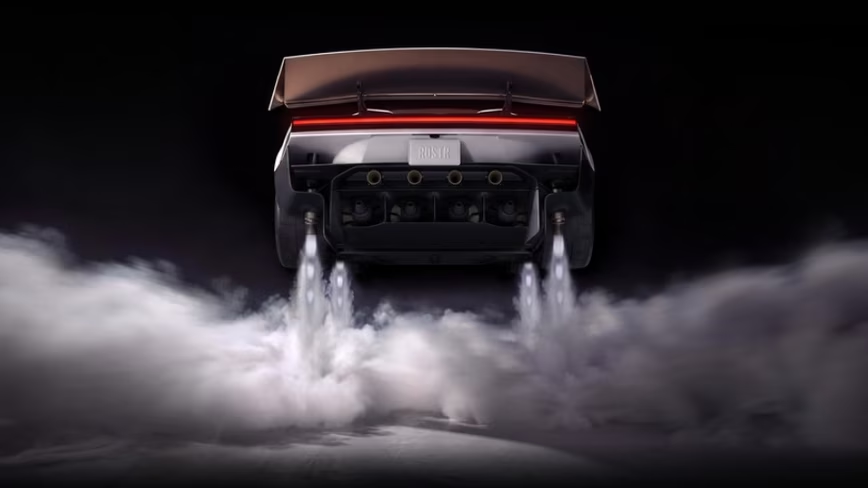
Tesla Unveils Thruster-Equipped Roadster, 2028 Production Targeted
Tesla has unveiled its second-generation Roadster, featuring cold-gas thrusters co-developed with SpaceX, enabling it to jump and flip. The electric sports car demonstrated 0-60mph in an astonishing 0.81 seconds, with production targeted for 2028. This highly anticipated reveal also serves as a key recruitment tool for Tesla's ambitious AI and robotics initiatives.

AI's Confidence vs. Formal Methods' Rigor: Design Flaws & Verification
While AI accelerates code generation, formal methods remain critical for ensuring system correctness. Languages like TLA+ and tools like Quint enable developers to model and verify system designs before coding, catching subtle flaws. Quint makes formal methods more accessible with developer-friendly syntax and executability. This approach is vital for verifying AI-generated code through trace validation and model-based testing, ensuring reliability against real-world data.