
AMD Ryzen AI Desktop Chips: A Modest Debut for Mainstream AI
Quick Verdict AMD's first foray into bringing "Ryzen AI" processors to standard desktop PCs is a cautious, understated affair. These new chips, essentially repackaged laptop silicon, offer a modest boost for everyday
Quick Verdict
AMD's first foray into bringing "Ryzen AI" processors to standard desktop PCs is a cautious, understated affair. These new chips, essentially repackaged laptop silicon, offer a modest boost for everyday computing and AI acceleration, primarily targeting business desktops. While they lack the top-tier performance of AMD's high-end laptop CPUs and aren't designed for serious gaming, they represent an accessible entry point for AI capabilities on the desktop. Don't expect a revolution, but do anticipate a competent, power-efficient option for the right user.
Introduction: AI Comes to the Desktop (Sort Of)
After making significant strides in the mobile space, AMD is now bringing its "Ryzen AI" processors to standard desktop PCs. This move marks an expansion of their integrated Neural Processing Units (NPUs) into a broader market. However, those hoping for a desktop equivalent of AMD's most powerful laptop silicon might need to temper their expectations. This initial lineup is a strategic, rather than spectacular, launch, focusing on efficiency and foundational AI capabilities for a specific segment of the market.
Key Features and Specifications
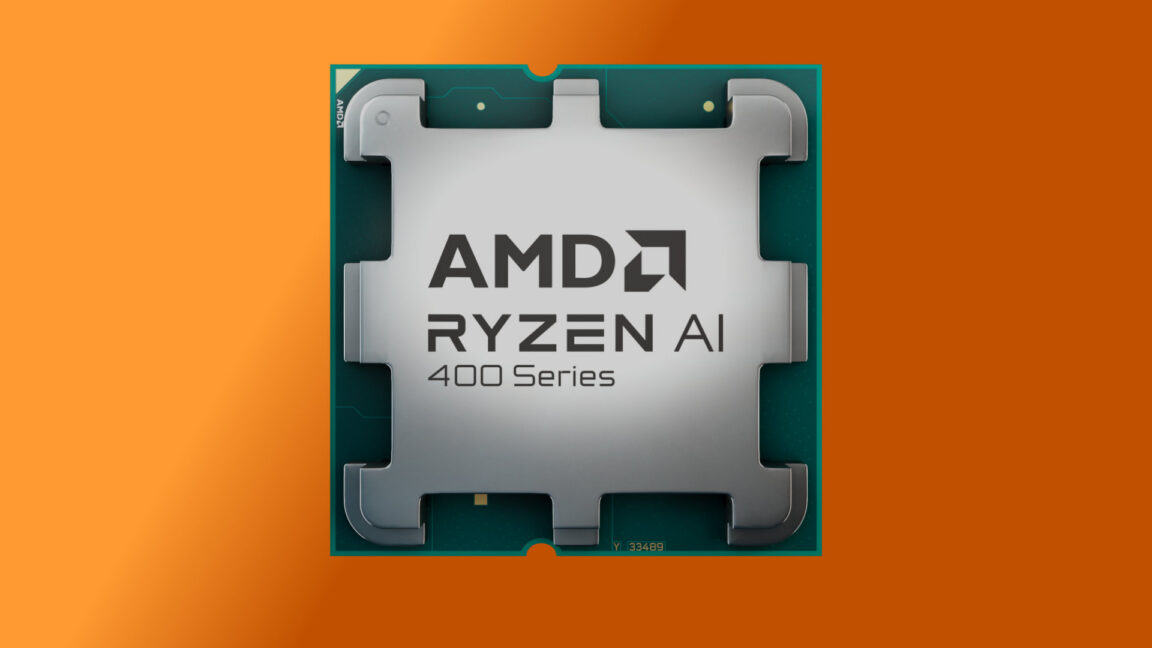
AMD's initial Ryzen AI desktop lineup consists of six distinct chips, designed with varying power envelopes to suit different system needs. These are split evenly between variants with a 65 W default TDP (Thermal Design Power) and more power-efficient 35 W TDP options, catering to a range of compact and standard desktop form factors.
Crucially, these desktop processors are based on AMD's existing laptop silicon, a practice seen with past G-series Ryzen chips. While they carry the "Ryzen AI 400-series" branding for desktops, their core specifications largely align with the Ryzen AI 300-series laptop processors. The main differentiating factor cited for the 400-series laptop CPUs is a slightly faster NPU, offering up to 55 TOPS (Trillions of Operations Per Second) of AI performance, which we can reasonably expect to be reflected in these desktop counterparts.
However, it's important to note what's not included in this initial desktop launch. Unlike the top-end Ryzen AI 9 HX 370 or 375 laptop processors, which boast 12 CPU cores and powerful integrated GPUs like the 16-core Radeon 890M, these desktop chips are more constrained. The three models announced today top out at 8 CPU cores. These cores are likely a mix of AMD's faster Zen 5 cores and the smaller, more power-efficient Zen 5c cores, a configuration designed to balance performance with power consumption. For graphics, the integrated GPU is capped at a Radeon 860M, featuring 8 RDNA 3.5 graphics cores. This is a capable iGPU for general use and light multimedia but falls short of the higher-end Radeon 880M or 890M found in their mobile counterparts.
Performance Expectations and User Experience
Given that these chips are essentially laptop silicon adapted for desktop use, and not the absolute pinnacle of AMD's mobile offerings, users should set their performance expectations accordingly. The core count and integrated graphics suggest a user experience tailored more towards everyday productivity, web browsing, office applications, and accelerated AI workloads than demanding tasks.
For business users, who appear to be the primary target market, these Ryzen AI processors offer a compelling package. The integrated NPU is designed to accelerate AI-driven tasks, which are becoming increasingly prevalent in modern software, from video conferencing enhancements to local AI assistants and content creation tools. The power-efficient 35W TDP variants are particularly well-suited for compact, quiet business machines where energy consumption is a concern. The AM5 socket ensures modern platform support, though the benefits might be more long-term than immediate high-performance gains.
For consumers, especially those considering building a budget gaming PC, the picture is less appealing. AMD's decision to withhold its top-tier integrated graphics from these desktop chips seems to be a calculated one. As the source content points out, constructing a mini gaming PC around socket AM5 processors currently makes little financial sense. The current high prices for fast DDR5 RAM, which is essential to maximize the performance of integrated graphics, make the frames-per-second-per-dollar proposition of desktop iGPUs particularly unattractive. This economic reality likely steered AMD towards a more conservative launch focused on business applications rather than consumer gaming.
Overall, the user experience will be one of solid, reliable performance for typical daily tasks, with the added benefit of dedicated AI acceleration. These chips are not envelope-pushers in raw CPU or GPU power for enthusiasts, but rather low-key iterations designed to expand AMD's AI footprint in a practical, accessible manner.
Pros and Cons
Pros:
- Integrated AI Acceleration: Features an NPU (likely 55 TOPS) to accelerate AI workloads directly on the desktop.
- Modern Platform: Utilizes the AM5 socket, ensuring compatibility with current generation motherboards and features.
- Power Efficiency: Available in 35W TDP variants, ideal for small form factor and energy-conscious systems.
- Business Focus: Well-suited for office environments, productivity, and general computing tasks.
- Accessible Entry to AI: Brings dedicated AI hardware to a broader desktop market.
Cons:
- Not Top-Tier Performance: Does not include AMD's most powerful laptop silicon; limited to 8 CPU cores and Radeon 860M iGPU.
- Limited Gaming Potential: The integrated graphics are suitable for light gaming but not demanding titles, especially given current DDR5 RAM prices.
- Repackaged Laptop Silicon: Essentially desktop versions of mobile chips, not purpose-built desktop designs for maximum performance.
- Modest Iteration: Described as "low-key iterations on existing technology that do little to push the envelope."
- DDR5 Price Sensitivity: Performance, particularly for the iGPU, is heavily reliant on fast DDR5 RAM, which remains expensive.
Buying Recommendation
Who should buy: These AMD Ryzen AI desktop processors are an excellent choice for business users, IT departments, and general consumers building a new PC primarily for productivity, office applications, web browsing, and light content creation that can leverage AI acceleration. If you need a power-efficient, capable system for daily tasks and want to future-proof for increasing AI integration in software, these chips offer a sensible entry point.
Who should consider alternatives: If you are a gamer, a professional content creator requiring significant CPU or GPU horsepower, or an enthusiast seeking cutting-edge performance, these chips are not for you. You will be better served by AMD's higher-end dedicated desktop CPUs (without integrated graphics, paired with a discrete GPU) or Intel's equivalent offerings. The high cost of fast DDR5 memory also makes these chips less appealing for any system where gaming performance is a priority.
Ultimately, this launch is about expanding the reach of AI capabilities to the mainstream desktop, not about shattering performance records. Buy these if your needs align with their strengths in efficiency and AI-accelerated productivity.
FAQ
Q: Are these Ryzen AI desktop chips good for gaming?
A: No, not for serious gaming. While the integrated Radeon 860M GPU can handle light games or older titles at lower settings, these chips lack the raw graphics power for modern, demanding games. Furthermore, the high price of fast DDR5 RAM, which is crucial for iGPU performance, makes them a poor value for gaming per dollar.
Q: Why isn't AMD bringing their top-tier laptop chips (like the Ryzen AI 9 HX 370) to desktop?
A: According to the source, it makes "little financial sense to try and build mini gaming PCs around socket AM5 processors right now" due to the extremely high prices of fast DDR5 memory. Focusing on business desktops with more moderate specifications is a more financially viable strategy in the current market, especially with broader RAM and storage shortages and competition for manufacturing capacity.
Q: What does "Ryzen AI" mean for these desktop processors?
A: "Ryzen AI" indicates the inclusion of a dedicated Neural Processing Unit (NPU) on the chip. This NPU is designed to accelerate AI-specific workloads, such as those found in modern operating systems, video conferencing tools, and AI-driven applications, allowing them to run more efficiently and with less strain on the CPU or GPU. These desktop chips are expected to feature an NPU capable of up to 55 TOPS, similar to their 400-series laptop counterparts.
Related articles
Android 17 QPR2 Beta 7.1: The Performance Relief You've Been Waiting
Android 17 QPR2 Beta 7.1: Finally Fixing the QPR1 Performance Woes Verdict: Android 17 QPR2 Beta 7.1 is a crucial and highly anticipated software update for Google Pixel users, specifically targeting and resolving the

DJI Solo Video Setups: Smart Choices for Lone Creators
This review delves into DJI's recommended solo video setups, highlighting the Osmo Pocket 3 Creator Combo as a top pick for its integrated camera, gimbal, and mic. It also covers stabilizers like the Osmo Mobile 8 and RS 4, and the DJI Mic Mini series for enhanced audio, providing honest pros, cons, and clear buying advice.

Ars Technica's Rocket Report: Your Essential Space Industry Briefing
Quick Verdict Ars Technica's Rocket Report, presented by veteran space reporter Stephen Clark, offers an invaluable and meticulously organized weekly (or similar frequency, implied by "Edition 9.15") digest of the most

Apple iPhone Duo: A Daring Debut with Notable Compromises
Apple's highly anticipated iPhone Duo, priced at $2,000, has gone on pre-order. While hailed as "Apple's most exciting device in a decade" for its innovative foldable design and immersive display, it comes with significant drawbacks like the absence of FaceID and a premium camera.
KDE Plasma 6.8: A Future-Focused 30th Anniversary Update
Quick Verdict KDE Plasma 6.8, arriving as the "30th Anniversary Edition," is a pivotal release that decisively pushes the desktop environment into the future. With a definitive farewell to native X11 sessions and a

regional: A two-person Seattle startup lands $1M to reinvent
Seattle startup TriMagnetix has secured $1 million to develop semiconductor chips that consume 800 times less energy and are radiation-resistant. The two-person company, leveraging nanomagnetic technology, is targeting space applications and data centers. With new funding and key partnerships, TriMagnetix aims for commercial sales within a year.