
Trump Supporters Debate: Is He the Antichrist
Staunch Trump supporters are now publicly questioning if he is the Antichrist, a dramatic shift from their previous perception of him as "God's chosen president." This re-evaluation was primarily triggered by an AI-generated image of Trump resembling Jesus Christ, alongside his administration's actions regarding the Iran war and recent criticism of the Vatican. High-profile conservative figures have openly expressed concern, calling the behavior blasphemous or indicative of an "Antichrist spirit." This growing schism could have significant political implications for Trump and the Republican Party, particularly among Catholic voters.

A significant shift is underway within former President Donald Trump's base, as some of his most ardent supporters are now publicly questioning whether he embodies the Antichrist, a figure in Christian eschatology. This dramatic re-evaluation, which reached a fever pitch on Sunday, April 13, 2026, was primarily sparked by an AI-generated image Trump posted of himself resembling Jesus Christ, alongside escalating tensions surrounding his administration's stance on the Iran war and recent criticism of the Vatican.
For years, Trump and his allies have leveraged religious rhetoric, often portraying him as divinely appointed. However, this recent series of events has created a notable schism among conservative commentators and fans, suggesting potential lasting repercussions for the former president and the Republican Party.
The Image That Sparked Outrage
The controversy intensified on Sunday night after Trump shared an AI-generated image on Truth Social depicting himself in a white robe and red sash, radiating golden light as he placed a hand on a man in a hospital bed. The imagery, which many perceived as invoking Jesus Christ, drew immediate backlash from some of his devout followers. Trump later deleted the image after approximately 14 hours, telling reporters he believed it showed him as a doctor.
High-profile figures within the MAGA movement quickly voiced their condemnation. Former congressperson Marjorie Taylor Greene declared on X, "It's more than blasphemy. It's an Antichrist spirit." Clint Russell, host of the right-wing Liberty Lockdown podcast, remarked on X that he had gone "from hesitantly voting for Trump to thinking there’s a decent chance he’s the antichrist" in 18 months.
Far-right Texas pastor Joel Webbon posted, "I genuinely believe Trump is currently demon possessed," and subsequently hosted a livestream titled "Is Donald Trump the Anti-Christ?" Even the Knights Templar Order, a Christian organization, felt compelled to "condemn it wholeheartedly and ask for a public apology."
A Broader Pattern of Concern
This isn't an isolated incident. Conservative pundit Tucker Carlson, known for his previous support of Trump using religious framing, recently delivered a 43-minute monologue insinuating that the administration's war in Iran, particularly comments made by Trump on Easter Sunday, constituted a "war on the Christian faith." Trump's Easter message had threatened to destroy Iranian infrastructure, stating, "Open the Fuckin’ Strait, you crazy bastards, or you’ll be living in Hell. JUST WATCH! Praise be to Allah."
Carlson's video, while not explicitly naming the Antichrist, was widely interpreted by figures like Alex Jones and users on the DonaldTrump666 subreddit as hinting at the possibility. This marks a notable shift for Carlson, who at the 2024 Republican National Convention, claimed Trump’s survival of an assassination attempt was due to "divine intervention." Trump himself has also cited divine intervention in the past.
Robert Jones, president and founder of the Public Religion Research Institute, noted that Trump's frequent self-portrayals as a messianic figure have inadvertently primed his base for this kind of extreme backlash. "The reason why people have reached for [the antichrist label] is because Trump has actually set the stage for that himself," Jones explained.
Conflict with the Vatican
The unfolding situation also encompasses Trump's strained relationship with the Catholic Church. Hours before posting the Jesus-like AI image, Trump criticized Pope Leo XIV on Truth Social, calling him "WEAK on Crime, and terrible for Foreign Policy," specifically citing the Pope's supposed tolerance for Iran possessing nuclear weapons. Pope Leo XIV has, in fact, been critical of Trump's actions in Iran, labeling the war "atrocious."
Further compounding the issue were recent reports of a January meeting between US administration officials and the Pope's ambassador, Cardinal Christophe Pierre. The Free Press reported that Elbridge Colby, the US undersecretary of war for policy, allegedly pressured Pierre for the Vatican to support Trump’s military objectives, reportedly referencing Avignon as a veiled threat. While the Pentagon confirmed the meeting, it dismissed the accounts as "exaggerated and distorted," and the Vatican issued a statement calling some details "untrue" while acknowledging a routine exchange of views.
This isn't Trump's first brush with AI imagery angering Catholics; he previously shared an AI-generated image of himself as Pope after the death of Pope Francis. However, with his approval ratings at a new low and concerns mounting for the upcoming midterms, the political fallout from these recent actions could be far more significant.
"It's a very politically risky move for Trump," Jones told WIRED. "Every time he's been on the ballot, white Catholics in the US have voted for him about six in 10… If he alienates Catholic voters, many of whom are his supporters, it could be very detrimental."
FAQ
Q: What primarily triggered Trump supporters to question if he is the Antichrist? A: The main catalyst was an AI-generated image Trump posted on Truth Social depicting himself in a white robe, radiating light and healing a man, which many interpreted as him portraying himself as Jesus Christ. This was compounded by his administration's actions regarding the Iran war and criticism of the Vatican.
Q: How have prominent conservative figures reacted to these recent events? A: Figures like Marjorie Taylor Greene called it an "Antichrist spirit," podcast host Clint Russell expressed a belief that Trump might be the Antichrist, and Texas pastor Joel Webbon questioned if Trump was "demon possessed" and hosted a livestream on the topic. Even Tucker Carlson, previously a strong religious supporter, insinuated Antichrist themes without explicitly stating them.
Q: What are the potential political implications of this shift in sentiment? A: According to Robert Jones of the Public Religion Research Institute, Trump's self-portrayals as a messianic figure have set the stage for this backlash. He warns that alienating white Catholic voters, who have historically been a significant part of Trump's base, could be "very detrimental" for him and the Republican Party, especially with current low approval ratings and upcoming midterms.
Related articles

Apple Unveils iPhone Duo: Pricey Foldable Sees Soaring Demand
Apple has officially entered the foldable smartphone arena with the long-anticipated launch of the iPhone Duo. Priced starting at a hefty $1,999, the device features a 5.4-inch outer display and a larger 7.6-inch inner

in-depth: Chicago-Area Cops Helped HSI Spy on Minnesota Anti-ICE
Chicago-area law enforcement, including local police and HSI agents, conducted undercover surveillance on Minnesota anti-ICE activists at an April 2, 2022, talk in Chicago. This operation was part of a federal conspiracy probe into 15 Minnesota activists facing felony charges related to immigration enforcement resistance. Civil liberties advocates have condemned the surveillance as a troubling intrusion into protected political activity.

Mark Wahlberg on using AI in film ‘the right way’ and being open to
Actor Mark Wahlberg believes AI has a place in filmmaking if used responsibly for enhancement, not script generation or actor replacement. At TechCrunch Disrupt, he expressed openness to an AI likeness carrying on his legacy, managed by his family, and emphasized storytelling.
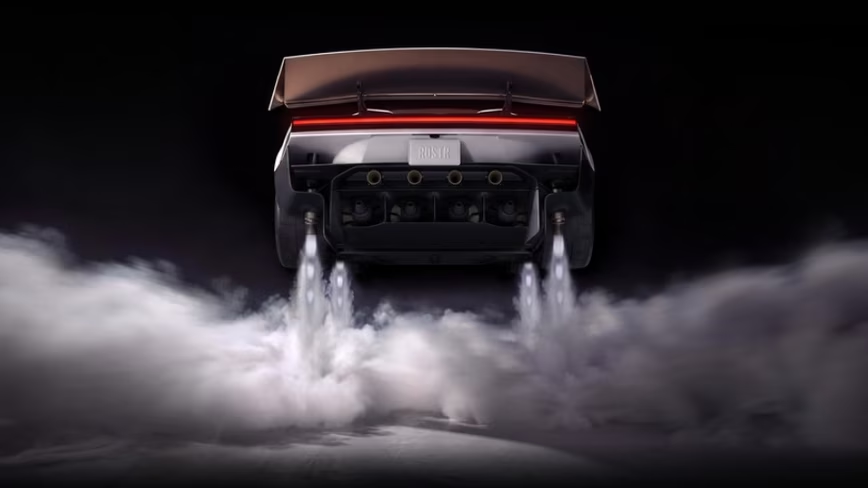
Tesla Unveils Thruster-Equipped Roadster, 2028 Production Targeted
Tesla has unveiled its second-generation Roadster, featuring cold-gas thrusters co-developed with SpaceX, enabling it to jump and flip. The electric sports car demonstrated 0-60mph in an astonishing 0.81 seconds, with production targeted for 2028. This highly anticipated reveal also serves as a key recruitment tool for Tesla's ambitious AI and robotics initiatives.

Amazon Prime Video Launches AI-Powered Prime 360 for NBA Coverage
Amazon Prime Video is elevating its NBA coverage with the introduction of Prime 360, an AI-powered replay system offering immersive, 'fly through' views of the action. Kicking off its second season, Prime Video also adds Yahoo fantasy integration and gains exclusive Eastern Conference Finals rights, expanding its tech-driven sports broadcast. The new features aim to deliver a unique and interactive viewing experience for basketball fans.

regional: A two-person Seattle startup lands $1M to reinvent
Seattle startup TriMagnetix has secured $1 million to develop semiconductor chips that consume 800 times less energy and are radiation-resistant. The two-person company, leveraging nanomagnetic technology, is targeting space applications and data centers. With new funding and key partnerships, TriMagnetix aims for commercial sales within a year.