
SanDisk 2TB Extreme Pro UHS-II: Pro-Grade Power, Pro-Grade Price
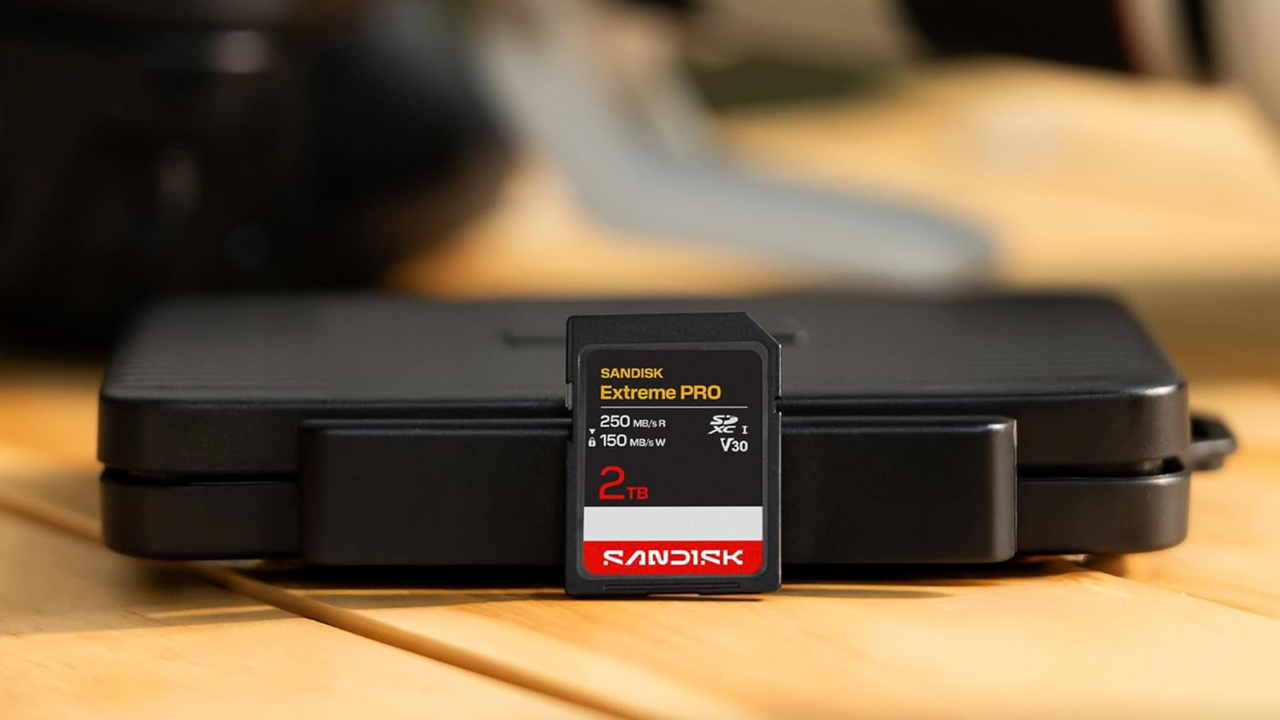
The 2TB SanDisk Extreme Pro UHS-II SD card delivers top-tier sequential read/write speeds over 300 MB/s, ideal for 8K video and burst photography. However, its eye-watering $2,000 price point and high cost per GB make it a niche investment for demanding professionals only.
Quick Verdict
SanDisk's 2TB Extreme Pro UHS-II SD card is a technical marvel, offering massive capacity and blistering sequential read/write speeds over 300 MB/s. It's purpose-built for the most demanding professional videographers and photographers capturing 8K footage or high-resolution burst shots. However, its eye-watering $1,999.99 price tag makes it an ultra-niche product. While it delivers unparalleled performance within the SD card format, its cost per gigabyte is significantly higher than alternative storage solutions, including SanDisk's own high-performance microSD Express cards and even its lower-tier UHS-I SD cards. This is a specialized tool for those who absolutely require its unique combination of speed, capacity, and durability, and have the budget to match.
Introduction: The New Era of SD Storage, At a Cost
SanDisk has quietly, yet significantly, expanded its Extreme Pro lineup with the introduction of a colossal 2TB UHS-II SD card. This isn't just about capacity; it's about delivering top-tier performance to professionals who push the boundaries of digital content creation. With promises of sequential read speeds up to 310 MB/s and write speeds reaching 305 MB/s, this card is designed to handle data-intensive tasks with ease. However, innovation often comes at a price, and in this case, the price is a staggering $1,999.99, marking a significant leap in cost compared to even other high-capacity cards. This review will delve into whether this premium investment truly pays off for its intended users.
Unleashing Raw Performance: Speed & Capacity
The headline feature of the 2TB SanDisk Extreme Pro UHS-II SD card is undoubtedly its speed. Rated V90, it boasts an impressive up to 310 MB/s sequential read performance and 305 MB/s sequential write performance. These speeds are crucial for professional applications such as capturing uncompressed 8K video, which generates enormous data streams, or for continuous high-resolution burst photography, where every frame counts and buffers need to be cleared instantly. For a professional shooting a crucial event, the ability to record continuously without dropped frames or missed shots due to slow storage can be invaluable. The 2TB capacity means you can store vast amounts of high-quality footage or thousands of RAW images without frequently swapping cards, streamlining workflows on location.
Compared to its UHS-I counterpart, the 2TB Extreme Pro UHS-II offers significantly higher sequential read performance and more than double the sequential write performance. This speed differential is the primary justification for its premium cost. While other, newer standards like microSD Express cards utilize modern PCIe and NVMe technology for even greater theoretical performance, the reality is that most professional digital cameras still rely on the established SD standard. This means that for the vast majority of current high-end camera systems, the UHS-II standard represents the pinnacle of available speed, and the 2TB Extreme Pro UHS-II is among the best performers within this ecosystem.
The Price of Premium: A Deeper Dive into Value
The $1,999.99 price tag on this 2TB SD card is the elephant in the room. This represents a more than four-fold increase over the lower-tier 2TB Extreme Pro UHS-I SDXC card, which can be found for less than $500. Breaking down the cost, the 2TB SanDisk Extreme Pro UHS-II comes in at approximately $0.98 per gigabyte. This high cost per GB is consistent across the UHS-II lineup, with the 512GB version also priced at $0.98/GB, and smaller capacities even higher ($1.09/GB for 256GB, $1.56/GB for 128GB).
Contrast this with SanDisk's 512GB microSD Express card, which, despite featuring more advanced underlying technology, costs only $119.99, translating to a mere $0.23 per gigabyte. Even the 2TB Extreme Pro UHS-I SDXC card offers a far more palatable $0.21 per gigabyte. This significant disparity highlights that you're paying a substantial premium for the combination of 2TB capacity and top-tier UHS-II speeds in the standard SD form factor. For many, this cost will be prohibitive, and the value proposition must be weighed against absolute necessity.
Beyond Speed: Durability & Design
Beyond raw performance, SanDisk has built the Extreme Pro UHS-II series with durability in mind, a critical factor for professionals working in challenging environments. The card boasts an IP68 environmental protection rating, meaning it's highly resistant to dust and water ingress. Furthermore, it has been rigorously tested to withstand drops from up to 6 meters (nearly 20 feet). These rugged features ensure that your valuable data is protected even in adverse conditions, making it a reliable choice for outdoor shoots, adventure photography, or fast-paced event coverage where accidental bumps and spills are a real possibility. While often overlooked in favor of speed and capacity, such robust build quality adds significant peace of mind for professionals.
Who Is This Card For? (And Who It Isn't)
This card is unequivocally designed for a very specific, high-end user base: professional videographers and photographers. If you regularly shoot 8K RAW video, engage in high-speed, high-resolution burst photography, or work in demanding production environments where every second and every frame counts, then the 2TB SanDisk Extreme Pro UHS-II SD card could be a game-changer. Its speed ensures smooth, uninterrupted recording, and its capacity minimizes the need for media changes during critical moments.
For virtually every other user, however, this card is likely overkill. Enthusiast photographers, amateur videographers, or even most semi-professionals will find that lower-tier UHS-I cards or even smaller capacity UHS-II cards offer more than enough performance and capacity for a fraction of the price. Investing $2,000 in an SD card that won't be fully utilized is simply not a wise allocation of resources. For those users, more affordable alternatives provide excellent performance without breaking the bank.
SanDisk Extreme Pro UHS-II & Alternatives Comparison Table
To better illustrate the pricing and performance tiers, here's a comparison of the 2TB Extreme Pro UHS-II against some key SanDisk alternatives:
| Card Model | Capacity | Performance Tier | Price | Price/GB |
|---|---|---|---|---|
| SanDisk Extreme Pro UHS-II SD | 2TB | UHS-II V90 | $1,999.99 | $0.98 |
| SanDisk Extreme Pro UHS-II SD | 512GB | UHS-II V90 | $499.99 | $0.98 |
| SanDisk Extreme Pro UHS-I SDXC | 2TB | UHS-I | $440.00 | $0.21 |
| SanDisk microSD Express Card | 512GB | MicroSD Express | $119.99 | $0.23 |
Note: UHS-II V90 offers sequential read up to 310 MB/s and write up to 305 MB/s. UHS-I offers significantly lower speeds. MicroSD Express cards, while faster on paper due to PCIe/NVMe, are not widely supported in current digital cameras.
The Market Context: Why So Expensive?
It's important to consider the broader economic factors contributing to this card's steep price. The current memory and storage chip shortage is a significant global issue, driving up manufacturing costs for all storage devices, including SD cards. In such an environment, companies often prioritize premium, high-margin products that can better absorb these increased production expenses. We see this trend not just with SanDisk but also with competing manufacturers like Lexar and Kingston, whose high-specification SD cards often come with comparable premium price tags. This suggests that the pricing isn't an anomaly but rather a reflection of current market realities for cutting-edge, high-capacity storage.
Final Recommendation
The 2TB SanDisk Extreme Pro UHS-II SD card is an exceptional piece of engineering, delivering class-leading performance and immense capacity within the SD form factor. Its speed and robust build quality make it an ideal choice for the most demanding professional workflows involving 8K video and rapid burst photography. However, its nearly $2,000 price tag is a major hurdle. If your professional work absolutely requires the highest possible speed and capacity in an SD card, and your camera fully supports the UHS-II standard, then this card is arguably worth the investment for the productivity and reliability it offers. For everyone else, particularly those not constantly pushing the limits of their gear, more affordable UHS-I options or smaller capacity UHS-II cards offer a far better balance of performance and value. Assess your true needs carefully; for most, this extreme card is an aspiration, not a necessity.
FAQ
Q: Is the 2TB SanDisk Extreme Pro UHS-II compatible with all cameras?
A: While it will physically fit in any SD card slot, to achieve the advertised UHS-II speeds (V90), your camera must explicitly support the UHS-II standard. If your camera only supports UHS-I, the card will still function, but it will operate at the slower UHS-I speeds, rendering the premium price for UHS-II performance largely redundant.
Q: Why is this card so much more expensive than other 2TB SD cards?
A: The primary reasons are its top-tier UHS-II V90 performance (over 300 MB/s sequential read/write), massive 2TB capacity, and robust durability features (IP68 rating, drop resistance). Additionally, current global memory chip shortages are contributing to higher manufacturing costs for premium storage products, which impacts retail pricing across the industry.
Q: Should I buy this card if I only shoot 4K video or high-resolution stills occasionally?
A: Probably not. For occasional 4K video or standard high-resolution stills, a 2TB UHS-I card or a smaller capacity UHS-II card would offer more than sufficient performance and capacity for a fraction of the cost. This 2TB Extreme Pro UHS-II is specifically designed for continuous, high-bitrate professional workflows like uncompressed 8K video or extremely rapid burst photography, where its immense speed and capacity are truly utilized.
Related articles

Apple Unveils iPhone Duo: Pricey Foldable Sees Soaring Demand
Apple has officially entered the foldable smartphone arena with the long-anticipated launch of the iPhone Duo. Priced starting at a hefty $1,999, the device features a 5.4-inch outer display and a larger 7.6-inch inner
Android 17 QPR2 Beta 7.1: The Performance Relief You've Been Waiting
Android 17 QPR2 Beta 7.1: Finally Fixing the QPR1 Performance Woes Verdict: Android 17 QPR2 Beta 7.1 is a crucial and highly anticipated software update for Google Pixel users, specifically targeting and resolving the

DJI Solo Video Setups: Smart Choices for Lone Creators
This review delves into DJI's recommended solo video setups, highlighting the Osmo Pocket 3 Creator Combo as a top pick for its integrated camera, gimbal, and mic. It also covers stabilizers like the Osmo Mobile 8 and RS 4, and the DJI Mic Mini series for enhanced audio, providing honest pros, cons, and clear buying advice.

Ars Technica's Rocket Report: Your Essential Space Industry Briefing
Quick Verdict Ars Technica's Rocket Report, presented by veteran space reporter Stephen Clark, offers an invaluable and meticulously organized weekly (or similar frequency, implied by "Edition 9.15") digest of the most

Apple iPhone Duo: A Daring Debut with Notable Compromises
Apple's highly anticipated iPhone Duo, priced at $2,000, has gone on pre-order. While hailed as "Apple's most exciting device in a decade" for its innovative foldable design and immersive display, it comes with significant drawbacks like the absence of FaceID and a premium camera.

Amazon Prime Video Launches AI-Powered Prime 360 for NBA Coverage
Amazon Prime Video is elevating its NBA coverage with the introduction of Prime 360, an AI-powered replay system offering immersive, 'fly through' views of the action. Kicking off its second season, Prime Video also adds Yahoo fantasy integration and gains exclusive Eastern Conference Finals rights, expanding its tech-driven sports broadcast. The new features aim to deliver a unique and interactive viewing experience for basketball fans.