
Ruipro Fiber Optic HDMI Cable: The Long-Distance 8K Solution
Reviewing the Ruipro fiber optic HDMI cable, a premium solution delivering flawless 48 Gbps performance for 8K@60Hz and 4K@120Hz over distances up to 990 feet. Is it worth the investment for demanding setups?
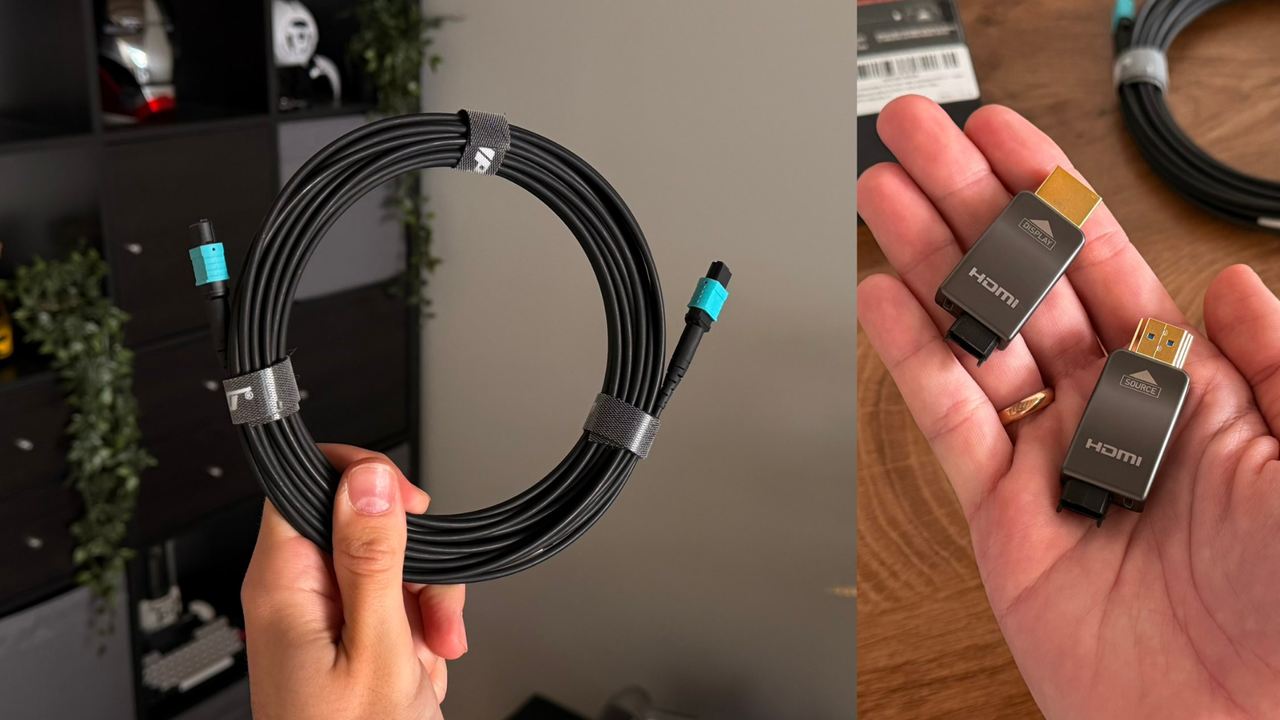
Ruipro Fiber Optic HDMI Cable: The Long-Distance 8K Solution
Expensive cables often come with a healthy dose of skepticism, and for good reason. The tech market is rife with "miracle cures" that promise performance boosts far beyond what science supports. However, there are genuine advancements, and fiber optic HDMI cables represent one such category. Today, we’re looking at a premium example: a fiber optic HDMI cable from Ruipro, specifically a 990-foot variant, designed to deliver uncompromised 48 Gbps performance, effortlessly handling 8K at 60 Hz and 4K at 120 Hz over truly staggering distances.
Quick Verdict
The Ruipro fiber optic HDMI cable is an undeniably niche product, but for those with very specific, demanding requirements – primarily extreme long-distance video transmission with high bandwidth – it’s an exceptional piece of engineering that delivers precisely what it promises. It’s not for the average user setting up a TV in a living room, and its $500 price tag for the 990-foot length reflects its specialized capability. However, for professional installations, large-scale home theaters, or commercial applications where signal integrity over vast runs is paramount, this cable is a highly justifiable investment, offering peace of mind and flawless performance where traditional copper simply cannot compete.
Diving into the Details: What Makes it Special?
This isn't just any HDMI cable; it's an Active Optical Cable (AOC). Unlike standard copper wiring, which struggles with signal degradation over distance, AOCs convert electrical HDMI signals into optical signals at one end, transmit them via fiber optic strands, and then convert them back to electrical signals at the other end. While some copper wires remain for low-priority communication and power, the vast majority of the critical video and audio data travels as light, dramatically extending the potential range without loss.
The real showstopper here is the 990-foot length, combined with full HDMI 2.1 compliance. This means the cable supports a robust 48 Gbps bandwidth, enabling resolutions like 8K at 60 Hz and 4K at 120 Hz without needing Display Stream Compression (DSC). It also fully supports 10-bit HDR, ensuring vibrant and accurate color reproduction. These specifications are impressive on their own, but the ability to maintain them flawlessly across nearly a thousand feet is truly remarkable. The HDMI Forum's often-loose branding for HDMI 2.1 means that not all cables claiming the standard genuinely deliver 48 Gbps, making a reliably full-fat cable like this even more valuable for critical applications.
Design, Build Quality, and User Experience
The Ruipro cable demonstrates thoughtful design geared towards practicality and durability, especially for installations where its extreme length will be utilized:
- Removable Connectors: This is a standout feature. The HDMI connectors on both ends are detachable. This isn't just a convenience; it's a major boon for installation. Should a plug become damaged, you don't need to replace the entire, potentially hundreds-of-feet-long, cable. Furthermore, with the ends removed, the cable can easily slot into standard keystone jacks and wall plates, simplifying routing through conduits or walls and maintaining a clean aesthetic.
- Thin Profile: Despite its immense length, the cable is noted for being relatively thin. This makes it far easier to pull through tight spaces, around corners, or within crowded conduits compared to bulky copper alternatives that would struggle to deliver similar performance over distance.
- Durable Construction: The connectors themselves are crafted entirely from metal, ensuring they can withstand the rigors of installation and long-term use, contributing to the cable's overall reliability.
- EMI Resistance: Fiber optic technology is inherently resistant to electromagnetic interference (EMI). While EMI isn't usually a critical concern for HDMI in typical home environments, for installations near high-power equipment, industrial settings, or where multiple cables run in close proximity, this added layer of signal integrity protection is a welcome, though secondary, benefit.
Pros and Cons
Like any specialized product, the Ruipro fiber optic HDMI cable comes with distinct advantages and disadvantages:
Pros:
- Unparalleled Length & Performance: Delivers full 48 Gbps HDMI 2.1 performance (8K@60Hz, 4K@120Hz, 10-bit HDR) over an astounding 990 feet, a feat impossible for standard copper cables.
- Flawless Signal Integrity: Active optical technology ensures zero signal loss and degradation across extreme distances.
- Installation-Friendly Design: Removable, durable metal connectors simplify routing through walls and conduits, allow for easy repair, and are compatible with wall plates.
- Relatively Thin: Easier to manage and install than bulky copper cables of equivalent (theoretical) capability.
- EMI Resistant: Provides additional peace of mind in electrically noisy environments.
- Legitimate Value Proposition: For its intended purpose, it offers a real solution to a challenging problem.
Cons:
- High Cost: At $500 for the 990-foot version, it's a significant investment that’s not necessary for most users.
- Overkill for Short Distances: For runs under 50 feet (or even less for 4K/120Hz), high-quality copper HDMI 2.1 cables are sufficient and much more affordable. The source points out that even the 3-foot version at $116 is excessively expensive for its length.
- Not a Universal Solution: Designed for very specific long-distance, high-bandwidth needs, it offers no benefit over cheaper copper cables for typical home setups.
Comparing Lengths and Value Proposition
The source material highlights different lengths of Ruipro's fiber optic HDMI cables, offering a good perspective on their pricing strategy and value:
- 3-foot cable ($116): This is considered quite expensive, and for this length, fiber optics are largely unnecessary. A premium copper HDMI 2.1 cable would perform identically for significantly less money. This option mostly serves to illustrate the base cost of the technology.
- 100-foot cable ($150): This length is highlighted as perhaps the "best deal." For only about $34 more than the 3-foot version, you get an extra 97 feet of high-performance fiber optic cable. This length crosses the threshold where copper cables start to struggle with 48 Gbps performance, making the fiber optic option a genuinely compelling choice for moderately long runs.
- 990-foot cable ($500): This is the ultimate long-distance solution. While the price is substantial, it unlocks capabilities that are simply not available through any other practical means for such extreme distances. The jump from 100 feet to 990 feet for an additional $350 represents the cost of producing and packaging a nearly tenfold increase in length, still delivering the same flawless signal. For a true long-distance 8K or 4K/120Hz setup, this becomes the only viable plug-and-play option.
In essence, the value proposition of these cables scales with length. The longer the run, the more indispensable and cost-effective the fiber optic solution becomes relative to the alternatives (or lack thereof).
Buying Recommendation
Who is this cable for?
The Ruipro 990-foot fiber optic HDMI cable is a professional-grade solution for a very specific audience:
- Dedicated Home Theater Enthusiasts: Especially those with projection systems or large displays located far from their source devices, requiring pristine 8K/60Hz or 4K/120Hz signals over significant distances.
- Professional AV Installers: For corporate boardrooms, auditoriums, lecture halls, digital signage, or complex residential installations where source and display are hundreds of feet apart.
- Gaming Setups with Remote Displays: If you have a powerful gaming PC in one room and want to enjoy a high-refresh-rate 4K experience on a large display in another, hundreds of feet away, this cable makes it possible.
- Anyone needing Guaranteed 48 Gbps over Distance: For mission-critical applications where any signal degradation is unacceptable and future-proofing for the highest HDMI 2.1 bandwidth is essential.
Who is it NOT for?
- Average Consumers: For typical living room setups (e.g., 6-25 feet), a quality copper HDMI 2.1 cable will suffice at a fraction of the cost.
- Budget-Conscious Buyers: Unless you absolutely require its unique capabilities, the high price is simply not justified for shorter runs.
In conclusion, if your project demands uncompromised 48 Gbps HDMI 2.1 performance over hundreds of feet, the Ruipro fiber optic cable is not just a strong contender—it's likely one of the only viable solutions. It’s a specialized tool for specialized jobs, and in those contexts, it delivers exceptional value and performance that few, if any, alternatives can match.
FAQ
Q: Do I need a fiber optic HDMI cable for my setup?
A: You likely don't need one for typical setups. For HDMI cable runs under approximately 50 feet (for 4K@60Hz) or even shorter for full 48 Gbps 4K@120Hz/8K@60Hz, high-quality copper HDMI 2.1 cables are usually sufficient and much more affordable. Fiber optic cables become essential when you need to transmit full HDMI 2.1 bandwidth over much longer distances, typically 50 feet and beyond, where copper cables would experience significant signal loss or fail to function reliably.
Q: Is the $500 price tag for the 990ft cable justified?
A: For the specific use case of transmitting full 48 Gbps HDMI 2.1 signals (like 8K@60Hz or 4K@120Hz) over extreme distances up to 990 feet, yes, the $500 price tag is justified. This is a highly specialized piece of equipment solving a problem that traditional copper cables simply cannot. The cost reflects the advanced active optical technology, the sheer length, and the guaranteed performance. For professional installations or demanding home theater setups that require this capability, it's an investment in reliable, high-fidelity signal transmission.
Q: What is an "active optical cable" and why does it matter for HDMI?
A: An active optical cable (AOC) for HDMI converts the electrical HDMI signal into optical (light) pulses at one end of the cable, transmits these pulses over thin fiber optic strands, and then converts them back into electrical signals at the other end. This process matters immensely for HDMI because it allows signals to travel much further without degradation compared to traditional copper wires. For high-bandwidth HDMI 2.1 signals, copper cables have severe distance limitations. AOCs like the Ruipro overcome these limitations, enabling full 48 Gbps performance over hundreds of feet, which is critical for long-distance 8K and high-refresh-rate 4K applications.
Related articles
Android 17 QPR2 Beta 7.1: The Performance Relief You've Been Waiting
Android 17 QPR2 Beta 7.1: Finally Fixing the QPR1 Performance Woes Verdict: Android 17 QPR2 Beta 7.1 is a crucial and highly anticipated software update for Google Pixel users, specifically targeting and resolving the

DJI Solo Video Setups: Smart Choices for Lone Creators
This review delves into DJI's recommended solo video setups, highlighting the Osmo Pocket 3 Creator Combo as a top pick for its integrated camera, gimbal, and mic. It also covers stabilizers like the Osmo Mobile 8 and RS 4, and the DJI Mic Mini series for enhanced audio, providing honest pros, cons, and clear buying advice.

Ars Technica's Rocket Report: Your Essential Space Industry Briefing
Quick Verdict Ars Technica's Rocket Report, presented by veteran space reporter Stephen Clark, offers an invaluable and meticulously organized weekly (or similar frequency, implied by "Edition 9.15") digest of the most

Apple iPhone Duo: A Daring Debut with Notable Compromises
Apple's highly anticipated iPhone Duo, priced at $2,000, has gone on pre-order. While hailed as "Apple's most exciting device in a decade" for its innovative foldable design and immersive display, it comes with significant drawbacks like the absence of FaceID and a premium camera.
KDE Plasma 6.8: A Future-Focused 30th Anniversary Update
Quick Verdict KDE Plasma 6.8, arriving as the "30th Anniversary Edition," is a pivotal release that decisively pushes the desktop environment into the future. With a definitive farewell to native X11 sessions and a
Galaxy Watch One UI 9 Beta: Promising Progress, But Patience Needed
Galaxy Watch 8, Watch Ultra, and Watch 7 are receiving a new One UI 9 Watch beta build with bug fixes and a security patch. Active development signals progress, but a stable release date remains elusive.