
regional: Microsoft Build decoded: Solara, Scout, AI models, GitHub’s
Microsoft's Build 2026 showcased a bold AI-first future with seven new in-house AI models, Project Solara for agent-first devices, and the Scout assistant. Mary Jo Foley helped decode these developments, highlighting Microsoft's push for AI self-sufficiency and the road ahead for Copilot and GitHub.

Microsoft's annual Build conference, held recently in San Francisco, served as a powerful showcase for the tech giant's accelerating commitment to artificial intelligence. The event unveiled a significant suite of innovations, including seven internally developed AI models signaling a strategic push for self-reliance, the ambitious Project Solara platform designed for agent-first devices, and the introduction of the intelligent Scout agentic assistant. Veteran technology journalist Mary Jo Foley, a key voice in Microsoft analysis, joined the GeekWire Podcast to provide critical insights, dissecting these announcements alongside the teased but un-shown Copilot "super app" and addressing the intensifying challenges confronting GitHub.
Microsoft's Bid for AI Self-Sufficiency
A cornerstone of Microsoft's evolving AI strategy is a pronounced drive towards "long-term self-sufficiency" in artificial intelligence. This was concretely demonstrated by the unveiling of seven new homegrown AI models. This strategic pivot signifies Microsoft's intent to lessen its dependence on prominent external partners such as OpenAI and Anthropic for core AI infrastructure and innovation. By cultivating a robust portfolio of its own large language models and advanced AI technologies, Microsoft seeks to solidify its position, accelerate internal development cycles, and gain more complete oversight of its AI development trajectory. This initiative is a clear statement of the company's ambition to build a comprehensive, end-to-end AI ecosystem, from foundational models to user-facing applications, reinforcing its competitive edge in the rapidly evolving AI landscape.
Ushering in the Agentic Future with Solara and Scout
One of Build's most forward-looking revelations was Project Solara, a revolutionary platform conceptualized for devices operating on AI agents rather than the traditional application model. This vision transcends current software paradigms, aiming for a future where intelligent agents proactively understand user intent, manage complex workflows, and execute tasks across various devices without explicit app launches. Accompanying this groundbreaking platform, Microsoft introduced Scout, an "agentic assistant" designed to exemplify this new era of intelligent interaction. Furthermore, the company highlighted the work of its OpenClaw team, which is dedicated to overcoming the technical hurdles in developing sophisticated personal assistants capable of truly intuitive and anticipatory engagement. This move towards agent-first computing underscores Microsoft's belief in a more seamless, context-aware, and powerful user experience driven by autonomous AI.
Copilot's Evolution and GitHub's Challenges
While the conference was brimming with AI-centric news, the much-anticipated Copilot "super app" remained a future promise, teased but not fully demonstrated, leaving a clear indication of its strategic importance for Microsoft's integrated AI vision. This forthcoming "super app" is expected to consolidate and amplify Copilot's powerful generative AI capabilities across an even broader range of Microsoft's products and services, aiming to create a highly unified and intelligent user assistance experience. Simultaneously, discussions at Build also acknowledged "mounting pressure" on GitHub, Microsoft's widely utilized code hosting and collaboration platform. Although specific details regarding these "woes" were not explicitly outlined in the overview, the pervasive presence of AI in coding, particularly through GitHub Copilot, implies growing demands for new features, enhanced security, performance optimizations, and potentially adapting to evolving developer workflows and ethical considerations in an AI-augmented development environment. The platform is continuously challenged to innovate while maintaining its status as a critical tool for global developers.
The Road Ahead for Microsoft's AI Ambitions
Microsoft Build 2026 painted an undeniable picture of a company aggressively pivoting towards an AI-first future, investing heavily in research, development, and strategic partnerships. Mary Jo Foley, known for her deep insights into Microsoft's corporate strategy and product pipeline, played a pivotal role in "decoding" the torrent of announcements. Her expert analysis helped distinguish between those innovations ready for immediate developer adoption and those still in their nascent stages, representing aspirational long-term projects. Foley's perspective is crucial for understanding that while some elements, like specific AI models, are maturing rapidly, the full realization of agent-first devices via Project Solara and a comprehensive Copilot "super app" will unfold over time. Microsoft's comprehensive strategy is not merely about integrating AI into existing products but fundamentally reshaping how users and developers interact with technology, ensuring AI is at the very core of its future offerings. The conference solidified Microsoft's intention to be a dominant force in the ongoing AI transformation.
FAQ
Q: What is Project Solara?
A: Project Solara is a new platform introduced by Microsoft at Build 2026, designed to power devices that run AI agents instead of traditional applications. This represents a shift towards more autonomous and intelligent computing experiences.
Q: Why is Microsoft developing its own AI models?
A: Microsoft is developing its own seven homegrown AI models to achieve "long-term self-sufficiency" in artificial intelligence. This strategy aims to reduce reliance on external partners like OpenAI and Anthropic, giving Microsoft greater control over its AI development, innovation, and strategic direction.
Q: What is the significance of the teased Copilot "super app"?
A: The teased Copilot "super app" suggests Microsoft's ambition to create a more integrated and expansive AI experience across its ecosystem. While not fully revealed at Build, it points to a future where Copilot's generative AI capabilities will be seamlessly woven into various products, forming a central hub for AI-powered productivity and assistance.
Related articles
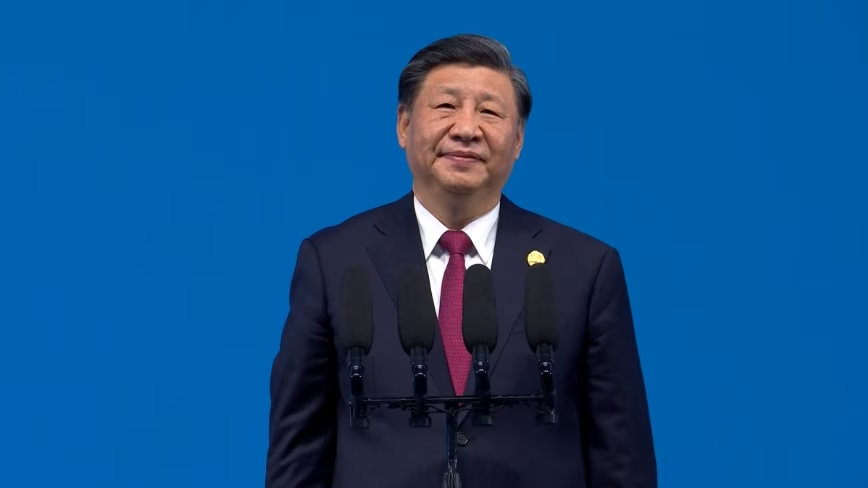
Xi pitches open-source AI to BRICS amid domestic curb debates
Chinese President Xi Jinping proposed a China-led open-source AI community and invited BRICS nations to join the World AI Cooperation Organization (WAICO) at the recent BRICS summit. This push for global collaboration contrasts sharply with Beijing's ongoing internal debates about restricting its own advanced AI models. Meanwhile, the EU's comprehensive AI Act, with its clear, enforceable rules for open-source AI, highlights a significant divergence in global AI governance approaches.

StarCraft Returns in 2030 as Open-World Shooter
Blizzard Entertainment announced a new StarCraft game, an open-world shooter, set to release in 2030. Unveiled at BlizzCon by VP Dan Hay, this marks the series' return after over a decade and a significant genre shift from its real-time strategy roots. The cinematic trailer showcased a gritty human-Zerg conflict, with many fans hoping for a traditional RTS follow-up.

Tesla Set to Finally Unveil Second-Generation Roadster on October 1
The much-anticipated second generation of the Tesla Roadster, a halo vehicle promising revolutionary performance, is finally slated for a public unveiling on October 1. After years of delays and a protracted development

Seattle Warned on Big Tech Reliance; Microsoft/OpenAI Sued; Apple's
A new City of Seattle study warns of the city's risky economic over-reliance on a few dominant tech companies. Simultaneously, the Seattle Times and Newsday are suing Microsoft and OpenAI for alleged AI training data theft, while Apple's new foldable iPhone Duo evokes memories of Microsoft's defunct Surface Duo.
Google's AI Branding Fix: A Clearer Vision for Gemini
This article critiques Google's fragmented AI branding, proposing a unified 'Gemini Intelligence' system to simplify user experience and strengthen Gemini's identity.

in-depth: The Best 3-in-1 Apple Charging Stations After Testing 30
Wired has released its top picks for 3-in-1 Apple charging stations, extensively tested for iPhone, Apple Watch, and AirPods. The guide highlights six leading models, from premium speedy options to budget-friendly and compact designs, all focused on decluttering and optimizing charging for Apple users.