
Razer Seiren V3 Pro Review: A Feature-Packed Mic, But Is It Worth It
Razer Seiren V3 Pro: A Feature-Packed Mic, But Is It Worth It? In a market overflowing with dual-connectivity microphones, Razer throws its hat into the ring with the Seiren V3 Pro. This new offering aims to capture the
Razer Seiren V3 Pro: A Feature-Packed Mic, But Is It Worth It?
In a market overflowing with dual-connectivity microphones, Razer throws its hat into the ring with the Seiren V3 Pro. This new offering aims to capture the attention of creators, streamers, and gamers alike by bundling USB-C and XLR connectivity with advanced features like 32-bit float audio. While it presents a compelling package on paper, especially with its seamless tap-to-mute and robust build, its steep $249.99 price tag and a few quirks might make some users pause. For most users, the unique combination of 32-bit float over USB and dual connectivity might not justify the premium, as several more affordable alternatives deliver comparable audio performance without the bells and whistles you might not need.
Design and Build Quality
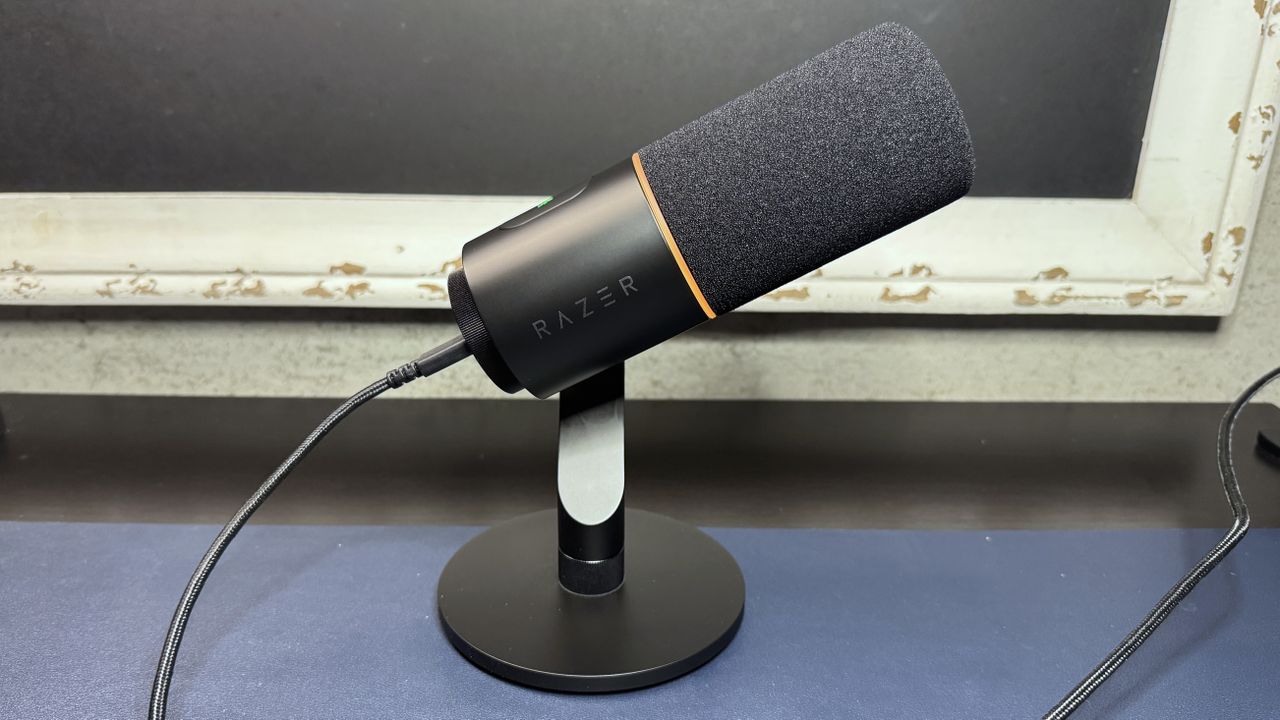
The Seiren V3 Pro sports a rather understated, cylindrical matte black zinc unibody design that, while sleek, doesn't particularly stand out from the crowd of other Shure MV7+-inspired microphones. Measuring 8.39 inches long (213mm) and 3.55 inches wide (90mm) with its integrated swing arm, it’s a fairly substantial microphone, weighing in at just under 1.5 pounds (670g). This gives it a solid, sturdy feel that speaks to its quality. Razer’s branding is subtle, limited to a glossy black text logo on one side, but a customizable RGB light ring around the center adds a touch of signature Razer flair. A notable downside, however, is its susceptibility to fingerprints – the matte black finish quickly shows smudges.
The mic comes with a built-in swing mount that can be attached to the included metal desktop stand or a boom arm using standard 5/8-27 or 3/8-16 threaded mounts. The desktop stand, a round metal base weighing about 7 ounces (200.5g) with non-slip rubber feet, feels stable, but positions the mic quite low. Given the microphone’s somewhat quiet output, a boom arm is often the superior mounting choice for optimal positioning. A removable foam pop filter is also included, sliding off easily to reveal the 30mm dynamic capsule with an integrated shock absorber.
Connectivity and Controls
Around the back/bottom, you’ll find the USB-C and XLR ports, along with a 3.5mm headphone jack for zero-latency monitoring. This dual connectivity is a major selling point, offering flexibility whether you're plugging directly into a PC or using an audio interface. On-mic controls are sparse: a single, textured metal wheel that adjusts gain by default (though it can be reconfigured in Synapse to control headphone volume) and a capacitive-touch tap-to-mute button. This tap-to-mute button is a standout feature, responding flawlessly to a light touch and providing clear visual feedback with both the button and light ring turning red when muted. While the gain wheel is smooth, its placement on the back/bottom can be a bit awkward during use.
Performance
At its core, the Seiren V3 Pro is an end-address dynamic microphone with a cardioid polar pattern, featuring a 30mm capsule and an advanced audio DSP. It records at 32-bit / 96 kHz resolution and supports 32-bit float, a somewhat rare feature for USB mics, though this is exclusively accessible via Razer’s Synapse software on Windows. Frequency response ranges from 50 - 16,000 Hz, with an adjustable gain of 40dB.
Out of the box, the microphone delivered a full, warm, and clear sound for voice, though some sibilance was present. The included foam pop filter performed adequately, managing plosives fairly well unless the user moved very close to the capsule. Listeners generally found the audio quality to be good, comparable to other studio-quality end-address microphones, but it didn't particularly stand out.
A key observation was the microphone's relatively quiet output, even with the gain cranked to its maximum. This necessitated speaking louder than with other comparable mics. This characteristic appears linked to the mic’s “enhanced” off-axis rejection, designed to suppress ambient noise without relying heavily on software processing. While it effectively minimized room reflections and background sounds (even with AI noise suppression off), it also meant that moving even slightly off-axis resulted in a significant drop in volume. This is typical for end-address mics, but the Seiren V3 Pro proved slightly less forgiving than some rivals like the HyperX FlipCast.
Features and Software
While Razer claims the Seiren V3 Pro can function without software, much of its advanced functionality is locked behind Razer Synapse. Beyond reconfiguring the gain wheel, Synapse offers a parametric EQ with presets (e.g., “Podcast,” “Studio”), EQ effects like De-Esser, Vocal Bass, Vocal Exciter, and a High Pass Filter. Additional effects include AI noise suppression, a noise gate, compressor, limiter, and reverb control. The AI noise suppression offered some benefit without over-processing, but didn't dramatically reduce noise. The noise gate was more effective at suppressing background noise but also risked clipping the user's voice, even at lower settings.
Synapse also houses a Stream Mixer, a virtual mixing console for managing various audio channels on your PC (stream, playback, headphone, mic). While potentially useful for advanced users, virtual mixers, including this one, typically have a steeper learning curve. Lastly, the 12-independent RGB zones of the light ring are fully customizable within Synapse, offering both quick effects and advanced Chroma app integration.
The Competition
The Seiren V3 Pro enters a competitive space with alternatives that offer similar features or superior performance in specific areas.
| Feature/Mic | Razer Seiren V3 Pro | HyperX FlipCast | Rode PodMic USB |
|---|---|---|---|
| Connectivity | USB-C, XLR | USB-C, XLR | USB-C, XLR |
| 32-bit Float | Yes (via Synapse) | No (implied) | No (implied) |
| On-Mic Controls | Tap-to-mute, 1 control wheel | Better on-mic controls | None |
| Design Influence | Shure MV7+ emulator | Shure-inspired, light ring | Unique, robust |
| Weight | 1.48 lbs (640g) | 1.26 lbs (571.5g) | 1.9 lbs (900g) |
| Proximity Effect | Decent, but quiet | Flexible | Excellent |
| MSRP / Price | $249.99 | (Not specified, but generally competitive) | (Not specified, but generally competitive) |
While the Seiren V3 Pro brings dual connectivity and 32-bit float to the table, the HyperX FlipCast boasts superior on-mic controls in a similarly styled chassis. The Rode PodMic USB, despite lacking on-mic controls entirely, is lauded for its excellent proximity effect and robust build quality, which some users might prioritize over software-driven enhancements.
Pros and Cons
Pros:
- Dual connectivity: USB-C and XLR for versatile use.
- Tap-to-mute: Flawless capacitive touch with clear visual feedback.
- Comes with a stand: Included desktop stand offers immediate usability.
- 32-bit float: A unique, albeit niche, feature for USB mics.
- Robust software features: Extensive EQ, noise reduction, and mixer options via Synapse.
Cons:
- Pricey: $249.99 is on the higher end for its class.
- Limited on-mic controls: Only one multi-function wheel besides mute.
- Quiet output: Requires higher gain and precise positioning.
- Fingerprint magnet: Matte black finish shows smudges easily.
- Synapse reliance: Many advanced features require software, which some users prefer to avoid.
Buying Recommendation
The Razer Seiren V3 Pro is a well-built, feature-rich microphone designed for content creators of all levels. Its dual USB and XLR connectivity, coupled with 32-bit float support, makes it technically advanced. However, at $249.99, it's a significant investment, especially when many users won't fully utilize the 32-bit float or find themselves heavily invested in Synapse's extensive but sometimes finicky software enhancements. If you absolutely need dual connectivity, appreciate Razer's ecosystem, and want the cutting-edge 32-bit float capability for maximizing dynamic range (and are comfortable working within Synapse), this mic could be a solid, if expensive, choice. However, for most streamers and gamers who prioritize straightforward setup, slightly better on-mic controls, or superior raw audio performance (like the Rode PodMic's proximity effect), more affordable and equally capable alternatives exist that might offer a better overall value proposition without the premium price tag.
FAQ
Q: Is the 32-bit float feature useful for most users? A: While 32-bit float theoretically offers immense dynamic range and prevents clipping in post-production, for the vast majority of users, especially those streaming or recording casual content, its benefits are negligible. Standard 24-bit audio is more than sufficient for high-quality recordings, making 32-bit float a niche feature for professionals who specifically need that headroom.
Q: Can I use the Razer Seiren V3 Pro without Razer Synapse software? A: Yes, the Seiren V3 Pro is designed to work as a plug-and-play microphone without Synapse. However, many of its advanced features, such as the parametric EQ, various audio effects (De-Esser, noise gate, compressor), and customization of the RGB light ring, are only accessible and configurable through the Synapse application.
Related articles

Crystal Lake Series on Peacock: A Deep Dive into Horror's Past
Crystal Lake Series Review: A Deep Dive into Horror's Past Verdict: Is Crystal Lake Worth the Dive? The long-awaited Friday the 13th prequel, Crystal Lake, is finally arriving on Peacock, promising a fresh, in-depth
Google's AI Branding Fix: A Clearer Vision for Gemini
This article critiques Google's fragmented AI branding, proposing a unified 'Gemini Intelligence' system to simplify user experience and strengthen Gemini's identity.

Chuwi UniBox AI495 Pro Review: A Mini AI Powerhouse
Chuwi's UniBox AI495 Pro review: A powerful mini workstation with 192GB RAM and an AMD Ryzen AI chip for local LLM processing, packed into a compact, Mac Pro-esque design.
Pixel Connectivity: Battery Drain, Not Data Speed, Is the Real
Google's Pixel series has consistently offered a compelling Android experience, often earning a spot on recommendation lists for its clean software and camera prowess. However, a recurring shadow has loomed over the

CNET's NYT Connections: Sports Edition Hints & Answers - Daily Puzzle
CNET's daily guide for NYT Connections: Sports Edition offers clear, spoiler-protected hints and answers, making it an efficient and reliable resource for sports puzzle enthusiasts.
Unofficial Sony Headphone PC Apps: Ditch Your Phone, Take Control
Tired of Sony's mobile app? These unofficial, open-source PC tools like Sony Device Center and SonyBridge offer desktop control over your Sony headphones' ANC, EQ, and more. A convenient, albeit unofficial, solution for Windows, Linux, and Mac users looking to ditch their phone for audio adjustments.