
OpenAI COBOL Migration: A Promising But Not Perfect Solution
The Engadget Verdict OpenAI's latest strides in large language models, specifically GPT-6 Astra and GPT-6.1 Sol, represent a significant leap forward in tackling one of the enterprise world's most intractable problems:
The Engadget Verdict
OpenAI's latest strides in large language models, specifically GPT-6 Astra and GPT-6.1 Sol, represent a significant leap forward in tackling one of the enterprise world's most intractable problems: migrating legacy COBOL systems. For banks and financial institutions grappling with aging codebases and a dwindling pool of COBOL experts, these models offer a tantalizing glimpse into a more efficient future. However, while the promise of AI-assisted modernization is compelling, it's crucial to understand that this is not a magic bullet. OpenAI's models are powerful tools designed to assist, not fully replace, the complex and human-intensive process of ensuring financial systems remain flawlessly accurate. Expect significant progress, but remember that expert oversight and rigorous testing remain non-negotiable.
Unpacking the COBOL Conundrum
For those outside the finance industry, the mention of COBOL might conjure images of archaic mainframes and dusty server rooms. Yet, this 60-year-old programming language still underpins an astonishing 40 percent of the world's banking systems. The sheer volume of critical operations handled by COBOL means that migrating to modern languages like C++, Java, or Python is not merely an upgrade; it's a necessity. The problem? These migrations are prohibitively expensive, often costing millions to hundreds of millions of dollars, and incredibly time-consuming. Compounding this challenge is the fact that COBOL programmers are rapidly nearing retirement, creating a looming skills gap that threatens the stability of these vital financial infrastructures.
OpenAI has stepped into this breach, asserting that its advanced models can now assist in this Herculean task. The company claims its models are significantly better at understanding and translating not just COBOL, but also other 'low-resource' programming languages like Fortran and Visual Basic, for which expert human resources are becoming increasingly scarce.
Performance & Precision: A Deep Dive into the Models
To gauge the efficacy of their models, OpenAI developed MultiLangBench, an AI evaluation suite designed to test a model's ability to create SQLite-compatible database engines in various programming languages. The results are indeed impressive, showcasing a substantial generation-over-generation improvement.
While GPT-5.6 Sol managed a mere 26.8 percent average test pass rate, its successor, GPT-6 Astra, achieved an average pass rate of 87.4 percent across 20 different languages. This indicates a profound leap in the models' general coding comprehension and generation capabilities. However, even with this significant advancement, COBOL stubbornly remains the toughest nut to crack, with Astra's pass rate specifically for COBOL coming in at 72 percent. While a vast improvement, this still leaves a considerable margin for error when dealing with mission-critical banking logic.
Beyond basic code generation, the true test lies in the models' ability to migrate existing COBOL programs to modern languages while meticulously preserving their original behavior. This is paramount in banking, where the smallest discrepancy – say, in how numbers are rounded or how missing records are handled – could lead to catastrophic financial errors. Here, OpenAI showcased GPT-6.1 Sol, which achieved a remarkable 97.9 percent accuracy with high reasoning effort when migrating COBOL programs to C++, Java, Kotlin, Python, or Rust, ensuring behavior preservation. Even at a lower reasoning effort, its accuracy stood at a solid 86.6 percent.
The Enterprise Experience: A Powerful Assistant, Not a Replacement
From an enterprise perspective, the implications of these capabilities are vast. Imagine the time and resources saved if AI could handle the initial heavy lifting of code translation and behavioral mapping. This would free up the precious few remaining COBOL experts, allowing them to focus on critical validation and system integration rather than painstaking manual translation.
However, OpenAI itself is clear-eyed about the limitations. As they rightly point out, a banking migration is only truly successful if “all tests pass.” The stakes are simply too high for anything less than perfect accuracy. The company explicitly states that while these behavior-preserving capabilities are incredibly useful for modernization teams, applying them to production software “still requires expert review and testing against the system's business rules and dependencies.” This isn't a hands-off, automated deployment; it's an AI-powered tool that significantly enhances human efficiency, rather than eliminating the need for human expertise.
Pros and Cons
Pros:
- Addresses a Critical Industry Need: Directly targets the expensive and complex problem of COBOL migration for financial institutions.
- Significant Performance Improvement: GPT-6 Astra and GPT-6.1 Sol show substantial gains in understanding and translating legacy code compared to previous models.
- Behavior Preservation: High accuracy (up to 97.9%) in maintaining original program logic during migration is crucial for banking applications.
- Supports Multiple Modern Languages: Flexibility to migrate COBOL to C++, Java, Kotlin, Python, or Rust.
- Reduces Reliance on Dwindling Expertise: Offers a path forward as COBOL programmers retire, potentially easing the skills gap.
- Accelerates Modernization: Can drastically reduce the time and cost associated with manual migration efforts, which currently cost millions.
Cons:
- Not 100% Accurate (Yet): COBOL still proves challenging, with Astra's 72% pass rate in MultiLangBench, and migration accuracy, while high, is not absolute. For banking, even small errors are unacceptable.
- Requires Expert Human Oversight: OpenAI explicitly states that expert review and extensive testing against business rules are still necessary. This isn't a 'set it and forget it' solution.
- Focus on Code, Not Full System: The models translate code and preserve behavior, but the broader migration involves complex system architecture, database migration, and integration that are not fully covered by this capability alone.
- No Explicit Cost Savings Figures: While implied that it would save millions, specific metrics on the degree of cost or time reduction through AI assistance are not provided.
The Bottom Line: Who Is This For?
OpenAI's COBOL migration capabilities are not for the faint of heart, nor are they a consumer product in the traditional sense. This is an enterprise-grade solution aimed squarely at large financial institutions, government bodies, and any organization burdened by extensive legacy COBOL systems. For CIOs and IT directors wrestling with the monumental costs and risks of manual migration, these models represent a compelling investment opportunity.
However, it's vital to approach this with realistic expectations. Think of OpenAI's models as a highly skilled, incredibly fast junior programmer capable of processing vast amounts of code and suggesting conversions with impressive accuracy. But like any junior, their output still requires the meticulous review, validation, and ultimate sign-off from experienced senior architects and domain experts. Pilot projects, phased rollouts, and a robust testing framework will be essential for any successful implementation. This is a powerful enabler of modernization, not a fully automated shortcut.
FAQ
Q: Is this a fully automated COBOL migration solution?
A: No, OpenAI's models are designed to significantly assist in the migration process by translating code and preserving behavior. However, expert human review and extensive testing against the system's specific business rules and dependencies are still explicitly required for production software.
Q: How much money or time can banks expect to save by using these models?
A: While the source indicates that current COBOL migrations cost millions to hundreds of millions and take a lot of time, specific figures for savings enabled by OpenAI's AI assistance are not provided. The implication is that savings will be substantial by speeding up and streamlining portions of the process.
Q: Which modern programming languages can COBOL be migrated to using these models?
A: OpenAI's models are capable of migrating COBOL programs to C++, Java, Kotlin, Python, or Rust, while preserving the original program's behaviors.
Related articles

YouTube Dislike Button Test: A Step Backward
YouTube's latest experiment to tuck away the dislike button on regular videos is a concerning move, further eroding a vital feedback mechanism for viewers and potentially allowing low-quality content to thrive unchecked.
UGREEN 25W MagFlow: Portable 2-in-1 Charger Hits Record Low
The UGREEN 25W MagFlow, a foldable 2-in-1 magnetic wireless charger for iPhones and earbuds, is back to its record-low Prime Day price. Offering Qi2 25W charging and a compact design, it's ideal for travelers and minimalists.

AI Model Lock-in? It's Not the Model, It's Everything Else
A recent survey reveals that while swapping AI models is becoming common, the real lock-in risk for enterprises lies in the surrounding infrastructure: integrations, agent workflows, and guardrails. Despite concerns about vendor lock-in, it often ranks lower than immediate priorities like security and cost in AI purchasing decisions. However, multi-model adopters are proactively building open, flexible architectures, demonstrating a path to mitigate future migration headaches.
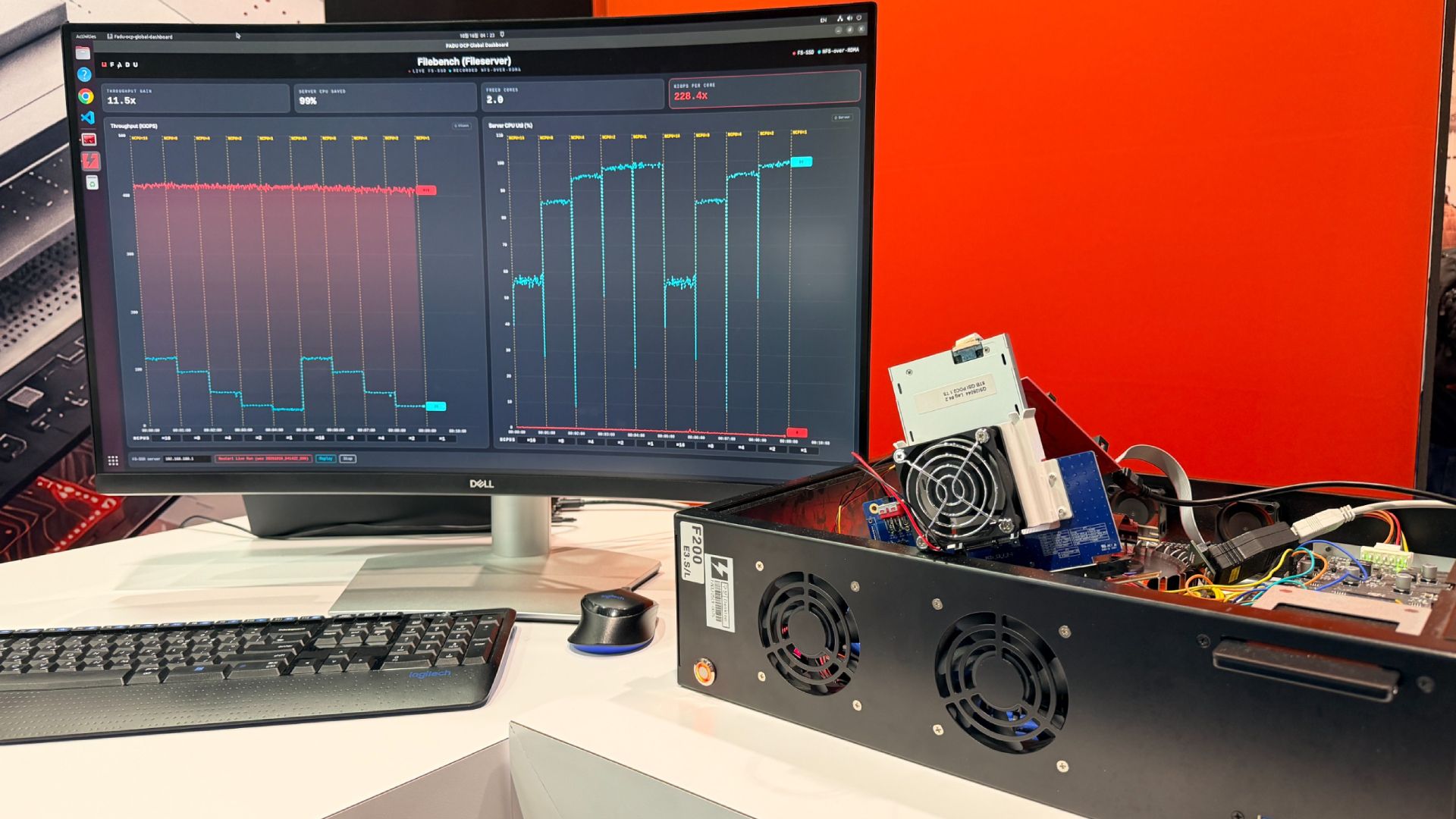
FADU FS-SSD: A Glimpse into the Future of Storage
FADU's File-Semantic SSD moves the filesystem directly into the drive, aiming to dramatically reduce host CPU overhead for file operations, especially for GPUs and DPUs. Promising early results, but a long wait for samples (Q3 2027).

Anthropic Pitches AI Safety Bill: Blocking Models at 50+ Deaths
Anthropic has pitched a draft AI safety bill to Congress that would allow blocking an AI model's release if it poses a "catastrophic risk" – defined as potentially causing over 50 deaths or $1 billion in damages through specific threats. The controversial proposal mandates that federal agencies seek judicial approval to halt a model's distribution, limiting their independent authority. This move comes amid ongoing debates over AI regulation and concerns about agentic hacking.

SpaceX's AI Business Fuels Explosive Q3 2026 Revenue Growth
SpaceX reported Q3 2026 revenues of $14.6 billion, a 161% jump, primarily driven by an 830% year-over-year surge in its Super Intelligence (SI) division. This growth was fueled by new cloud services, the Cursor acquisition, and wider Grok AI adoption, alongside robust performance in its Starlink Connectivity business.