
Artemis 2 Crew Makes Triumphant Splashdown, New Lunar Era Begins
NASA's Artemis 2 mission successfully concluded today with a triumphant splashdown in the Pacific Ocean, marking the first crewed trip around the moon since 1972. The four-astronaut crew returned after a 10-day odyssey, setting new human distance records and validating critical hardware for future lunar landings and the establishment of a permanent base.

NASA's Artemis 2 mission successfully concluded today, April 10, 2026, as its four-person crew made a triumphant splashdown in the Pacific Ocean off the coast of California. This landmark event marks humanity's first crewed journey around the moon since 1972, serving as a critical test flight to pave the way for future lunar landings and the establishment of a permanent human presence on the moon. Commander Reid Wiseman, pilot Victor Glover, and mission specialists Christina Koch and Jeremy Hansen returned after a 10-day odyssey, setting new records and affirming the next era of space exploration.
A Historic Journey's End
The Orion spacecraft, dubbed "Integrity" by its crew, plunged back into Earth's atmosphere at a blistering speed exceeding 24,000 mph. This intense re-entry created a plasma field, causing a six-minute radio communications blackout, a period of high tension for Mission Control. The crew, experiencing G-forces comparable to launch, endured the fiery descent, while Orion's heat shield successfully withstood temperatures soaring between 4,000 and 5,000 degrees Fahrenheit, validating design adjustments made after the uncrewed Artemis 1 mission.
Upon the return of communications, Commander Wiseman's clear voice, "Houston, Integrity: We have you loud and clear," was met with cheers from ground controllers. The spacecraft's parachutes deployed flawlessly, decelerating its descent to just 19 mph before its gentle impact with the Pacific Ocean southwest of San Diego at 5:07 p.m. PT. Wiseman quickly confirmed that all four astronauts were in good health, rounding off what NASA commentator Rob Navias described as a "textbook mission."
Recovery teams swiftly moved to the splashdown site, facing a minor satellite phone issue, though continuous radio contact with the crew was maintained. The astronauts were safely extracted from the Orion capsule, brought onto rafts, and then hoisted by helicopter to the USS John P. Murtha, the lead recovery ship. After initial medical assessments, they are scheduled to fly to Johnson Space Center in Houston via San Diego.
Pushing the Boundaries of Human Exploration
During their 10-day mission, the Artemis 2 crew traveled an astounding 700,237 miles, becoming the most distant human travelers ever. They swung more than 4,000 miles beyond the moon's far side, eclipsing the Apollo 13 record by 4,101 miles with a maximum distance of 252,756 miles from Earth. This diverse crew also made history through its composition: Christina Koch became the first woman, Victor Glover the first Black astronaut, and Jeremy Hansen the first non-U.S. astronaut to venture beyond Earth orbit.
Beyond the engineering tests, the mission delivered significant scientific and inspirational dividends. Astronauts conducted a wide-angle survey of the lunar far side, observing areas unseen by previous Apollo crews due to lighting conditions. They also captured breathtaking images of Earthset and Earthrise, evoking the awe inspired by Apollo 8's iconic 1968 photograph, and observed a unique solar eclipse that cast an eerie glow around the darkened moon.
Technical Triumphs and Minor Glitches
The success of Artemis 2 was underpinned by critical hardware, including contributions from the Pacific Northwest. L3Harris' Aerojet Rocketdyne team in Redmond, Washington, developed two sets of Orion's thrusters, while Karman Space & Defense in Mukilteo, Washington, manufactured mechanisms crucial for the safe deployment of the parachutes. NASA Associate Administrator Amit Kshatriya lauded the mission's historical and future significance, stating, "It's the most important human spaceflight mission I think we've done in many decades."
While overwhelmingly successful, the mission experienced a couple of minor technical issues. The spacecraft's first-ever deep-space toilet encountered a problem during the outbound journey, attributed to an ice blockage in a wastewater vent line. Additionally, a slight helium leak was detected in the pressurization system of Orion's service module's oxidizer tank. Although this posed no immediate threat to Artemis 2, NASA indicated that the system might require a redesign for the subsequent lunar landing mission, Artemis 4.
Laying the Groundwork for Lunar Future
NASA Administrator Jared Isaacman expressed immense pride in the agency's workforce, calling the experience a lifelong dream come true. He emphatically stated, "This is just the beginning," signaling NASA's intent to increase the frequency of lunar missions, aiming for a lunar landing in 2028 and the establishment of a permanent base in the 2030s. President Donald Trump also conveyed his congratulations, looking forward to a White House reception and extending aspirations to Mars.
The path to a sustained lunar presence will see significant collaboration. SpaceX's Starship lander and Blue Origin's Blue Moon lander are currently under development to transport future astronauts to the lunar surface. NASA plans to test these landers in low Earth orbit during Artemis 3 next year. If all progresses as planned, one of these vehicles will facilitate the first human lunar landing since 1972 during the Artemis 4 mission in early 2028, followed by the commencement of a south pole base by the Artemis 5 crew in late 2028. Blue Origin CEO Dave Limp hailed Artemis 2 as "this generation's Apollo moment" and highlighted his company's plan to send an uncrewed Blue Moon lander, named Endurance, to the moon's south polar region later this year, a prime location for its potential ice reserves vital for future settlements.
FAQ
Q: What was the primary goal of the Artemis 2 mission? A: The main objective of Artemis 2 was to test the Orion spacecraft's hardware, crew systems, and operational procedures with astronauts aboard, in preparation for future missions that will land humans on the lunar surface and eventually establish a permanent lunar base.
Q: Which astronauts were part of the Artemis 2 crew? A: The historic crew consisted of NASA astronauts Reid Wiseman (Commander), Victor Glover (Pilot), Christina Koch (Mission Specialist), and Canadian Space Agency astronaut Jeremy Hansen (Mission Specialist).
Q: What is planned for the next stages of the Artemis program? A: Artemis 3 is scheduled to test commercial lunar landers in low Earth orbit next year. Artemis 4 aims for the first human lunar landing since 1972 in early 2028, utilizing one of these new landers. Artemis 5, planned for late 2028, will begin work on establishing a permanent base near the moon's south pole.
Related articles

Apple Unveils iPhone Duo: Pricey Foldable Sees Soaring Demand
Apple has officially entered the foldable smartphone arena with the long-anticipated launch of the iPhone Duo. Priced starting at a hefty $1,999, the device features a 5.4-inch outer display and a larger 7.6-inch inner

in-depth: Chicago-Area Cops Helped HSI Spy on Minnesota Anti-ICE
Chicago-area law enforcement, including local police and HSI agents, conducted undercover surveillance on Minnesota anti-ICE activists at an April 2, 2022, talk in Chicago. This operation was part of a federal conspiracy probe into 15 Minnesota activists facing felony charges related to immigration enforcement resistance. Civil liberties advocates have condemned the surveillance as a troubling intrusion into protected political activity.

Mark Wahlberg on using AI in film ‘the right way’ and being open to
Actor Mark Wahlberg believes AI has a place in filmmaking if used responsibly for enhancement, not script generation or actor replacement. At TechCrunch Disrupt, he expressed openness to an AI likeness carrying on his legacy, managed by his family, and emphasized storytelling.
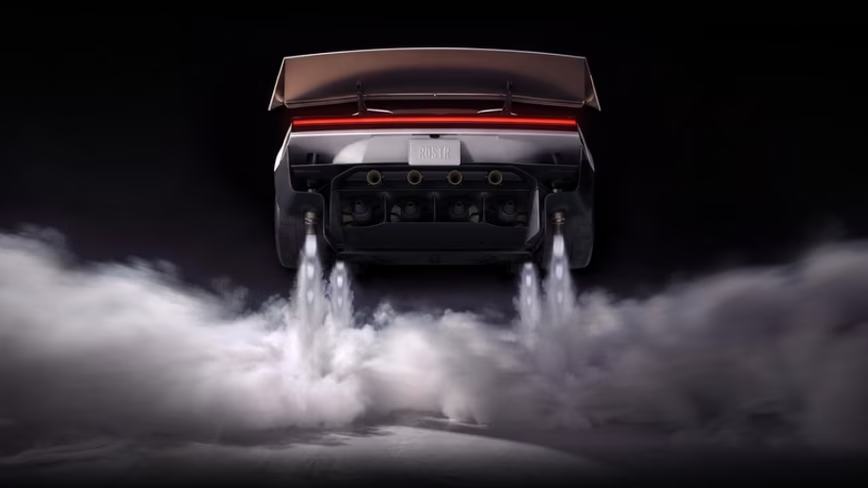
Tesla Unveils Thruster-Equipped Roadster, 2028 Production Targeted
Tesla has unveiled its second-generation Roadster, featuring cold-gas thrusters co-developed with SpaceX, enabling it to jump and flip. The electric sports car demonstrated 0-60mph in an astonishing 0.81 seconds, with production targeted for 2028. This highly anticipated reveal also serves as a key recruitment tool for Tesla's ambitious AI and robotics initiatives.

AI's Confidence vs. Formal Methods' Rigor: Design Flaws & Verification
While AI accelerates code generation, formal methods remain critical for ensuring system correctness. Languages like TLA+ and tools like Quint enable developers to model and verify system designs before coding, catching subtle flaws. Quint makes formal methods more accessible with developer-friendly syntax and executability. This approach is vital for verifying AI-generated code through trace validation and model-based testing, ensuring reliability against real-world data.

Amazon Prime Video Launches AI-Powered Prime 360 for NBA Coverage
Amazon Prime Video is elevating its NBA coverage with the introduction of Prime 360, an AI-powered replay system offering immersive, 'fly through' views of the action. Kicking off its second season, Prime Video also adds Yahoo fantasy integration and gains exclusive Eastern Conference Finals rights, expanding its tech-driven sports broadcast. The new features aim to deliver a unique and interactive viewing experience for basketball fans.