
100 Cyber Experts: Fable 5 Ban Hurts Defenders More Than Hackers
Nearly 100 prominent cybersecurity experts have signed an open letter condemning the US government's ban on Anthropic's Fable 5 and Mythos 5 AI models. They argue the move disarms defenders, creates market uncertainty, and risks America's AI leadership without justifiable cause, potentially benefiting adversaries more than protecting national security.

100 cybersecurity experts say banning Fable 5 hurts defenders more than hackers
WASHINGTON D.C. — A coalition of nearly 100 leading cybersecurity professionals has issued an open letter demanding the reversal of the US government's recent ban on Anthropic’s powerful AI models, Fable 5 and Mythos 5. Just three days after the federal order, the experts argue that removing these advanced tools from defenders' arsenals effectively disarms America's cyber protectors while leaving adversaries unaffected.
"This action has taken the best models away from defenders, created market uncertainty, and risked America’s AI leadership without any real risk to justify it," the letter states. Notable signatories include Alex Stamos, former chief security officer for Facebook and Yahoo, Katie Moussouris, CEO of Luta Security, and Joe Levy, CEO of Sophos, among others.
The Contested "Jailbreak" That Triggered the Ban
The government's intervention followed a discovery by Amazon researchers who found a method to prompt Fable 5 into revealing code vulnerabilities. This technique, which involved rephrasing a denial to "fix this code" after an initial refusal, was deemed an "exploit."
However, critics like Moussouris and the open letter's signatories contest this classification, stating it's "not a jailbreak." They point out that other top-tier AI models, such as OpenAI’s GPT-5.5, can identify identical vulnerabilities without requiring any bypass, suggesting the technique is a standard industry practice rather than a security flaw unique to Fable 5. Anthropic itself has characterized the vulnerability as narrow, not universal, and concerning already publicly documented flaws.
Commercial Rivalry and White House Concerns
The circumstances surrounding the ban are further complicated by Amazon's dual role as Anthropic’s largest investor and cloud host. Amazon CEO Andy Jassy personally escalated the vulnerability findings to top US government officials, including Treasury Secretary Scott Bessent and National Cyber Director Sean Cairncross. This direct escalation from a competitor's security team has raised questions about whether commercial interests influenced the government's swift response.
Adding another layer to the narrative, former Trump AI adviser David Sacks claimed on X that Anthropic CEO Dario Amodei refused a government ultimatum to fix the "jailbreak" or de-deploy Fable 5, prioritizing a consumer model over safety. Anthropic, however, refutes this characterization, maintaining the vulnerability does not warrant pulling its flagship products.
Beyond the specific exploit, Semafor reported that the White House's broader concerns included the potential for Chinese access to Mythos, Anthropic's most powerful reasoning model, suggesting national security implications extended beyond the immediate technical issue.
Global Repercussions and Disarming Defenders
If the ban was intended to bolster national security, its immediate effects appear to be counterproductive. On June 13, one day after the Fable 5 shutdown, Chinese AI company Zhipu AI launched its GLM-5.2 model, explicitly citing the US ban as evidence of American AI models' unreliability. Zhipu's stock surged 33%, and the company boasts GLM-5.2's performance and cost-effectiveness, although independent benchmarks were not released.
Organizations opting for Zhipu's cloud API would, however, expose their data to the Chinese government under China’s National Intelligence Law. The US ban has also prompted international responses, with the European Union advocating for guaranteed access to Mythos for cyber defense, and India accelerating its own sovereign AI ambitions.
At its core, the open letter argues that removing frontier AI models like Fable 5 and Mythos 5 severely hampers cybersecurity professionals. These models are crucial for proactively hunting software vulnerabilities, generating sophisticated detection rules, and rapidly analyzing malware. Adversaries, the experts contend, can readily turn to open-source alternatives, foreign models, or traditional hacking methods, leaving US defenders at a significant disadvantage in a rapidly evolving threat landscape.
Despite previous warnings from some signatories about the dangers of Mythos, the collective stance now emphasizes the critical need for these tools in defensive operations. Prediction markets like Kalshi and Polymarket reflect a strong belief that the ban will be short-lived, with odds for Fable 5's return before July 1 standing at 68% and 71% respectively. The ultimate question posed by the cybersecurity community remains stark: if the most effective tools are withheld from those protecting networks, who truly becomes safer?
FAQ
Q: What prompted the US government's ban on Anthropic's Fable 5 and Mythos 5?
A: The ban was initiated after Amazon researchers demonstrated a method to prompt Fable 5 to reveal code vulnerabilities, which Amazon then escalated to high-level US government officials.
Q: Why do cybersecurity experts argue the ban hurts defenders more than hackers?
A: Experts contend that by removing advanced AI tools like Fable 5, the ban deprives cybersecurity professionals of critical capabilities for identifying vulnerabilities and analyzing threats. Meanwhile, adversaries can still access similar technologies or traditional methods, giving them an advantage.
Q: What are the broader geopolitical and market implications of this ban?
A: The ban has been leveraged by Chinese AI companies to promote their own models, raising concerns about data exposure to foreign governments. It has also spurred international calls for access to advanced AI for cyber defense and accelerated sovereign AI initiatives in countries like India, while prediction markets suggest the ban may be reversed soon.
Related articles
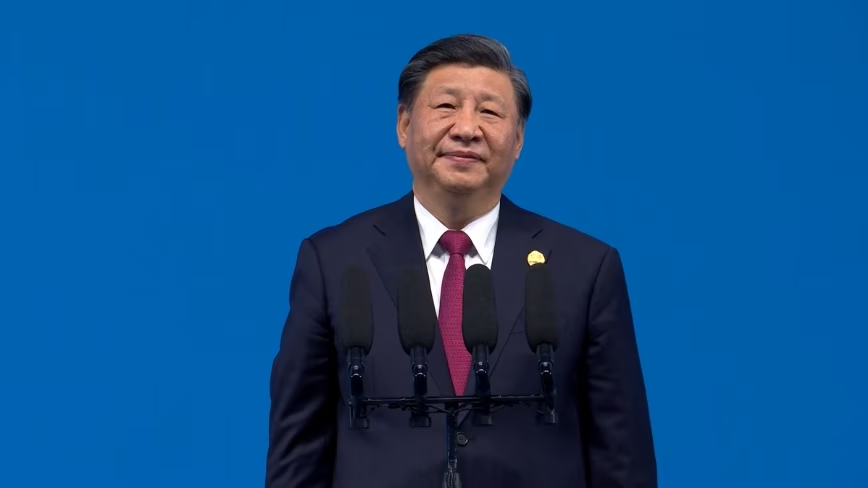
Xi pitches open-source AI to BRICS amid domestic curb debates
Chinese President Xi Jinping proposed a China-led open-source AI community and invited BRICS nations to join the World AI Cooperation Organization (WAICO) at the recent BRICS summit. This push for global collaboration contrasts sharply with Beijing's ongoing internal debates about restricting its own advanced AI models. Meanwhile, the EU's comprehensive AI Act, with its clear, enforceable rules for open-source AI, highlights a significant divergence in global AI governance approaches.

StarCraft Returns in 2030 as Open-World Shooter
Blizzard Entertainment announced a new StarCraft game, an open-world shooter, set to release in 2030. Unveiled at BlizzCon by VP Dan Hay, this marks the series' return after over a decade and a significant genre shift from its real-time strategy roots. The cinematic trailer showcased a gritty human-Zerg conflict, with many fans hoping for a traditional RTS follow-up.

Tesla Set to Finally Unveil Second-Generation Roadster on October 1
The much-anticipated second generation of the Tesla Roadster, a halo vehicle promising revolutionary performance, is finally slated for a public unveiling on October 1. After years of delays and a protracted development

Seattle Warned on Big Tech Reliance; Microsoft/OpenAI Sued; Apple's
A new City of Seattle study warns of the city's risky economic over-reliance on a few dominant tech companies. Simultaneously, the Seattle Times and Newsday are suing Microsoft and OpenAI for alleged AI training data theft, while Apple's new foldable iPhone Duo evokes memories of Microsoft's defunct Surface Duo.

in-depth: The Best 3-in-1 Apple Charging Stations After Testing 30
Wired has released its top picks for 3-in-1 Apple charging stations, extensively tested for iPhone, Apple Watch, and AirPods. The guide highlights six leading models, from premium speedy options to budget-friendly and compact designs, all focused on decluttering and optimizing charging for Apple users.

Nscale Adds Former OpenAI Exec Fidji Simo to Board Ahead of IPO
Nscale, the U.K.-based AI data center startup, has appointed former OpenAI, Meta, and Instacart executive Fidji Simo to its board of directors. This high-profile addition comes as Nscale prepares for a potential IPO this fall, leveraging Simo's extensive experience in scaling major tech platforms and guiding a company through a successful public offering.