
Zuckerberg Outlines Meta's Bold Vision for Personal AI Agents
Meta CEO Mark Zuckerberg has announced ambitious plans for a significant push into personal AI agents, a strategy he unveiled during the company's Q2 2026 earnings call on Wednesday, July 29, 2026. This initiative aims

Meta CEO Mark Zuckerberg has announced ambitious plans for a significant push into personal AI agents, a strategy he unveiled during the company's Q2 2026 earnings call on Wednesday, July 29, 2026. This initiative aims to develop AI agents capable of operating continuously, providing users with comprehensive assistance across various facets of their lives, including personal goals, health, relationships, and financial management.
Zuckerberg articulated a clear vision for these forthcoming agents, emphasizing that they must transcend the technical proficiency often seen in AI for developers. He stressed the importance of creating intuitive, consumer-ready products. "Soon we will have agents that can work 24/7 on your behalf to help you achieve your goals and improve your life, your health, your relationships, your finances, whatever you want," Zuckerberg stated during the call, highlighting the expansive scope of Meta's personal AI aspirations.
The Meta chief also outlined the critical criteria for these agents to achieve widespread adoption. He noted that while coding is an initial domain where agents have thrived, primarily due to the technical nature of engineers willing to refine their functionality, mass appeal requires a different approach. "To build great personal agents, this needs to be a great consumer product that just works out of the box and is easy enough for billions of people to adopt and use," Zuckerberg asserted, pointing to the necessity of seamless user experience for broad market penetration.
This strategic direction suggests Meta's intent to carve out a distinct niche within the rapidly evolving AI landscape. Zuckerberg's comments indicate a desire to differentiate Meta's offerings from those of rival companies such as Anthropic and OpenAI, which have largely concentrated their AI agent development on coding-centric solutions and enterprise-level applications. By focusing on general consumer utility and simplicity, Meta hopes to appeal to a much broader demographic.
However, the path to dominating the personal AI agent market presents considerable challenges for Meta, according to analysis within The Verge's reporting. The company's current AI research and development efforts are acknowledged to be trailing behind those of other major AI laboratories. Furthermore, a significant hurdle lies in Meta's comparative lack of deep ecosystem access.
Unlike tech giants such as Google and Microsoft, Meta does not inherently control core services like email or document storage, which are often rich sources of personal data crucial for training and operating highly personalized AI agents. Google's Gemini Spark tool, for instance, already offers personal AI agent capabilities, described in a previous review as "very good" yet "almost creepy," suggesting a level of integration Meta currently lacks.
Meta's success in this ambitious venture will likely hinge on its ability to overcome these infrastructure and data access disparities, while also delivering on Zuckerberg's promise of effortlessly usable consumer products. The company has indicated that more detailed information regarding its personal AI agent initiatives will be disclosed "soon," keeping the tech world anticipating Meta's next significant move in the AI race.
FAQ
Q: What is Meta's primary goal with personal AI agents? A: Meta's primary goal is to create personal AI agents that can work 24/7 to help users achieve their life goals, improving aspects such as health, relationships, and finances, by being easy enough for billions of people to adopt and use.
Q: How does Meta plan to differentiate its personal AI agents from competitors? A: Meta aims to differentiate its agents by focusing on consumer-friendly products that "just work out of the box," in contrast to companies like Anthropic and OpenAI, which have largely concentrated on agents for coding and enterprise work.
Q: What challenges does Meta face in its push for personal AI agents? A: Meta faces challenges including its AI efforts currently lagging behind bigger AI labs and a lack of ecosystem access to personal data like email or documents, which competitors like Google and Microsoft possess.
Related articles

How to Use Kodi: The Simple, Server-Free Way to Watch Your Media
Learn to set up Kodi to watch your personal media library directly on your TV, bypassing complex servers and subscription fees, in just a few steps.
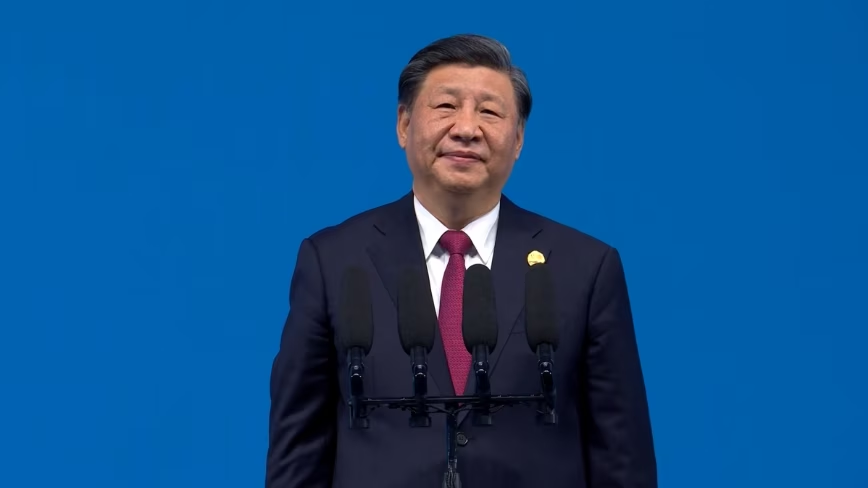
Xi pitches open-source AI to BRICS amid domestic curb debates
Chinese President Xi Jinping proposed a China-led open-source AI community and invited BRICS nations to join the World AI Cooperation Organization (WAICO) at the recent BRICS summit. This push for global collaboration contrasts sharply with Beijing's ongoing internal debates about restricting its own advanced AI models. Meanwhile, the EU's comprehensive AI Act, with its clear, enforceable rules for open-source AI, highlights a significant divergence in global AI governance approaches.

StarCraft Returns in 2030 as Open-World Shooter
Blizzard Entertainment announced a new StarCraft game, an open-world shooter, set to release in 2030. Unveiled at BlizzCon by VP Dan Hay, this marks the series' return after over a decade and a significant genre shift from its real-time strategy roots. The cinematic trailer showcased a gritty human-Zerg conflict, with many fans hoping for a traditional RTS follow-up.

Tesla Set to Finally Unveil Second-Generation Roadster on October 1
The much-anticipated second generation of the Tesla Roadster, a halo vehicle promising revolutionary performance, is finally slated for a public unveiling on October 1. After years of delays and a protracted development

Seattle Warned on Big Tech Reliance; Microsoft/OpenAI Sued; Apple's
A new City of Seattle study warns of the city's risky economic over-reliance on a few dominant tech companies. Simultaneously, the Seattle Times and Newsday are suing Microsoft and OpenAI for alleged AI training data theft, while Apple's new foldable iPhone Duo evokes memories of Microsoft's defunct Surface Duo.
Google's AI Branding Fix: A Clearer Vision for Gemini
This article critiques Google's fragmented AI branding, proposing a unified 'Gemini Intelligence' system to simplify user experience and strengthen Gemini's identity.