
When LLMs Are Literal Little Learners: A K-5 Knowledge Boundary
Modern Large Language Models (LLMs) are notorious black boxes. Trained on vast, unfiltered swaths of the internet, they exhibit incredible emergent capabilities, but understanding how and when these capabilities arise
Modern Large Language Models (LLMs) are notorious black boxes. Trained on vast, unfiltered swaths of the internet, they exhibit incredible emergent capabilities, but understanding how and when these capabilities arise remains a significant challenge. Is a new skill truly learned from the ground up, or is the model merely eliciting pre-existing knowledge that was implicitly encoded somewhere in its massive training corpus?
This fundamental question forms the core of the LittleLearner project. Developed by researchers from MPI for Intelligent Systems, ELLIS Institute Tübingen, and ETH Zürich, LittleLearner offers a unique, controlled environment to investigate how language models acquire and utilize knowledge. Imagine an LLM that only knows what a fifth grader knows – that's the premise, and the findings offer critical insights for anyone working with these powerful, yet opaque, systems.
The Problem of Untamed Knowledge
Traditional LLM training involves exposing models to 'everything at once.' While effective for creating versatile general-purpose models, this approach obscures the learning process. If a model suddenly demonstrates proficiency in advanced calculus, it's hard to discern if it derived that knowledge or if it simply memorized patterns from highly specific, advanced texts it encountered during pretraining. This lack of a clear knowledge boundary makes systematic study of learning and capability emergence incredibly difficult.
LittleLearner addresses this by introducing a pedagogically-controlled knowledge exposure. Instead of training on the entire web, these models are intentionally constrained to a curriculum designed to mirror the knowledge base of a K-5 elementary school student in the U.S. This allows researchers to establish an interpretable knowledge boundary and observe what happens when a model's information diet is strictly managed.
Building a Bounded Learner: The LittleCurriculum and LittleLearner Models
The foundation of the LittleLearner project is its meticulously curated dataset and the models trained upon it:
The LittleCurriculum Dataset
At the heart of LittleLearner is LittleCurriculum, an 88-billion-token corpus. This dataset wasn't just randomly filtered; it was carefully distilled from the larger FineWeb-Edu corpus through a rigorous five-stage pipeline. The entire filtering process was aligned with U.S. Common Core standards for Kindergarten through Grade 5. Crucially, concepts, facts, and vocabulary taught above Grade 5 were explicitly excluded.
This deliberate exclusion ensures that the models are only exposed to information within the defined K-5 scope, providing a clean slate for studying how skills develop without the influence of advanced external knowledge.
The LittleLearner Models
Using the LittleCurriculum dataset, the researchers trained several LittleLearner models from scratch. These models come in three scales: 0.6 billion, 1.3 billion, and 5 billion parameters. For robust comparison, each LittleLearner model has a corresponding 'Unfiltered' control model. These control models share the exact same architecture, tokenization, and training recipe, but they are trained on an unrestricted, unfiltered corpus. This matched control setup is vital for isolating the impact of the K-5 curriculum.
Beyond the base pretrained models, the project also provides specialized variants:
- Base: The core pretrained models.
- GRPO (Generalized Reinforcement Learning for Problem-solving): Math-specialist models post-trained on
MathCAMPS, which can exhibit a tendency towards math-oriented output. - Chatty: Variants fine-tuned for general chat behavior, offering a more interactive experience.
These models are openly available on Hugging Face, allowing other researchers and developers to experiment with them and verify findings.
Key Findings: The Pretraining Filter is the Capability Ceiling
The central and most striking finding from the LittleLearner project is dubbed "Elicitation, not Acquisition." The research strongly indicates that the pretraining corpus sets the effective capability ceiling for an LLM. This means what the model sees during its initial training largely dictates the upper bound of its knowledge and reasoning abilities.
Let's break down how various interventions, typically used to improve LLM performance, fared when attempting to push LittleLearner beyond its K-5 boundaries:
-
Scaling Model Size: While increasing model size (from 0.6B to 5B parameters) significantly improved performance within the K-5 curriculum scope and modestly extended to problems along the same learning trajectory, it yielded little to no improvement on problems requiring more advanced capabilities outside the K-5 exposure. This suggests that simply making a model larger doesn't magically unlock knowledge it was never exposed to.
-
Post-training: Even with advanced post-training techniques like GRPO, which substantially boosted in-scope K-5 capabilities, the models failed to recover out-of-scope, beyond-K-5 capabilities. This held true even when the post-training data itself included out-of-scope material. The initial knowledge boundary, set by pretraining, remained firm.
-
In-context Learning (ICL): Providing in-context examples, a powerful technique for prompting LLMs, also proved ineffective at unlocking new reasoning capabilities for beyond-K-5 problems in the trained 5B
LittleLearner. The model could leverage ICL for in-scope tasks but couldn't bridge the knowledge gap for advanced concepts.
In essence, the project demonstrates that scaling, post-training, and in-context learning primarily amplify what the curriculum already taught, rather than enabling the acquisition of entirely new, out-of-scope knowledge.
Practical Takeaways and Future Directions
For developers and researchers, LittleLearner offers a compelling, controlled sandbox for studying core LLM behaviors. Its explicitly specified training exposure means that any observed behavioral or representational changes can be directly tied to the concepts introduced or withheld. This opens up several exciting research directions:
- RL & Discovery: With a K-5 knowledge prior, any new capabilities that emerge under Reinforcement Learning (RL) can be more confidently attributed to the RL process itself, offering a tractable proxy for reward-driven discovery.
- Continual Learning: Researchers can precisely introduce new concepts, such as negative numbers, and measure how models learn, retain, and manage interference. It's also possible to probe model behavior near the knowledge boundary: Does it answer, abstain, or hallucinate when faced with unknown territory?
- Educational Science: The controlled exposure allows for direct human-model comparisons. Do models and children require similar exposure to master concepts like fractions? Do they make similar types of errors on word problems?
The LittleLearner project underscores a critical aspect of LLM development: the training data is paramount. While architectural innovations and post-training techniques are valuable, they might be more about optimizing for what's already there rather than instilling entirely new, high-level understanding that was never present in the initial exposure. For robust, predictable LLMs, careful consideration of the pretraining data's scope and quality is not just good practice, it's fundamental.
FAQ
Q: What is the primary difference between a LittleLearner model and its Unfiltered control counterpart?
A: Both LittleLearner and Unfiltered control models share the same architecture, tokenization, and training recipe. The crucial difference lies in their pretraining corpus: LittleLearner models are trained exclusively on the 88-billion-token LittleCurriculum dataset, which is strictly filtered to K-5 U.S. elementary school standards. Unfiltered control models are trained on an unrestricted, general corpus, providing a baseline for comparison against models with bounded knowledge.
Q: Does increasing the size of a LittleLearner model (e.g., from 0.6B to 5B) allow it to learn concepts beyond its K-5 training data?
A: No, the research indicates that scaling model size primarily improves performance within the model's controlled K-5 knowledge exposure and extends only modestly to problems along the same learning trajectory. It yields little improvement on problems requiring advanced capabilities outside the initial K-5 curriculum, reinforcing that the pretraining filter sets the effective capability ceiling.
Q: Can advanced post-training or in-context learning techniques overcome the knowledge limitations of a LittleLearner model?
A: The study found that neither post-training (even with out-of-scope data) nor in-context learning (with the tested prompts) meaningfully improved out-of-scope performance for LittleLearner models. While these techniques can amplify in-scope abilities, they do not appear to enable the acquisition of new reasoning capabilities for knowledge that was explicitly excluded from the model's initial pretraining corpus.
Related articles

AI's Confidence vs. Formal Methods' Rigor: Design Flaws & Verification
While AI accelerates code generation, formal methods remain critical for ensuring system correctness. Languages like TLA+ and tools like Quint enable developers to model and verify system designs before coding, catching subtle flaws. Quint makes formal methods more accessible with developer-friendly syntax and executability. This approach is vital for verifying AI-generated code through trace validation and model-based testing, ensuring reliability against real-world data.
Ephemeral PR Preview Environments on GKE: A Deep Dive
Every development team eventually grapples with the limitations of shared staging environments. The familiar scenario: multiple features deployed simultaneously, database migrations clashing, and the phrase "it works on
Secure Internal API Access for AI Agents with MCP
AI agents accessing internal APIs directly pose significant risks, including identity loss, unrestricted queries, and security bypasses. The Model Context Protocol (MCP) offers a solution by defining explicit tools. A secure architecture involves an MCP server wrapping the API with strict input validation, coupled with a gateway that handles authentication, rate limiting, and audit logging, ensuring safe and accountable access.
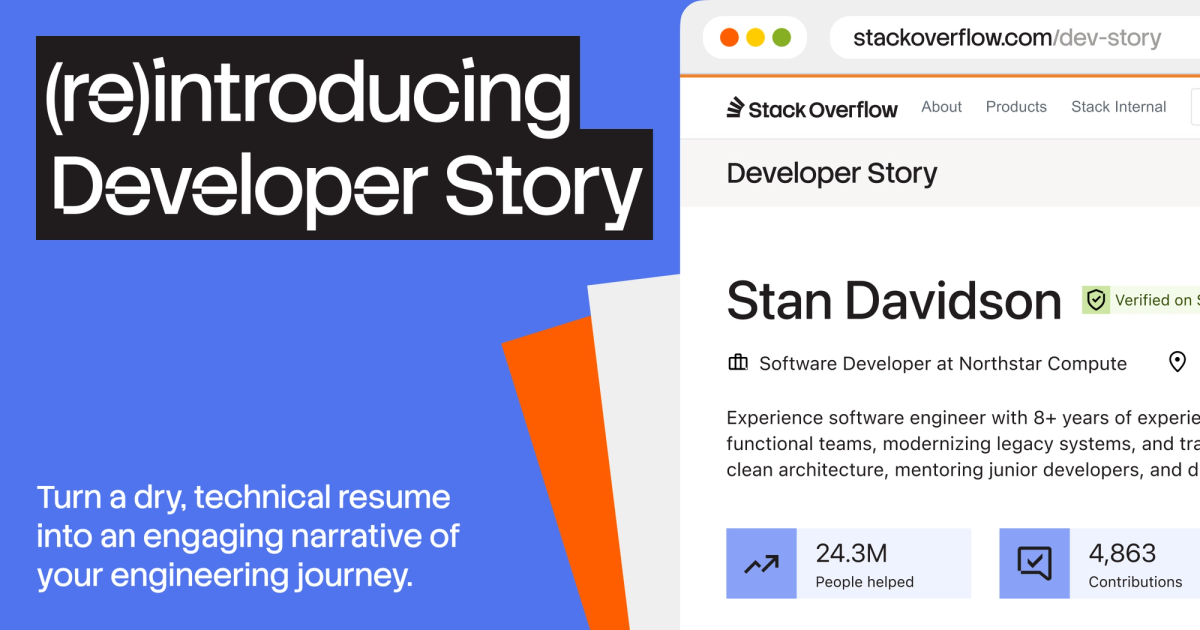
Beyond the Resume Noise: Developer Story Rethinks Tech Hiring
Stack Overflow is addressing the growing challenges in tech hiring, exacerbated by AI's influence leading to untrustworthy and generic resumes. Their solution, the re-introduced Developer Story, offers a platform for developers to authentically showcase their work, expertise, and impact through verifiable contributions and personal projects. This aims to provide hiring teams with more objective insights and help genuine talent stand out in a crowded market.
Adding & Validating JSON-LD Structured Data in Next.js
When we build websites, we want them to be discoverable and accurately understood by search engines. This isn't just about keywords and meta descriptions anymore; it's about providing explicit, machine-readable context.

The maker of non-text AI model Jev valued at $7.5B just weeks after
TypeSafe AI, the creator of the non-text AI model Jev, has achieved a $7.5 billion valuation following a massive $870 million funding round led by Andreessen Horowitz. Launched just weeks ago, Jev quickly went viral, attracting a third of Fortune 500 companies with its unique approach to automation that is faster and more efficient than traditional LLMs.