
US Navy Drone Landing Software: Autonomous Ops Game-Changer
Quick Verdict The US Navy's groundbreaking new software for autonomous drone landings on moving ships, leveraging only onboard cameras and motion sensors, is nothing short of a game-changer. By completely removing
Quick Verdict
The US Navy's groundbreaking new software for autonomous drone landings on moving ships, leveraging only onboard cameras and motion sensors, is nothing short of a game-changer. By completely removing reliance on GPS, this technology directly addresses a critical vulnerability in modern warfare and promises to significantly enhance the resilience, cost-efficiency, and operational flexibility of uncrewed naval aircraft. While still progressing towards full operational testing, its implications for future maritime drone capabilities are immense.
Introduction: Navigating Beyond GPS
In an increasingly complex and contested maritime environment, the ability to operate independently of satellite navigation systems like GPS has become paramount. As the US Navy acutely notes, GPS is often "the first operational link an adversary attempts to sever." This pressing challenge has spurred the Naval Air Warfare Center Aircraft Division (NAWCAD) to develop and test innovative software designed to allow unpiloted aircraft to complete missions and recover aboard moving vessels even when satellite signals are unavailable or disrupted. This isn't just about convenience; it's about maintaining critical operational links in high-stakes scenarios.
The Technology Under the Hood: Vision-Based Autonomy
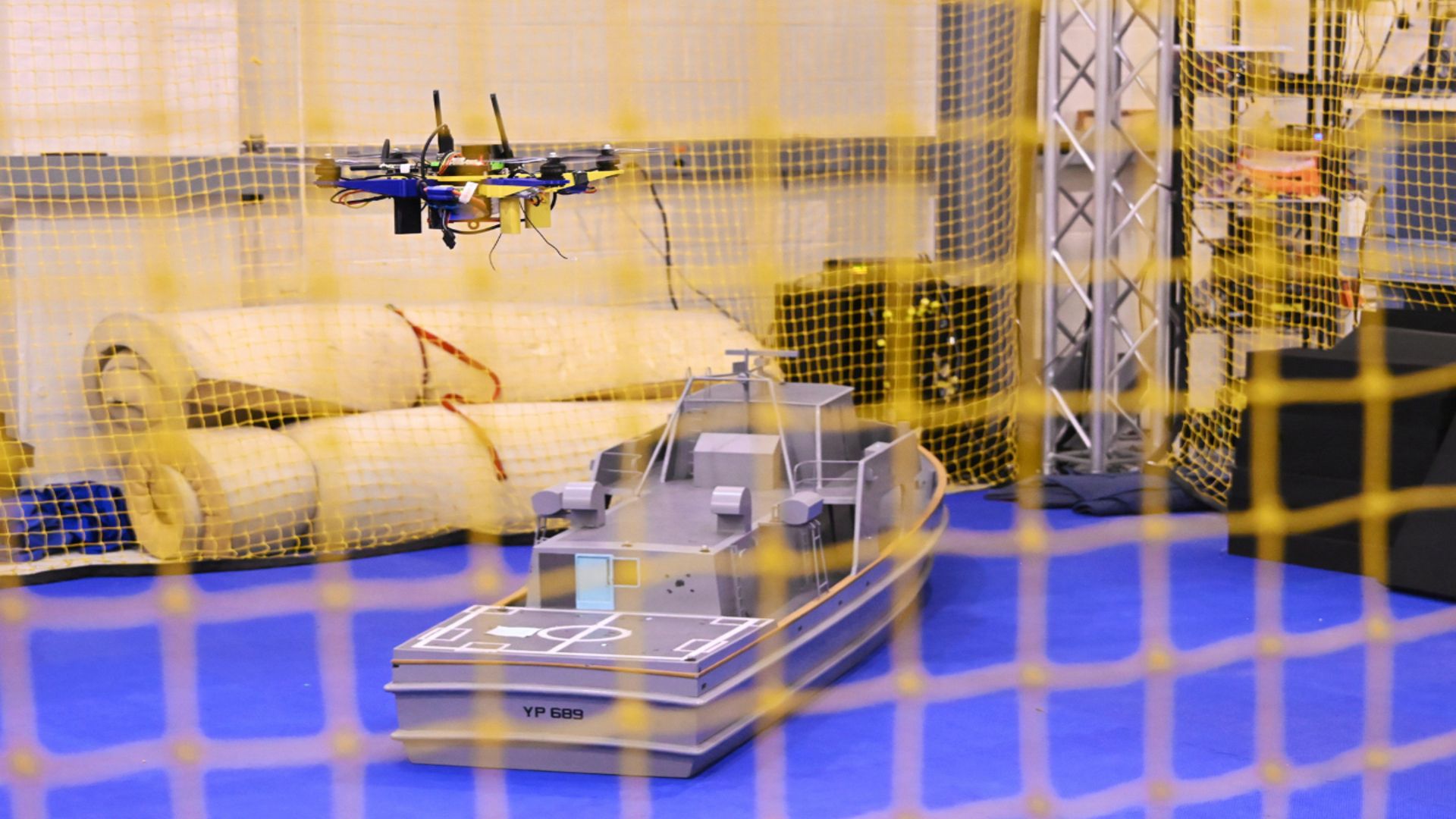
At the core of this impressive development is a sophisticated blend of existing drone hardware and advanced algorithmic intelligence. Instead of relying on external, often vulnerable, satellite signals, the system harnesses the drone's onboard cameras, motion sensors, and specialized algorithms. This suite of technologies works in concert to guide the uncrewed aircraft towards a moving ship, even one experiencing significant deck movement.
The software functions by meticulously analyzing the visual characteristics of the vessel through the drone's cameras. It then uses this visual data to calculate the ship's current position and anticipate its movements. Simultaneously, its algorithms estimate the ship's deck motion – the pitching and rolling inherent to a vessel at sea – allowing the drone to precisely coordinate its approach and touchdown. The beauty of this approach lies in its self-contained nature; all processing happens on the aircraft itself, making it inherently resistant to external jamming efforts. This internal processing of visual information through existing aircraft equipment marks a significant evolutionary step in autonomous drone recovery.
Why This is a Game-Changer: Unpacking the Pros
The benefits of this GPS-independent landing software are multifaceted and deeply impactful for naval operations:
-
Enhanced Operational Resilience: The most crucial advantage is the ability to operate in GPS-denied or contested environments. "In contested areas where satellites and communications are jammed, autonomy gives significant advantage to our sailors," highlights Rear Adm. Todd Evans, commander of NAWCAD. This ensures that valuable intelligence, surveillance, and reconnaissance (ISR) or combat support missions can continue without interruption, even under adversary electronic warfare attacks.
-
Significant Cost Efficiency: Traditional autonomous drone recovery systems often necessitate expensive, dedicated shipboard tracking hardware, additional landing equipment, and complex vessel modifications. NAWCAD reports that this new software could entirely eliminate the need for such specialized shipboard equipment. This translates directly into reduced procurement costs and simpler, more economical integration of drones across a wider range of naval vessels.
-
Simplified Vessel Integration: By offloading the complex tracking requirements from the ship to the drone's internal systems, the software inherently simplifies the integration process. Ships may no longer require extensive retrofits or specialized personnel to facilitate drone landings, making it easier to deploy and recover uncrewed aircraft from various maritime platforms.
-
Wider Applicability for Future Programs: This technology isn't designed for a single drone type but offers a flexible solution for numerous ongoing and future naval initiatives. It has potential applications for the Navy's Small Tactical Unmanned Aircraft Systems program, the Collaborative Combat Aircraft initiative, and the Defence Advanced Research Projects Agency's (DARPA) Early VTOL Aircraft Demonstration (EVADE) initiative, which seeks to enable vertical takeoff and landing from ship decks without conventional launch or recovery equipment.
Comparing to Previous Approaches
Historically, the US Navy's autonomous drone recovery operations relied on different, more hardware-intensive methods. For instance, the landmark 2006 landing of the RQ-8A Fire Scout aboard the USS Nashville utilized shipborne radar to establish the aircraft's relative position and guide its approach. This meant the ship itself needed dedicated radar systems and infrastructure to support the drone's landing.
The new software fundamentally shifts this paradigm. Instead of requiring external ship-based radar or dedicated tracking hardware to guide the drone, the drone itself becomes the primary sensor and navigator. It processes visual information internally, making it a self-sufficient entity for recovery. This eliminates the dependency on specialized, expensive shipboard equipment, streamlining operations and reducing the logistical footprint associated with drone deployments.
Challenges and The Path Ahead: What's Next?
While the demonstrations have proven the core concept, the technology is now moving towards its next critical phase: operational testing. This is where the capability transitions from controlled demonstrations to assessments using aircraft and equipment intended for actual fleet service. This stage will be crucial for confirming its performance under a wider array of real-world operational conditions, which can include varying weather, sea states, and flight profiles.
Furthermore, while the software's adaptability is a key strength, establishing compatibility and ensuring reliability across the diverse designs of individual uncrewed aircraft programs remains a vital step. The ultimate goal is a robust, universally applicable solution, and operational testing will be key to ironing out any platform-specific nuances.
Funded by the Naval Innovative Science and Engineering Program and the Office of Naval Research, this development underscores the Navy's proactive investment in future-proofing its autonomous capabilities.
Recommendation
From a technological standpoint, this new software represents a profound advancement in autonomous drone capabilities. Its ability to enable precise landings on moving ships without GPS is not merely an incremental improvement; it's a strategic imperative for modern naval forces. The potential for increased operational resilience in contested areas, coupled with significant cost savings and simplified integration, makes this a highly promising development.
For any defense force or tech enthusiast observing the evolution of autonomous systems, this technology is undoubtedly one to watch. Its successful transition to operational testing and subsequent fleet integration will mark a pivotal moment, ushering in an era of more robust, flexible, and independent uncrewed maritime operations.
FAQ
Q: What problem does this new software solve for the US Navy?
A: It solves the critical problem of GPS reliance in drone operations. Since GPS is a primary target for adversaries to sever in conflicts, this software allows drones to autonomously land on moving ships using only onboard cameras, ensuring continued operation even when satellite navigation is unavailable or jammed.
Q: How does the drone navigate and land on a moving ship without GPS?
A: The drone utilizes its onboard cameras, motion sensors, and specialized algorithms. These components work together to visually analyze the ship, calculate its movement in real-time, estimate the deck motion, and adjust the drone's approach for a precise and coordinated touchdown.
Q: Will this technology replace all existing drone landing equipment on Navy ships?
A: The software has the potential to eliminate the need for expensive shipboard tracking equipment during certain autonomous aircraft recovery operations, thus reducing procurement costs and simplifying vessel integration. However, full operational testing will confirm its broad applicability and compatibility across various aircraft and vessel types before widespread replacement of all legacy equipment.
Related articles

Nothing CMF Clip Pro Review: Open-Ear Awareness at a Steal
The Nothing CMF Clip Pro offers a unique open-ear listening experience, designed for situational awareness and comfort. Now $30 off at $69, it's an appealing option for those seeking spacious sound without sealing off the world.

Apple's Touchscreen MacBook Pro: A Long-Awaited Touch
The Verdict Apple's rumored touchscreen MacBook Pro represents a long-overdue evolution, promising to blend the convenience of direct screen interaction with the powerful macOS laptop experience. While not an essential

CMF Watch 3 Pro: Affordable Style Meets Solid Performance
CMF Watch 3 Pro: Affordable Style Meets Solid Performance In the crowded market of smartwatches, finding a device that balances features, design, and affordability can be a challenge. Enter the CMF Watch 3 Pro, a

Love Island Australia S8 Guide: Navigating the Stream, Mostly Free
Love Island Australia Season 8 Streaming Guide: Navigating the Digital Waters Verdict: TechRadar's guide to watching Love Island Australia Season 8 is a generally useful, if somewhat navigationally challenged, resource

Sculpture Re-creates Lycurgus Cup Effect: A Glimmering Triumph of Art
The University of Sheffield successfully re-creates the 1,600-year-old dichroic glass recipe of the Lycurgus Cup. A new sculpture by artist Elliott Walker displays the stunning green-to-red optical effect, blending ancient tech with modern art. A significant scientific and artistic achievement.

Nvidia Backs Indian Startup to Boost AI Efficiency with Fewer GPUs
Nvidia has backed Indian startup Simplismart in a $14 million Series B round. Simplismart's software helps companies run AI models efficiently, often requiring fewer GPUs, addressing the strain on computing capacity. This investment highlights a strategic focus on AI inference optimization.