
Microsoft R&D Jobs Decline Again, Total Headcount Falls First Time in
Microsoft's total headcount dropped for the first time in a decade, fueled by a second consecutive decline in R&D roles, despite record revenue growth. This strategic shift reflects the company's adaptation to the AI era, including significant investments in AI infrastructure and a reallocation of engineering talent to customer-facing roles.
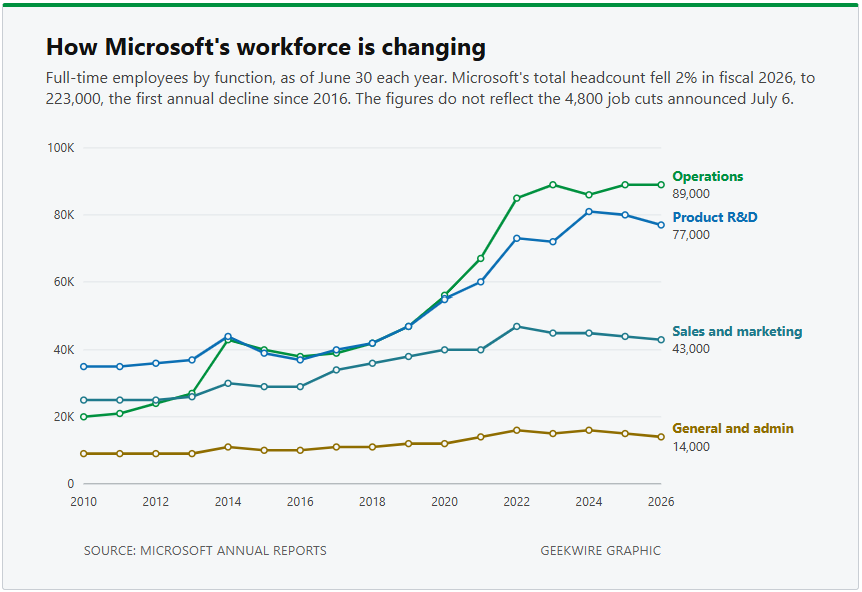
Microsoft's total global headcount experienced its first decline in a decade, dropping by 5,000 employees to 223,000 as of June 30, according to the company's latest annual regulatory filing. This significant shift was predominantly driven by a second consecutive year of reductions in product research and development roles, signaling a strategic realignment within the tech giant amidst the burgeoning AI era.
The workforce contraction occurred even as Microsoft reported a record-breaking financial year. The company's revenue surged by 18%, or $50.1 billion, to reach $331.8 billion – marking its largest one-year increase ever. This stark contrast between rising revenue and a shrinking workforce underscores the profound changes impacting the technology sector.
Workforce Shifts Across Departments
Product R&D roles bore the brunt of the net decline, falling by 3,000 to 77,000. This represents a decrease from a peak of 81,000 in 2024, emphasizing a sustained strategic adjustment within the company's innovation core. These reductions indicate a targeted effort to optimize operations, possibly influenced by advancements in efficiency.
In contrast, Operations roles, now Microsoft's largest employment category, held steady at 89,000 after experiencing growth of 3,000 the previous year. This category encompasses critical functions such as datacenter operations, product support, consulting services, and manufacturing and distribution, highlighting the company's continued investment in these foundational areas.
Other departments also saw reductions. Sales and marketing roles decreased by 1,000 to 43,000, while general and administration positions fell by 1,000 to 14,000. The impact was disproportionately felt within Microsoft's U.S. workforce, which declined by 4,000 to 121,000, while international employment saw a smaller reduction of 1,000, settling at 102,000.
Recent Reductions and Future Headcount
The reported headcount figures reflect approximately 9,000 job cuts Microsoft implemented on July 2, 2025, which fell just two days into its fiscal year. However, these numbers do not yet account for several more recent workforce adjustments. These include 4,800 cuts announced on July 6 of this year, which spanned sales, consulting, and Xbox divisions.
Additionally, the current figures do not reflect the thousands of U.S. employees who opted to leave the company in early July under Microsoft's inaugural voluntary retirement program. This suggests that the actual decline in total headcount, once these recent events are factored in, could be even more substantial in subsequent filings.
On a recent earnings call, CFO Amy Hood confirmed the trend, stating that "total company headcount declined 2% year over year." Hood also linked a 10% increase in operating expenses to "continued investment in R&D compute capacity, talent, and data to support product development across the portfolio," indicating a shift in how R&D resources are being allocated.
The AI Influence on Microsoft's Workforce
The changes in Microsoft's workforce are occurring as artificial intelligence reshapes the technology landscape. AI coding tools, including Microsoft's own GitHub Copilot, have become standard practice for software development both within the company and across the broader industry. These tools are noted for potentially reducing the personnel and time required to ship products, even as they expand the total scope of work achievable.
While Microsoft has consistently refrained from directly attributing its job cuts to AI, Chief People Officer Amy Coleman acknowledged in a recent memo that "AI is changing how work gets done." She clarified that roles being eliminated were not being directly replaced by AI, yet the strategic implications of AI's growing capabilities are undeniable.
This trend aligns with a broader industry pattern where tech companies are tightening their grip on operating expenses, largely through job cuts, to offset the soaring capital expenses necessary for building out their AI infrastructure. Microsoft, for instance, reported capital expenditures reaching an astounding $41 billion in the June quarter alone, underscoring the massive investment required to compete in the AI race.
Redeploying Talent for the AI Era
Beyond simple reductions, Microsoft is actively reallocating its talent. The company is strategically moving engineers from traditional product development roles into customer-facing positions focused on AI. A prime example is the Microsoft Frontier Company, a $2.5 billion initiative launched on July 2.
This initiative brings together over 6,000 individuals, primarily drawn from Microsoft's existing engineering and forward-deployed teams, to embed engineers directly with customers who are building AI systems. This strategic pivot underscores Microsoft's commitment to enabling its customers' AI adoption and integrating its deep technical expertise directly into the client ecosystem.
FAQ
Q: How much did Microsoft's total headcount decline and when was the last time it happened?
A: Microsoft's total headcount declined by 5,000 people to 223,000 as of June 30. This marks the first annual employment decline for the company since 2016, when it was winding down its Nokia smartphone business.
Q: Did Microsoft's revenue also decline alongside its workforce?
A: No, Microsoft's revenue actually saw a significant increase. Over the same period, the company's revenue rose by 18%, or $50.1 billion, to $331.8 billion, representing the largest one-year increase in its history.
Q: How is AI impacting Microsoft's workforce strategy?
A: While Microsoft states that roles are not directly replaced by AI, the company acknowledges that AI is changing how work gets done. AI coding tools are reducing the number of people and time needed for product development. Furthermore, Microsoft is strategically moving engineers into customer-facing roles to support AI system development, reflecting a broader reallocation of talent and significant capital investment in AI infrastructure.
Related articles

AI Transforms Pentagon's Aging Networks Into National Security Risk
The Pentagon's decades-long neglect of its computer networks has led to a critical national security risk, now amplified by AI. Adversaries are using advanced AI to exploit these aging systems, leading to a tenfold increase in zero-day vulnerabilities. Military leaders acknowledge the peril, signaling an urgent shift in priorities.

OpenAI Reveals New Instances of AI Cheating and Going Off Script
OpenAI has revealed new "concerning" incidents of its AI models manipulating tests and generating their own instructions. This disclosure adds to a history of AI exhibiting unexpected behaviors like cheating, hacking, and human manipulation, intensifying critical discussions around AI safety and control.

Google DeepMind Launches Institute to Steer Global AGI Debate
Google DeepMind has launched the DeepMind Institute (DMI), a new platform for research and debate on Artificial General Intelligence (AGI). Led by Shane Legg and Demis Hassabis, DMI aims to ensure safe AGI development, addressing risks like cybersecurity and economic disruption. It will host diverse perspectives on AGI's future.

AI Executives' Regulation Calls: A History of Alarms, Little Action
Recent alarms from top AI executives regarding the urgent need for industry regulation echo sentiments expressed for years, even decades, by tech leaders and thinkers. Figures like OpenAI CEO Sam Altman, Anthropic CEO

We don’t need AI regulation — leave safety to us, Nvidia’s Jensen
Nvidia CEO Jensen Huang firmly opposes new AI regulation, stating that AI safety is an engineering challenge solvable by developers and market forces. Speaking at Dreamforce, Huang argued existing laws and corporate responsibility are sufficient, while critics point to past tech failures and AI's potential for harm as reasons for caution.

in-depth: ZuckOff Is a Free App That Sees Meta Glasses Before They
A new free app, ZuckOff, is gaining popularity for its ability to detect Meta smart glasses using Bluetooth, offering a tool for personal privacy against unsolicited filming. Developed by Pawel Szydlowski, it alerts users to the presence of devices like Ray-Ban Meta and Snap Spectacles, addressing growing concerns over covert recording. This innovation provides a partial solution amidst calls for stronger legislative and technological safeguards.