
Mastering Full-Stack Deployment: Secure, Automate, Go Live
This article highlights a comprehensive freeCodeCamp.org course on deploying, securing, and automating full-stack web applications. It covers crucial steps from server provisioning and foundational security with UFW and Fail2Ban, to application runtime setup, data management, global access via Nginx and Cloudflare, and robust CI/CD pipelines with GitHub Actions. The course emphasizes a hands-on approach, integrating continuous security testing and observability, culminating in a production-ready application.
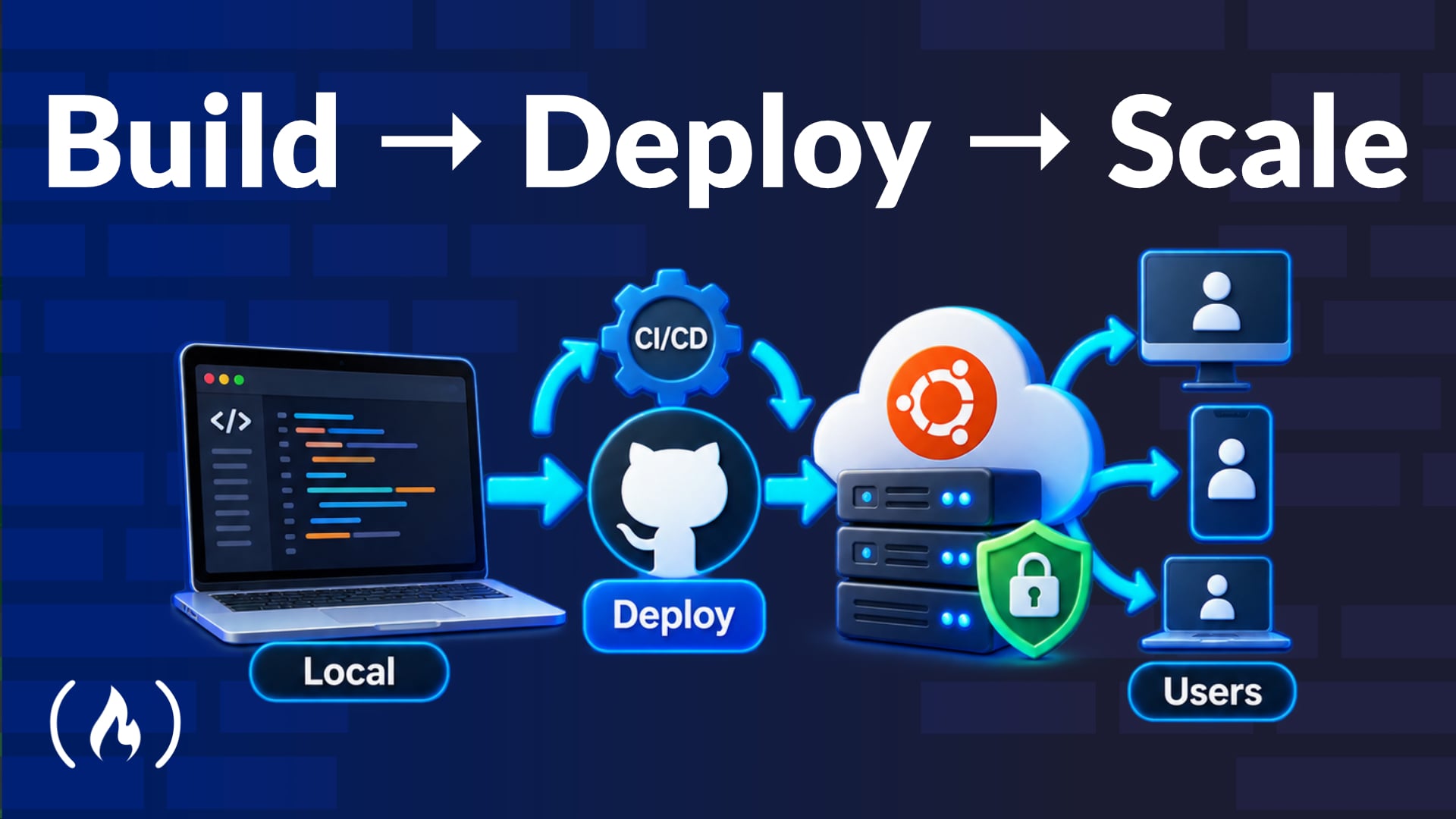
Taking a web application from local development to a live, secure, and production-ready environment is often a significant hurdle for many developers. While building features is engaging, the intricacies of infrastructure, security, and automation can feel like an entirely different discipline. Understanding how to confidently deploy, maintain, and scale your applications is a crucial skill that transforms a working prototype into a robust service accessible to users worldwide.
FreeCodeCamp.org recently published a comprehensive, hands-on course designed to demystify this process. Developed by Imad Saddik, this 11-hour deep dive is not just about showing you tools; it’s about building a foundational understanding by first tackling manual deployment steps, and then layering on powerful automation. This approach ensures you grasp the 'why' before diving into the 'how' of complex systems.
Building a Secure Foundation: Infrastructure and Core Security
The journey begins with establishing a solid, secure foundation for your application. The course guides you through provisioning an Ubuntu server, a common choice for web applications. Security is paramount from day one, emphasizing robust SSH key authentication. This initial setup includes vital steps like completely disabling less secure password logins and restricting root access, significantly hardening your server against unauthorized entry. Beyond access control, you'll learn to configure the Uncomplicated Firewall (UFW) to precisely control network traffic, blocking unneeded ports. To combat brute-force attacks, the course introduces Fail2Ban, an essential tool that automatically identifies and bans malicious IP addresses attempting to gain access.
Application Runtimes and Data Management
Once the server infrastructure is secure, the focus shifts to preparing the environment for your application. The course covers the installation of essential application runtimes like Python and Node.js, catering to various full-stack architectures. For servers with limited resources, a practical lesson on configuring swap memory is included, ensuring your application remains stable under heavier loads. Process management is crucial for keeping your applications running reliably; you'll learn to set up Gunicorn for Python applications and Supervisor for managing background processes, ensuring they restart automatically and stay operational.
Beyond the application, managing data efficiently and securely is vital. The course demonstrates how to self-host a lightweight Meilisearch instance for powerful search capabilities. Critically, it emphasizes isolating this service with a dedicated system user, adhering to the principle of least privilege. Data integrity is addressed through automating daily database snapshots, providing a crucial recovery point in case of unforeseen issues.
Global Access, Performance, and SSL
Making your application accessible globally involves several key steps. The course covers mapping custom domains using DNS records, connecting your server to its public identity. Essential for user trust and data security, you'll learn to secure all connections with free SSL certificates from Let's Encrypt. Nginx is then configured as a powerful reverse proxy, handling incoming requests, directing them to the correct application processes, and often serving static assets more efficiently. To further enhance performance and resilience, the course explores leveraging Cloudflare's Content Delivery Network (CDN) for edge caching, distributing your content closer to your users and protecting against various online threats.
Elevating Efficiency with CI/CD Automation
While understanding manual deployment is crucial, true production readiness comes with automation. The course dedicates significant time to Continuous Integration/Continuous Deployment (CI/CD) pipelines using GitHub Actions. You'll build workflows that automate critical development steps: linting code for style consistency, formatting to maintain readability, and running unit tests to catch regressions early. A particularly valuable aspect is the implementation of atomic virtual environment rollbacks, allowing for safe deployments and quick reversion to previous stable states if issues arise.
Integrating Continuous Security
Security isn't a one-time setup; it's an ongoing process. The course integrates continuous security practices directly into your pipeline. This includes Software Composition Analysis (SCA) to identify vulnerabilities in third-party libraries, Static Application Security Testing (SAST) with tools like Bandit for analyzing your codebase for common security flaws, and Dynamic Application Security Testing (DAST) using OWASP ZAP to find vulnerabilities in your running application. These integrations ensure that security checks are an intrinsic part of your development and deployment lifecycle.
Observability and Monitoring for Production
Finally, maintaining a healthy production environment requires constant vigilance. The course introduces tools for observability. You'll learn to monitor critical server resources like CPU and memory usage, as well as orphaned processes, using tools like Btop. Furthermore, it covers parsing Nginx access logs in real-time with GoAccess. This allows you to quickly detect unusual activity, identify potential issues, and even block malicious bot traffic, providing immediate insights into your application's operational status and user interactions.
By the culmination of this extensive course, you will have taken a full-stack Vue.js and FastAPI application through the entire journey: from manual, hands-on deployment to a fully automated, secure, and production-ready pipeline. This comprehensive approach ensures not just theoretical knowledge, but practical experience in the critical aspects of modern web application deployment.
You can access this in-depth course on the freeCodeCamp.org YouTube channel, offering 11 hours of invaluable learning.
FAQ
Q: Why does the course emphasize manual deployment steps before introducing CI/CD automation?
A: The course adopts a hands-on, ground-up approach. By performing deployment tasks manually first, developers gain a deep foundational understanding of how complex systems are hosted, secured, and maintained. This knowledge is crucial for troubleshooting automated pipelines and understanding the underlying mechanisms that CI/CD abstracts.
Q: What is the primary role of Nginx in the full-stack deployment covered in the course?
A: Nginx serves multiple critical functions. Primarily, it acts as a reverse proxy, directing incoming web requests to the appropriate application backend (like Gunicorn for FastAPI). It also handles SSL termination using Let's Encrypt certificates, offloading encryption tasks from the application server, and can efficiently serve static assets, improving overall application performance.
Q: How does the course ensure continuous security beyond initial setup?
A: The course integrates security directly into the CI/CD pipeline. This includes Software Composition Analysis (SCA) to scan for vulnerable dependencies, Static Application Security Testing (SAST) with Bandit to analyze custom code for common flaws, and Dynamic Application Security Testing (DAST) using OWASP ZAP to test the running application for vulnerabilities. This continuous integration of security tools ensures ongoing protection throughout the development lifecycle.
Related articles
Community Fibre 8.5Gbps: UK's Fastest, But Pricey Fibre
Quick Verdict Community Fibre has just launched the UK's fastest residential internet connection, boasting an incredible 8.5Gbps (8,200Mbps) symmetrical full fibre service. It's a technical marvel, delivering speeds
Ordewell: Orchestrating AI Coding Agents for Structured Development
Ordewell is an orchestration tool for AI coding agents that transforms a single development goal into an ordered, dependency-aware plan of tasks. Each task specifies its runner, model, thinking effort, and mode, allowing for granular control. It verifies results based on evidence rather than opinion, and offers CLI, VS Code, and web interfaces, along with an extensible skill system.

Maximize Your Sharge Disk Pro 2: Setup, Storage & Hub Features
Learn how to set up, install an SSD, and utilize all features of your Sharge Disk Pro 2, including its HDMI output, card readers, and power delivery, in this comprehensive guide.

Gates Foundation Pledges $1B to Leverage AI for Global Impact
The Gates Foundation is investing at least $1 billion over the next two years into artificial intelligence tools for global health, agriculture, and education, primarily targeting the poorest countries. This initiative aims to accelerate progress against disease and poverty, though CEO Mark Suzman clarifies that AI cannot replace vital government funding cuts to global health services. The foundation emphasizes AI's potential as an equalizer, but stresses the importance of equitable development and deployment.

Apple Home’s new security camera features cost as much as $60 a
Apple's new AI-powered security camera features for HomeKit Secure Video come with a hefty price tag, reaching up to $60 a month. These Apple Intelligence enhancements offer video summaries and advanced search but require higher-tier iCloud Plus subscriptions, a significant increase from the previous $1 monthly entry cost.

How to Grab the Bissell Cordless Stick Vacuum for $100 Off
Learn how to get the Bissell PowerClean DualBrush Cordless Stick Vacuum for $100 off. This guide details features, benefits, limitations, and provides sequential steps to secure this deal, ensuring you make an informed purchase.