
Lisette: Rust-like Syntax, Go Runtime — Bridging Safety and
Lisette is a new language inspired by Rust's syntax and type system, but designed to compile directly to Go. It aims to combine Rust's compile-time safety features—like exhaustive pattern matching, no nil, and strong error handling—with Go's efficient runtime and extensive ecosystem. This approach allows developers to write safer, more expressive code while seamlessly leveraging existing Go tools and libraries.
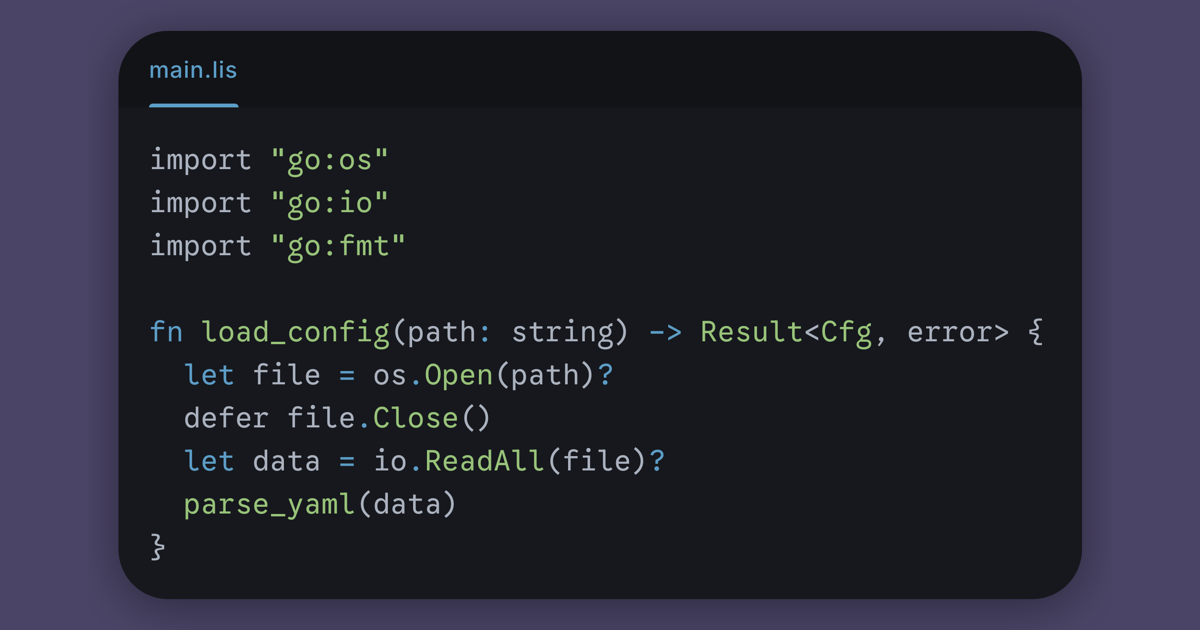
For many developers, the elegance of Rust's type system and the productivity of Go's runtime represent a compelling, yet often disparate, set of benefits. Lisette, a new "little language," aims to bridge this gap by offering a Rust-inspired syntax that compiles directly to Go. This approach promises to deliver enhanced compile-time safety and ergonomic features while leveraging Go's robust runtime, concurrency model, and vast ecosystem.
The Motivation: Addressing Go's Compile-Time Gaps
Go has become a cornerstone for backend services due to its simplicity, performance, and excellent concurrency primitives. However, developers occasionally encounter runtime issues that a stronger type system could catch earlier. Common pain points include nil pointer dereferences, unhandled error results, and non-exhaustive switch statements. Lisette steps in here, aiming to bring the kind of compile-time assurances often associated with languages like Rust, but without requiring a complete shift from the Go ecosystem.
By compiling to Go, Lisette allows developers to continue building on their existing Go projects, interoperate with Go libraries, and deploy applications using familiar Go tooling. It's an incremental step towards a safer, more expressive development experience within the Go landscape.
Familiarity for Rust & Go Developers Alike
Lisette's syntax draws heavily from Rust, making it immediately familiar to those accustomed to modern systems languages. This includes core features like:
- Algebraic Data Types (Enums) & Pattern Matching: Enums allow defining types with several variants, which can carry associated data. Pattern matching provides an exhaustive way to handle these variants, ensuring all cases are covered at compile time.
lisette enum Message { Ready, Write(string), Move { x: int, y: int }, }
fn handle(msg: Message) -> string { match msg { Message.Ready => "ready", Message.Write(text) => f"wrote: {text}", Message.Move { x, y } => f"move to ({x}, {y})", } }
- Structs &
implBlocks: Similar to Rust, structs define data structures, andimplblocks are used to associate methods with these structs.
lisette import "go:math" struct Point { x: float64, y: float64, }
impl Point { fn distance(self, other: Point) -> float64 { let (dx, dy) = (self.x - other.x, self.y - other.y) math.Sqrt(dxdx + dydy) } }
- Expression-Oriented Programming: Lisette treats many constructs, like
ifstatements and blocks, as expressions that evaluate to a value, promoting a more functional style. - Chaining and Lambdas: The language supports method chaining on
OptionandResulttypes, combined with anonymous functions (lambdas), for concise data transformations. - Interfaces & Generics: Lisette incorporates interfaces for polymorphic behavior and generics for writing type-agnostic functions, mirroring concepts familiar in both Go and Rust.
if let&let else: These constructs provide ergonomic ways to destructure and conditionally bind values fromOptionorResulttypes, offering clean error handling and value extraction.
Prioritizing Compile-Time Safety
One of Lisette's most compelling features is its ability to catch common Go runtime issues during compilation. This includes:
- Exhaustive Pattern Matching: The compiler ensures that
matchstatements cover all possible variants of an enum, preventing logic errors from unhandled cases. - No Nil: Lisette eradicates
nilvalues. Absence is explicitly encoded using theOption<T>type, forcing developers to handle bothSomeandNonecases. - Result Handling: The compiler warns if a
Resulttype, representing an operation that can succeed or fail, is silently discarded. This encourages explicit error handling. - Visibility Checks: It prevents private types from being exposed in public APIs, enforcing encapsulation.
- Immutability by Default: Bindings are immutable unless explicitly declared with
let mut, helping to prevent unintended side effects. - Struct Field Initialization: The compiler ensures that all fields of a struct are initialized when an instance is created.
Enhancing Ergonomics for Go Development
Lisette isn't just about safety; it also introduces features designed to improve developer experience, especially when interacting with Go:
- Pipeline Operator (
|>): This operator simplifies method chaining, making code flow more readable by passing the result of one function as the first argument to the next.
lisette import "go:strings" fn slugify(input: string) -> string { input |> strings.TrimSpace |> strings.ToLower |> strings.ReplaceAll(" ", "-") }
slugify(" Hello World ") // => "hello-world"
- Try Blocks: For operations that return
Resulttypes,tryblocks allow for concise error propagation (?operator) within a scope, consolidating error handling. - Concurrency with
taskandselect: Lisette integrates with Go's concurrency model throughtaskfor goroutines andselectfor non-blocking channel operations, making concurrent programming intuitive. - Serialization Attributes: It provides attributes (e.g.,
#[json(...)],#[tag(...)]) for seamless interoperability with Go'sencoding/jsonand other serialization libraries, allowing for custom field names, omission, and tagging. - Panic Recovery: Lisette offers a
recoverblock to safely convert Go panics intoResulttypes, allowing for graceful error handling instead of program crashes. - Deferral: The
deferkeyword, familiar to Go developers, ensures that resources are released or cleanup actions are performed when a function exits, regardless of how it returns.
Transparent Compilation to Understandable Go
A key aspect of Lisette is its commitment to transparent compilation. The generated Go code is designed to be readable and understandable, which is crucial for debugging, auditing, and integrating with existing Go projects. For instance, Lisette's sophisticated pattern matching for Option types compiles down to straightforward Go if statements and struct field accesses.
Lisette Code: lisette fn classify(opt: Option<int>) -> string { match opt { Some(x) if x > 0 => "positive", Some(x) if x < 0 => "negative", Some(_) => "zero", None => "none", } }
Compiled Go Code: go func classify(opt lisette.Option[int]) string { if opt.Tag == lisette.OptionSome { x := opt.SomeVal if x > 0 { return "positive" } if x < 0 { return "negative" } return "zero" } return "none" }
Similarly, the ? operator for Result types translates into idiomatic Go error checking with early returns.
Lisette Code: lisette fn combine() -> Result<int, string> { let x = first()? let y = second()? Ok(x + y) }
Compiled Go Code: go func combine() lisette.Result[int, string] { check_1 := first() if check_1.Tag != lisette.ResultOk { return lisette.MakeResultErrint, string } x := check_1.OkVal check_2 := second() if check_2.Tag != lisette.ResultOk { return lisette.MakeResultErrint, string } y := check_2.OkVal return lisette.MakeResultOk[int, string](x + y) }
This level of transparency means developers aren't working with an opaque black box but with a language that generates understandable, maintainable Go code.
Practical Takeaways
Lisette presents an exciting option for developers who appreciate Rust's strong type system and safety guarantees but need to leverage Go's runtime and ecosystem. It offers a path to writing more robust Go applications with fewer runtime surprises, all while maintaining a familiar development workflow. If you're building services in Go and have felt the desire for stronger compile-time checks and more expressive language features, Lisette is definitely worth exploring. Its interoperability and transparent compilation make it a pragmatic choice for incrementally enhancing existing Go projects.
FAQ
Q: How does Lisette achieve interoperability with existing Go packages?
A: Lisette supports import "go:pkg_name" syntax, allowing direct access to Go packages. This means you can call Go functions, use Go types, and integrate seamlessly with the vast Go ecosystem directly from Lisette code.
Q: Does Lisette introduce a new runtime or garbage collector?
A: No, Lisette compiles directly to Go code. This means it leverages Go's existing runtime, including its garbage collector and concurrency model (goroutines and channels). There is no separate runtime overhead introduced by Lisette itself.
Q: What is the primary benefit of Lisette's Hindley-Milner type system compared to Go's type system?
A: Lisette's Hindley-Milner type system provides advanced type inference and algebraic data types (enums with pattern matching), which enable stronger compile-time checks, such as exhaustive match checking and explicit handling of optional values (Option<T>) rather than nil. This reduces the likelihood of entire classes of runtime errors commonly found in languages with simpler type systems.
Related articles

AI's Confidence vs. Formal Methods' Rigor: Design Flaws & Verification
While AI accelerates code generation, formal methods remain critical for ensuring system correctness. Languages like TLA+ and tools like Quint enable developers to model and verify system designs before coding, catching subtle flaws. Quint makes formal methods more accessible with developer-friendly syntax and executability. This approach is vital for verifying AI-generated code through trace validation and model-based testing, ensuring reliability against real-world data.

Ephemeral PR Preview Environments on GKE: A Deep Dive
Every development team eventually grapples with the limitations of shared staging environments. The familiar scenario: multiple features deployed simultaneously, database migrations clashing, and the phrase "it works on

Secure Internal API Access for AI Agents with MCP
AI agents accessing internal APIs directly pose significant risks, including identity loss, unrestricted queries, and security bypasses. The Model Context Protocol (MCP) offers a solution by defining explicit tools. A secure architecture involves an MCP server wrapping the API with strict input validation, coupled with a gateway that handles authentication, rate limiting, and audit logging, ensuring safe and accountable access.

Microsoft president says UK is best placed to drive AI regulation
Microsoft President Brad Smith is advocating for urgent, legally binding AI regulation, arguing that current oversight lags behind basic consumer products. He highlights the UK's AI Security Institute (AISI) and its unique geopolitical position as ideal for leading global safety rules, despite recent US pushback. Smith proposes measures like breach reporting and "kill switches," rejecting voluntary agreements as insufficient.
Beyond the Resume Noise: Developer Story Rethinks Tech Hiring
Stack Overflow is addressing the growing challenges in tech hiring, exacerbated by AI's influence leading to untrustworthy and generic resumes. Their solution, the re-introduced Developer Story, offers a platform for developers to authentically showcase their work, expertise, and impact through verifiable contributions and personal projects. This aims to provide hiring teams with more objective insights and help genuine talent stand out in a crowded market.
Adding & Validating JSON-LD Structured Data in Next.js
When we build websites, we want them to be discoverable and accurately understood by search engines. This isn't just about keywords and meta descriptions anymore; it's about providing explicit, machine-readable context.