
industry: IBM's $40B stock wipeout is built on a misconception:
IBM experienced a $40 billion stock drop after Anthropic unveiled AI tools for COBOL translation. However, industry experts and IBM argue that this reaction stems from a misunderstanding: translating COBOL code is distinct from comprehensive mainframe modernization, which involves complex architectural redesign and ensuring critical system reliability. Enterprises are advised to approach new AI tools with caution, conducting pilots to assess actual ROI for modernization efforts.
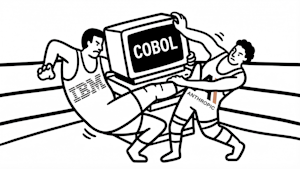
IBM's $40B stock wipeout is built on a misconception: Translating COBOL isn't the same as modernizing it
Key takeaways
- Anthropic's new AI tools for COBOL translation led to a swift $40 billion drop in IBM's market capitalization, perceived as an existential threat to its mainframe business.
- Industry analysts and IBM itself argue that the market reaction is based on a fundamental misconception: mere COBOL code translation does not equate to full mainframe application modernization.
- Mainframes offer unique determinism, scalable compute, and reliability that general-purpose servers and cloud environments often cannot match for mission-critical enterprise workloads.
- Comprehensive modernization involves extensive data architecture redesign, runtime replacement, ensuring transaction processing integrity, and leveraging decades of hardware-software coupling.
- Enterprises should approach new AI translation tools cautiously, running bounded pilots to measure outcomes and integrating AI as an accelerator within disciplined modernization programs, rather than a magic conversion solution.
What happened
On Tuesday, Anthropic launched new tools allowing its Claude AI to read, analyze, and translate legacy COBOL code into modern programming languages such as Java and Python. This announcement triggered a significant market reaction, resulting in investors wiping approximately $40 billion from IBM's market capitalization by the end of the trading day. This marked IBM's largest single-day stock drop in 25 years, largely driven by the perception that Anthropic's new capabilities posed an existential threat to IBM's long-standing mainframe business.
Why it matters
The swift market downturn for IBM highlights a fundamental misreading of why many enterprises continue to rely on mainframes. COBOL, a language designed in 1959, remains critical, powering an estimated 250 billion lines of code in active production for transaction processing systems. While the retirement of experienced COBOL engineers has created a costly skills gap, which IBM has been addressing with its own AI tools like watsonx Code Assistant for Z since 2023, the actual barrier to modernization has rarely been purely technical.
According to Gartner analyst Matt Brasier, "Modernizing COBOL has been a technically solved problem for a while... The real problem is that the costs of modernization are high and the ROI is low." Steve McDowell, chief analyst at NAND Research, further emphasized that applications run on mainframes not because of COBOL, but "because mainframes deliver a class of determinism, scalable compute and reliability that general purpose servers can't match." This distinction underscores that merely translating COBOL code does not resolve the deeper architectural and operational advantages of mainframe systems.
Key details / context
IBM communications director Steven Tomasco clarified IBM's position, stating that "Translating COBOL is the easy part." The true complexity lies in "data architecture redesign, runtime replacement, transaction processing integrity, and hardware-accelerated performance built over decades of tight software and hardware coupling." IBM's watsonx Code Assistant for Z aims to accelerate this modernization process for clients like Royal Bank of Canada, the National Organization for Social Insurance, and ANZ Bank, allowing them to modernize COBOL without migrating off the IBM Z platform.
While Amazon (AWS Transform) and Google Cloud Platform have offered AI-powered COBOL migration tools for years, Anthropic's Claude Code enters a competitive landscape. Its utility is particularly relevant for enterprises running COBOL on distributed platforms like Windows and Linux, where IBM's vertical integration offers less of an advantage. However, for mainframe-specific COBOL, McDowell notes that IBM's deep understanding of its own technology gives its watsonx tool a distinct edge. Analyst Matt Brasier also cautions that while GenAI tools are helpful, their non-deterministic nature can lead to inconsistent code, which doesn't solve the fundamental ROI challenge of modernization.
What happens next
Senior data and infrastructure engineers are expected to field numerous questions from executives who may have misinterpreted the recent headlines. Experts advise against making emotional or sudden strategic changes. Raj Joshi, senior vice president at Moody's Ratings, noted, "It's not like you transform millions of lines and somehow you are ready to go to cloud. It's a massive risk assessment, dependencies and all those things."
Chirag Mehta, analyst at Constellation Research, suggests that IT leaders should "treat this as a reason to run a small, bounded pilot to measure outcomes, not as a reason to rip and replace vendors." He recommends evaluating new tools through specific application slices or workflows, focusing on metrics like dependency mapping quality, recovered business logic, test coverage, performance, and reliability.
The broader takeaway is that modernization extends far beyond code conversion. It fundamentally involves extracting institutional knowledge, re-working processes and controls, managing change, and meticulously containing operational risk in systems that cannot fail. Mehta concludes that "The teams that win will treat AI as an accelerator inside a disciplined modernization program, with measurable checkpoints and risk guardrails, not as a magic conversion button." While Anthropic's tool may capture some business, its impact on IBM's core mainframe revenue is anticipated to be marginal.
Related articles

Ars Technica's Rocket Report: Your Essential Space Industry Briefing
Quick Verdict Ars Technica's Rocket Report, presented by veteran space reporter Stephen Clark, offers an invaluable and meticulously organized weekly (or similar frequency, implied by "Edition 9.15") digest of the most

AI's Confidence vs. Formal Methods' Rigor: Design Flaws & Verification
While AI accelerates code generation, formal methods remain critical for ensuring system correctness. Languages like TLA+ and tools like Quint enable developers to model and verify system designs before coding, catching subtle flaws. Quint makes formal methods more accessible with developer-friendly syntax and executability. This approach is vital for verifying AI-generated code through trace validation and model-based testing, ensuring reliability against real-world data.

Amazon Prime Video Launches AI-Powered Prime 360 for NBA Coverage
Amazon Prime Video is elevating its NBA coverage with the introduction of Prime 360, an AI-powered replay system offering immersive, 'fly through' views of the action. Kicking off its second season, Prime Video also adds Yahoo fantasy integration and gains exclusive Eastern Conference Finals rights, expanding its tech-driven sports broadcast. The new features aim to deliver a unique and interactive viewing experience for basketball fans.

Kojima Compares Divisive New Film 'Digger' to MGS2's Prescient Vision
Gaming icon Hideo Kojima has praised the divisive 2026 film *Digger*, drawing intriguing parallels to his own prophetic game, *Metal Gear Solid 2*. Both works, he explains, uniquely explore the dangers of misinformation and a fragmented digital reality, anxieties he shares with *Digger*'s director, Alejandro González Iñárritu.
Secure Internal API Access for AI Agents with MCP
AI agents accessing internal APIs directly pose significant risks, including identity loss, unrestricted queries, and security bypasses. The Model Context Protocol (MCP) offers a solution by defining explicit tools. A secure architecture involves an MCP server wrapping the API with strict input validation, coupled with a gateway that handles authentication, rate limiting, and audit logging, ensuring safe and accountable access.

Flox Intelligence Harnesses AI to Safeguard Wildlife and
Flox Intelligence, a KTH spin-off and TechCrunch Disrupt finalist, is deploying AI-powered edge devices to deter wildlife from critical infrastructure like railways and airports. The system identifies animals and uses species-specific sounds, learning and adapting to prevent costly collisions and delays. With 150 devices deployed globally and $5 million raised, Flox aims to scale significantly with a new Series A round.