
DeveloperWeek 2026: Building AI Tools That Truly Deliver Value
DeveloperWeek 2026 highlighted that for AI tools to be truly valuable, they need improved usability, deep contextual understanding, and robust interoperability. Key discussions centered on giving human developers more agency over AI outputs, integrating proprietary company knowledge into models, and designing agentic systems that can collaborate seamlessly across workflows.

DeveloperWeek 2026, though briefer than its name suggests, was a focal point for exploring the cutting edge of developer tooling and workflows. Amidst the discussions of achieving 10x development, one overarching question permeated the San Jose Convention Center: are AI tools actually good? While AI promises efficiency and speed, many developers find themselves grappling with tools that, despite their potential, fall short in practical usability and trustworthiness. The conference highlighted key areas where AI needs to evolve to genuinely empower developers rather than burden them with rework.
Giving Developers Agency: Beyond the Black Box
One persistent challenge with current AI tools is their usability, often sacrificed for raw efficiency. As Caren Cioffi from Agenda Hero highlighted, many AI products are designed to be fast, but not necessarily easy to use. Take image generation, for example: an AI might produce an "almost right" image, but attempts to fine-tune it often lead to worse results because the process is a non-deterministic black box. Natural language prompts are the only interface, making nuanced adjustments frustratingly difficult.
This lack of control isn't just an annoyance for personal projects; it's a critical impediment for developers. When an AI suggests code or fixes a bug, needing to regenerate entire outputs for minor tweaks can feel less like assistance and more like a wild goose chase. Cioffi's solution is simple yet powerful: restore human agency. This means allowing users to edit small sections of AI output directly within the UI, rather than forcing full regeneration. When developers can make precise, direct adjustments, they feel in control. This enhanced usability is crucial for adoption, ensuring that AI tools genuinely accelerate work instead of introducing new forms of technical debt through constant rework.
The Power of Context: Curing AI's Knowledge Gap
"Context" was a resounding buzzword at DeveloperWeek 2026, underscoring a major roadblock in enterprise AI adoption. AI models, powerful as they are, are only as good as their training data. Most public datasets lack the specific nuances, architectural standards, and operational guidelines unique to an organization. This means an AI coding assistant, without proper context, might generate code that ignores company-wide conventions, leaving developers to clean up and refactor – a "janitorial job" that negates supposed productivity gains.
As Stack Overflow's Chief Product and Technology Officer, Jody Bailey, emphasized, context is the "master key" to unlocking AI's full potential. Without it, developers struggle to trust AI tools due to incorrect answers or inappropriate actions. The solution lies in feeding LLMs the proprietary knowledge that resides within an organization. This could involve using MCP (Managed Cloud Platform) servers to provide human-validated data, feeding bots meeting notes, or implementing guardrails with specific personas and specifications. Figma, for instance, is incorporating user-inputted brand kits and copy specs to contextualize its AI outputs. Akamai's Senior Director of Developer Relations, Lena Hall, succinctly stated, "Context is all you need." She advocated for integrating domain expertise during AI logic formation, viewing the problem not as a lack of model intelligence, but as an information design challenge. Solutions include advanced Retrieval Augmented Generation (RAG) and Application-to-Application (A2A) integrations, alongside validated data sources like Stack Internal.
Building Agentic Teams: Interoperability for True Automation
For AI to move beyond individual tasks to automate entire workflows, interoperability is paramount. IBM's Chief Architect for AI, Nazrul Islam, stressed that merely having millions of agents isn't enough; they must work together. Developers often want to offload mundane tasks like documentation and code review, but the real challenge arises in cross-departmental workflows where multiple teams must collaborate on unexciting tasks. Here, agentic systems could transform a mess of siloed tools into a cohesive AI strategy.
Achieving this "gold-medal relay baton pass" between agents – where a sales AI informs a finance AI, which then updates a customer success AI – is complex. It requires connecting distributed systems across SaaS, public cloud, and on-prem environments that were not originally designed to communicate. Islam highlighted the pitfalls to avoid: siloed work, vendor lock-in, and unstructured workflows that lead to context loss. His advice for organizations aiming for agentic teams includes:
- Inventory Capabilities: Identify existing APIs and events.
- Normalize Access: Standardize model access through MCP and A2A.
- Establish Governance: Create observable and auditable interaction rules.
- Map Journeys: Outline cross-system agent workflows.
- Build Teams: Structure your AI teams for collaboration.
Ideally, well-designed interoperability could even allow agents to "discover" each other, dynamically forming new pathways for automation and information sharing.
Beyond Code: The Evolving Role of Developers
For junior developers entering an AI-saturated job market, the path to a first job is changing. Coders Lab, a Romanian IT academy, illustrated that simply demonstrating coding ability is no longer sufficient when AI generators can produce competent code. The new imperative is to prove value beyond code.
Coders Lab addresses this by involving junior developers in actual client projects, mentored by senior engineers. This approach allows them to showcase technical prowess, hone critical soft skills like communication and collaboration, and gain invaluable real-world experience. The presence of bright-eyed students at the DeveloperWeek Hackathon and networking events underscored a growing awareness among the youngest generation of tech workers: physical presence, community engagement, and interpersonal skills offer a distinct advantage over purely algorithmic capabilities. DeveloperWeek 2026 ultimately validated that while AI tools are progressing, significant work remains to realize their full potential. This ongoing evolution ensures a continued and vital role for human developers in shaping the future of technology.
FAQ
Q: What is the primary issue with many current AI tools regarding usability? A: Many AI tools are optimized for speed and efficiency but lack mechanisms for granular human control and direct editing of outputs. Their non-deterministic, black-box nature, primarily relying on natural language prompts, makes precise corrections or nuanced adjustments difficult, often forcing users into repetitive regeneration cycles that reduce perceived productivity.
Q: How does "context" specifically address the problem of AI trust among developers? A: Developers often distrust AI due to incorrect or irrelevant outputs that waste time and require rework. By providing AI tools with specific company context – such as internal knowledge bases, architectural standards, or project-specific guidelines – the AI can generate more accurate, relevant, and trustworthy results that adhere to organizational nuances, thereby reducing errors and the need for human intervention to fix mistakes.
Q: What are some technical approaches mentioned for improving AI context and interoperability in enterprise settings? A: For context, advanced Retrieval Augmented Generation (RAG) is crucial, alongside Application-to-Application (A2A) integrations and feeding human-validated data via MCP (Managed Cloud Platform) servers. For interoperability, establishing a framework involves inventorying existing APIs and events, normalizing access across models, and implementing governance for observable and auditable interactions between distributed agentic systems.
Related articles
Android 17 QPR2 Beta 7.1: The Performance Relief You've Been Waiting
Android 17 QPR2 Beta 7.1: Finally Fixing the QPR1 Performance Woes Verdict: Android 17 QPR2 Beta 7.1 is a crucial and highly anticipated software update for Google Pixel users, specifically targeting and resolving the
"thegentlemanpervert": A Catastrophic Failure in Digital Ethics and
"thegentlemanpervert" review: An AI CSAM production and distribution operation, led by a NJ prosecutor, proved to be an absolute and catastrophic failure, resulting in felony charges and a stark warning about digital culpability.

in-depth: Katie Zacharia Was Linked to an AI Rare-Earths Startup
Katie Zacharia, former White House press secretary, denies an advisory role at AI-powered NRED Intelligent Mining, despite a press release announcing her appointment. This adds to her controversial past, as the company pivoted dramatically and its board notably lacks mining expertise.
regional: Etzioni on AI: The colorful and cranky language of the AI
AI researchers Oren Etzioni and Daniel S. Weld have released a new GeekWire glossary of over 35 non-technical AI terms, revealing a "cranky" vocabulary heavily focused on AI's problems and potential harms. They define terms like "AI slop," "deepfakes," and "brain rot," alongside their own coinages such as "AI slap," "promptatory," and "agentsomnia," noting a distinct lack of common phrases for AI's positive impacts.

Porsche’s electric Macan Turbo is an automotive existential crisis
Porsche's 2026 electric Macan Turbo challenges traditional sports car definitions, blending exhilarating 630-hp performance with an anonymous crossover design. Tested on various roads, it raises questions about automotive identity in the EV era, proving that immense power can come in an understated package.
RapidCanvas Secures $29M Series B to Scale Enterprise AI Solutions
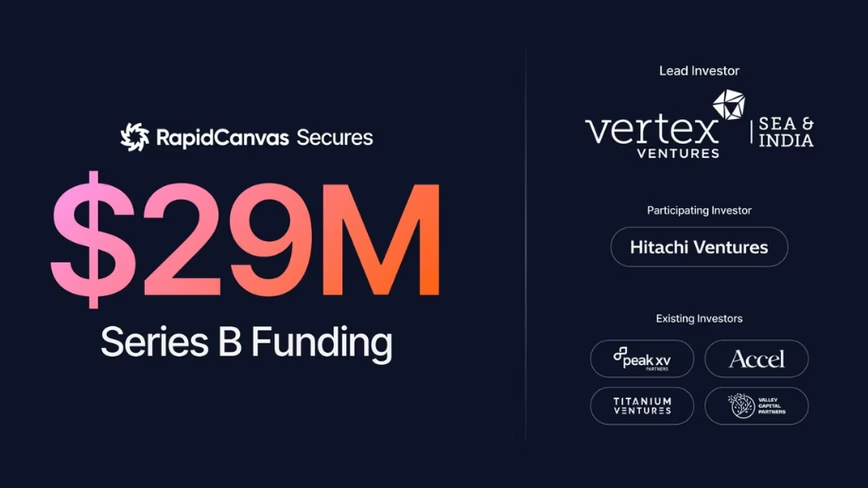
Austin, Texas – RapidCanvas, a burgeoning startup specializing in building and running custom AI applications for enterprises, has announced a successful close of its Series B funding round, raising $29 million. Led by