
Cutting Through the AI Hype: A Developer's Call for Reality
The AI landscape is currently awash with headlines, promises, and a pervasive sense of FOMO. From prophecies of job elimination to the notion that everyone needs an 'AI agent' they barely understand, the discourse often
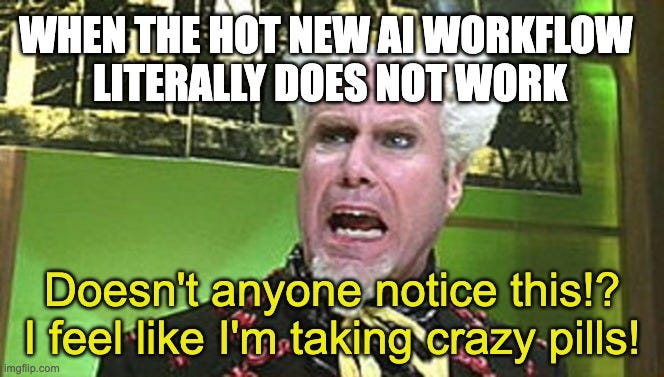
The AI landscape is currently awash with headlines, promises, and a pervasive sense of FOMO. From prophecies of job elimination to the notion that everyone needs an 'AI agent' they barely understand, the discourse often feels detached from practical reality. Many of us, working daily with AI, find ourselves asking: has everyone else truly cracked the code, or are we experiencing what can only be described as the 'AI Confidence Theater'?
This phenomenon, characterized by exaggerated claims and superficial boasts, is more than just annoying; it actively hinders genuine innovation and creates an exhausting environment for developers.
The Illusion of Effortless Expertise
Working at an AI company and using these tools extensively, it's common to feel that others have unlocked some secret, 'life-changing' AI potential. Yet, when challenged to demonstrate this impact, most showcase basic workflows: summarizing communications, drafting emails, or scheduling tasks. While useful, these rarely represent systems so critical that their absence would bring work to a halt.
This disconnect creates several problems:
Reality Distortion Stifles Innovation
When developers constantly hear about miraculous AI systems that supposedly replace entire teams, only to find the actual tools underperforming or requiring significant hand-holding, it breeds cynicism. Promising employee-replacing super agents that only trigger half the time or deliver acceptable outputs with very specific context leads to a collective shrug and dismissal of AI's legitimate, current capabilities. Instead of celebrating actual time saved and reduced annoyances, the bar is set unrealistically high, leading people to believe all AI is 'BS'.
The 'Reverse-Hustle' Culture
We've transitioned from a culture that glorified working harder to one that glorifies AI doing all the work. Five years ago, success metrics were revenue, user milestones, or fundraising. Today, the focus often shifts to 'tokens burned' or the number of 'agents' deployed. It's the same performative culture, just with different props. This subtle shift devalues tangible business outcomes in favor of superficial AI adoption metrics, making it hard to discern real impact.
Hiring for Competence Becomes a Mess
AI has made the language of expertise incredibly cheap. Terms like 'vector databases,' 'MCP,' 'agents,' 'memory,' and 'RAG' are now common vernacular. Everyone can confidently articulate a smart-sounding one-liner or three hot takes. However, sounding competent and actually being competent are vastly different. Verbal interviews alone are insufficient; a candidate might explain MCP perfectly without ever having built a single, reliable workflow. To cut through this, case studies and practical work trials become absolutely necessary to assess actual building capability and dependency on delivered solutions.
Why We're Drowning in Hype
This widespread confidence theater isn't accidental. Several factors conspire to create this environment:
- Social Media Rewards Hype: Attention is currency, and shocking or exaggerated claims garner more clicks and impressions. A modest 'saves me 15 minutes' becomes 'ZOMG THIS CHANGED MY LIFE.'
- The Wild West Landscape: AI genuinely can do incredible things, making it hard to distinguish between legitimate breakthroughs and performative fakes. The rapidly evolving nature of LLMs, data structuring, and workflow setups means it's often unclear if a claim is impossible or if one's own implementation is simply flawed.
- Marketing Selling Certainty: Traditional software had clear, predictable outcomes. AI is different: possibilities are vast, use cases are fluid, and context is paramount. Yet, marketing often presents AI products as infallible, magical employees. This over-selling erodes trust, a critical component of 'trust-based growth', when the gap between demo and daily reality is enormous.
- Top-Down Pressure: The pressure originates from investors expecting AI-powered miracles. This trickles down to executives demanding similar miracles from employees. Faced with underperforming tools and unrealistic targets, employees are incentivized to perform the 'AI Confidence Theater' to justify career progression or even protect their jobs.
Reclaiming Reality: A Developer's Practical Approach
Stopping this charade requires a collective effort, particularly from the development community.
For Content and Collaboration: Be Honest, Demand Proof
If you're sharing your AI workflows, focus on genuine impact. Instead of exaggerating, go deep on what you truly know and build something that delivers real value. People will remember a genuinely impactful solution far more than a clickbaity, false promise. Conversely, if you encounter hyped content, hold creators accountable. Ask for the receipts. Don't amplify content you haven't validated yourself.
For Projects and Teams: Anchor in Outcomes
Leaders and managers should set realistic expectations, managing investor and internal demands. For development teams, the focus must shift to measurable business outcomes. How does AI amplify what your team can achieve, rather than just being integrated for its own sake? Provide the space for genuine experimentation that leads to lasting, impactful solutions.
For Personal Growth: Make Space for Deep Learning
Dedicate specific, protected time—a few hours weekly—to experimenting and truly understanding AI. This isn't a side hustle; learning AI is the job right now. This deliberate investment allows you to connect AI capabilities to core business problems, becoming a 'Hi-C' (highly impactful individual contributor) in the process.
Embrace the 'Living System' Paradigm
Crucially, understand that AI systems are not 'set it and forget it.' They are living, breathing entities that demand constant monitoring, evaluation, iteration, and tuning. Models change, prompts lose efficacy, API behaviors shift, and integrations break—often unnoticed. This continuous maintenance, adaptation, and optimization is where the real value is created, yet it's the part rarely showcased in the confidence theater. Be transparent about this ongoing effort; sharing promising prototypes is perfectly acceptable.
AI is arguably the most exciting technological innovation of our time. It doesn't need exaggerated claims or magical thinking to be compelling. Let's embrace honesty about what we and our products can actually do, and focus on the hard, continuous work that creates genuine, lasting value.
FAQ
Q: How can developers differentiate genuine AI expertise from mere buzzword knowledge during hiring?
A: Relying solely on verbal explanations of terms like 'vector databases' or 'RAG' is insufficient. Instead, incorporate practical case studies, coding challenges, or work trials that require candidates to build, debug, or optimize an AI-powered workflow. This demonstrates actual ability to apply knowledge, not just recite it.
Q: What are 'living systems' in the context of AI, and why is this important for developers?
A: 'Living systems' refers to AI applications that require continuous monitoring, evaluation, and iteration post-deployment. Unlike traditional software, AI models are sensitive to data drift, prompt changes, and API updates. Developers must account for ongoing maintenance, performance tuning, and adaptive development, as these systems are not 'set it and forget it' but rather demand constant care to retain their value and reliability.
Q: What distinguishes a 'promising prototype' from an 'amazing build' when discussing AI solutions?
A: A 'promising prototype' demonstrates a potential use case or a basic workflow, often requiring significant manual oversight, specific context, or frequent adjustments to function. An 'amazing build,' by contrast, is a robust, reliable solution that consistently delivers tangible impact, is resilient to common issues (e.g., model changes, varying inputs), and requires minimal babysitting. The key differentiator is the consistency of output, the robustness of the system, and its proven, measurable business impact without constant intervention.
Related articles
Android 17 QPR2 Beta 7.1: The Performance Relief You've Been Waiting
Android 17 QPR2 Beta 7.1: Finally Fixing the QPR1 Performance Woes Verdict: Android 17 QPR2 Beta 7.1 is a crucial and highly anticipated software update for Google Pixel users, specifically targeting and resolving the

AI's Confidence vs. Formal Methods' Rigor: Design Flaws & Verification
While AI accelerates code generation, formal methods remain critical for ensuring system correctness. Languages like TLA+ and tools like Quint enable developers to model and verify system designs before coding, catching subtle flaws. Quint makes formal methods more accessible with developer-friendly syntax and executability. This approach is vital for verifying AI-generated code through trace validation and model-based testing, ensuring reliability against real-world data.

Amazon Prime Video Launches AI-Powered Prime 360 for NBA Coverage
Amazon Prime Video is elevating its NBA coverage with the introduction of Prime 360, an AI-powered replay system offering immersive, 'fly through' views of the action. Kicking off its second season, Prime Video also adds Yahoo fantasy integration and gains exclusive Eastern Conference Finals rights, expanding its tech-driven sports broadcast. The new features aim to deliver a unique and interactive viewing experience for basketball fans.

Kojima Compares Divisive New Film 'Digger' to MGS2's Prescient Vision
Gaming icon Hideo Kojima has praised the divisive 2026 film *Digger*, drawing intriguing parallels to his own prophetic game, *Metal Gear Solid 2*. Both works, he explains, uniquely explore the dangers of misinformation and a fragmented digital reality, anxieties he shares with *Digger*'s director, Alejandro González Iñárritu.
Ephemeral PR Preview Environments on GKE: A Deep Dive
Every development team eventually grapples with the limitations of shared staging environments. The familiar scenario: multiple features deployed simultaneously, database migrations clashing, and the phrase "it works on
Secure Internal API Access for AI Agents with MCP
AI agents accessing internal APIs directly pose significant risks, including identity loss, unrestricted queries, and security bypasses. The Model Context Protocol (MCP) offers a solution by defining explicit tools. A secure architecture involves an MCP server wrapping the API with strict input validation, coupled with a gateway that handles authentication, rate limiting, and audit logging, ensuring safe and accountable access.