
China's AI Agents: The Digital Evolution Beyond Super-Apps
China is moving beyond super-apps to embrace AI agents from Alibaba (Qwen) and Tencent (WeChat). These agents promise unparalleled convenience by automating complex tasks through conversational requests, but their success hinges on establishing user trust through accuracy and reliability.

Verdict: China Forges a New Digital Frontier with AI Agents
China is pioneering the next significant evolution in digital interaction, moving beyond its highly successful super-app model to embrace sophisticated AI agents. Led by tech giants like Alibaba with Qwen and Tencent with an upcoming WeChat agent, this shift aims to transform how users interact with services, compressing multi-step app-based tasks into seamless conversational requests. While promising unparalleled convenience and personalization, the success of these agents hinges on establishing user trust through impeccable accuracy and reliability. This isn't just an upgrade; it's a fundamental reimagining of the digital user experience, potentially setting a new global standard for how we manage our daily lives through technology.
What Are China's AI Agents?
Imagine your favorite super-app – WeChat, for instance – but instead of navigating through layers of menus and mini-programs for different services, you simply tell an AI what you want, and it handles everything. This is the essence of China's move towards AI agents. These aren't just chatbots; they are intelligent assistants designed to understand complex requests, interact with multiple third-party services, and complete tasks on your behalf within a single conversational interface.
Alibaba's Qwen is at the forefront of this movement, actively opening its platform to third-party brand AI agents. Early adopters include major players like KFC, Luckin Coffee, Mixue, and China Eastern Airlines, indicating a broad application across diverse sectors from food service to travel. Tencent is also developing its own AI agent, slated for integration directly into its ubiquitous WeChat platform.
User Experience: A Paradigm Shift in Digital Interaction
The core appeal of these AI agents lies in their ability to dramatically simplify the user experience. Currently, China's super-apps like WeChat have accustomed users to centralizing their digital lives – messaging, payments, shopping, food orders, ride-hailing, and more – all within one application. However, even with this integration, users still navigate through distinct menus and separate interfaces for each service.
AI agents promise to abstract away these individual steps. Consider ordering food: a traditional app process involves opening the food delivery section, searching for a restaurant, selecting items, applying coupons, choosing pickup or delivery, and confirming payment. An AI agent, as envisioned by Alibaba, could streamline this to a single conversational prompt. You might simply say, “Order my usual fried chicken from the nearest KFC for pickup in 30 minutes, apply any available coupons,” and the agent would handle all the underlying logic and execution.
This shift means fewer taps, fewer app switches, and a significantly reduced cognitive load. Brands can leverage these agents to offer proactive, personalized services. Luckin Coffee could, for example, prompt users to pre-order during peak hours based on their routine, or China Eastern Airlines could suggest travel plans tailored to individual preferences. The goal is a more intuitive, efficient, and personalized digital interaction where the chat interface becomes the primary command center for daily tasks.
Key Features and Functionality
While the specific technical 'specs' are still evolving, the functional capabilities of these AI agents are clear:
- Conversational Interface: Users interact using natural language, making requests as if speaking to a human assistant.
- Multi-Step Task Automation: Agents can execute complex tasks requiring interaction with multiple internal and external services (e.g., finding a store, checking availability, applying discounts, placing an order, confirming payment).
- Third-Party Integration: Platforms like Qwen are designed to host AI agents from various brands, enabling a unified experience across different services.
- Personalized Suggestions: Agents can learn user preferences and habits to offer tailored recommendations and proactive assistance (e.g., suggesting a coffee order or a travel itinerary).
- Commerce Integration: Alibaba has already tied Qwen deeply into its shopping platform, Taobao, allowing the assistant to filter products, compare options, and complete purchases directly through the chatbot.
- Payment Integration: Leveraging existing payment infrastructures within super-apps, agents can facilitate transactions seamlessly.
Pros and Cons of AI Agents
Pros:
- Unprecedented Convenience: Simplifies multi-step processes into single conversational requests, saving time and effort.
- Enhanced Efficiency: Reduces the need to switch between multiple apps or navigate complex menus.
- Personalized Experience: Agents can learn user habits and preferences to offer tailored suggestions and services.
- Centralized Control: Consolidates daily tasks within a familiar chat interface, building upon the super-app model.
- Potential for Proactive Assistance: Brands can push relevant offers or services at opportune moments (e.g., ordering coffee during a busy commute).
Cons:
- The Risk of Trust: If an AI agent makes errors (e.g., wrong order, missed discount, incorrect booking), user frustration could be higher than when performing the task manually. Rebuilding trust after mistakes will be critical.
- Dependence on Accuracy: The entire system relies heavily on the AI's ability to accurately interpret requests and flawlessly execute tasks across diverse third-party systems.
- Compliance and Regulation: Tencent's reported testing of a WeChat prototype includes compliance steps, highlighting the regulatory hurdles and the need for robust safeguards in such integrated systems.
- Potential for Over-Automation: While convenient, some users may prefer manual control for sensitive or significant transactions.
The Evolution: Beyond Super-Apps, Not Their Demise
This development isn't about the demise of super-apps, but rather their evolution. China's super-app model successfully trained users to conduct a vast array of their digital lives within a single platform. AI agents represent the next logical step, refining this model by making interaction even more fluid and less prescriptive. Instead of vanishing, the super-app era will start running on instructions, with chat becoming the new home for all digital chores.
Globally, this movement contrasts with the development pace in other regions. For instance, Meta has reportedly faced delays with its own flagship AI model, "Muse Spark," due to concerns over performance and competitiveness. This highlights the ambitious and potentially groundbreaking nature of China's current push with AI agents, which aims for deep, immediate integration into daily consumer services.
Buying Recommendation: Embrace the Evolution, Cautiously
For users in China, this development signals a future of unparalleled digital convenience. As these AI agents roll out, expect your interactions with services like food delivery, shopping, and travel booking to become significantly more streamlined. The recommendation is to embrace these new tools, experiment with their capabilities, but remain mindful of the initial "trust" phase. Early iterations may have hiccups, so verifying critical transactions (especially financial ones or travel bookings) will be prudent until the technology matures and proves its reliability.
For the global tech landscape, China's aggressive push with AI agents offers a compelling vision of the future. It's a testament to the potential of AI to move beyond mere information retrieval and into active task execution, fundamentally redefining the user interface and how we interact with the digital world. Companies worldwide will undoubtedly be watching closely to learn from both the successes and challenges faced by Alibaba and Tencent.
FAQ
Q: What is the main difference between China's super-apps and these new AI agents?
A: Super-apps aggregate many services into one platform, but users still navigate through distinct menus for each. AI agents take this further by allowing users to make requests conversationally, with the agent automating the multi-step process across different services, reducing the need for manual navigation.
Q: What are the biggest risks or challenges for these AI agents?
A: The biggest challenge is building and maintaining user trust. If agents make errors in ordering, booking, or applying discounts, users may lose confidence and revert to manual app usage. Ensuring high accuracy, reliability, and clear oversight will be crucial for their widespread adoption.
Q: How does this impact consumers outside of China?
A: While directly impacting users in China first, this development sets a precedent for how AI can deeply integrate into daily consumer services. It provides a real-world model for other tech companies globally, demonstrating the potential for transforming digital interactions and influencing future AI product development worldwide.
Related articles

Crystal Lake Series on Peacock: A Deep Dive into Horror's Past
Crystal Lake Series Review: A Deep Dive into Horror's Past Verdict: Is Crystal Lake Worth the Dive? The long-awaited Friday the 13th prequel, Crystal Lake, is finally arriving on Peacock, promising a fresh, in-depth
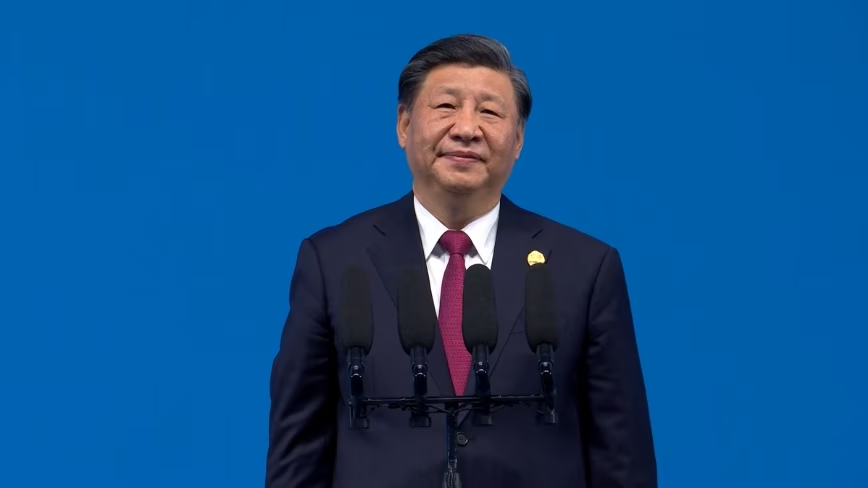
Xi pitches open-source AI to BRICS amid domestic curb debates
Chinese President Xi Jinping proposed a China-led open-source AI community and invited BRICS nations to join the World AI Cooperation Organization (WAICO) at the recent BRICS summit. This push for global collaboration contrasts sharply with Beijing's ongoing internal debates about restricting its own advanced AI models. Meanwhile, the EU's comprehensive AI Act, with its clear, enforceable rules for open-source AI, highlights a significant divergence in global AI governance approaches.

Tesla Set to Finally Unveil Second-Generation Roadster on October 1
The much-anticipated second generation of the Tesla Roadster, a halo vehicle promising revolutionary performance, is finally slated for a public unveiling on October 1. After years of delays and a protracted development
Google's AI Branding Fix: A Clearer Vision for Gemini
This article critiques Google's fragmented AI branding, proposing a unified 'Gemini Intelligence' system to simplify user experience and strengthen Gemini's identity.

Chuwi UniBox AI495 Pro Review: A Mini AI Powerhouse
Chuwi's UniBox AI495 Pro review: A powerful mini workstation with 192GB RAM and an AMD Ryzen AI chip for local LLM processing, packed into a compact, Mac Pro-esque design.

Microsoft comms chief Frank Shaw to exit after nearly three decades
Frank X. Shaw, Microsoft's long-serving chief communications officer, will exit at year-end after nearly three decades shaping the company's message through pivotal periods. Shaw, 64, is not retiring but plans a break before his next move, leaving behind a legacy of adapting communications for a digital age and embracing AI tools. Microsoft is now searching for his successor.