
Zelensky Urges Trump to Block Russia's Starlink Rival, FT Reports
Ukrainian President Volodymyr Zelensky has reportedly asked Donald Trump to sanction Russian and Chinese companies developing "Rassvet," a satellite internet network intended as a Starlink rival. Zelensky raised the issue multiple times, including recently in New York, according to the Financial Times. Ukraine views Rassvet as a critical threat, as it would provide Russia with an independent, secure communication system for its military, potentially operational by early next year.
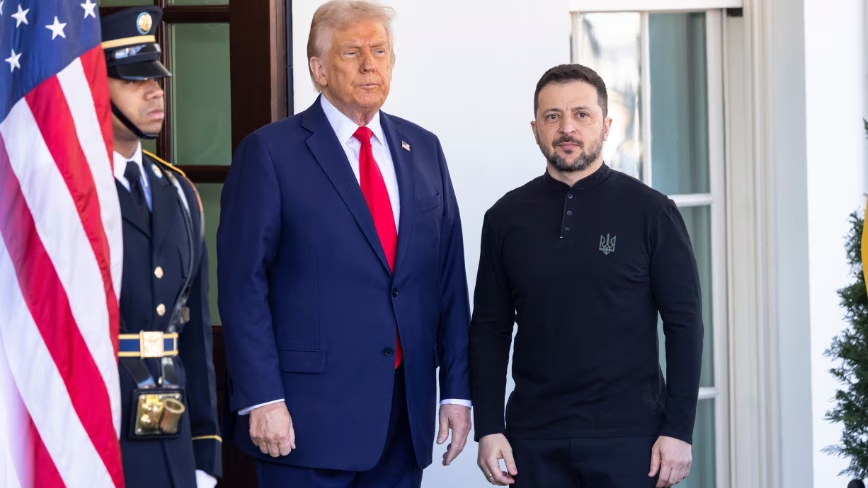
Ukrainian President Volodymyr Zelensky has reportedly appealed directly to former U.S. President Donald Trump, urging him to impose sanctions on Russian and Chinese entities involved in developing "Rassvet," a burgeoning satellite internet network designed to rival Elon Musk's Starlink. The request, which Zelensky has raised multiple times with Trump, including at a recent meeting in New York, aims to cripple Russia's efforts to establish an independent communication system for its military, a critical strategic concern for Ukraine, according to a report by the Financial Times.
Zelensky's Urgent Plea
Zelensky's push for sanctions underscores the escalating technological dimension of the conflict in Ukraine. The Ukrainian president highlighted that the Russian firm Bureau 1440 is developing Rassvet, with alleged assistance from China, stating, "We know that China works on satellites, works on the possibility of helping Russia with a similar Starlink."
This direct appeal to Trump, who is a prominent figure in U.S. politics and a potential future presidential candidate, adds a layer of political intrigue to Ukraine's strategic efforts. While their Oval Office meeting in February 2025 reportedly ended without a minerals deal, the continued engagement indicates Ukraine's persistent lobbying on critical security matters.
Rassvet: A Strategic Counter to Starlink
The advent of satellite internet has been a game-changer on the Ukrainian battlefield. Starlink has become an indispensable tool, linking Ukrainian troops and enabling drone operations, despite Russia's consistent attempts to jam its signals. A Russian-controlled network, by contrast, would provide Moscow’s forces with a secure and resilient communication channel that neither the U.S. nor SpaceX could switch off or disrupt.
The strategic implications are profound. Such a network would grant Russia greater operational autonomy, potentially neutralizing a key technological advantage Ukraine currently holds. This makes the pre-emptive disruption of Rassvet a high priority for Kyiv.
Development Timeline and Challenges
While Zelensky indicated that Rassvet could begin working as early as "early next year" (2027), the developer, Bureau 1440, has a more conservative timeline. The company launched its first 16 working satellites in March, but requires more than 250 satellites to offer a comprehensive service. Bureau 1440 has previously cited a 2027 commercial launch, a date it has already pushed back once.
This discrepancy suggests either a more ambitious assessment from Kyiv or a strategic urgency to impact the project before it matures. Despite the current developmental lag behind Starlink, the potential for a fully operational Russian network remains a significant concern for Ukrainian defense strategists.
Unanswered Questions and Geopolitical Stakes
As of the report, neither the White House nor SpaceX has publicly commented on President Zelensky's request for sanctions. The silence from official U.S. channels leaves the immediate impact of Zelensky's plea uncertain, but the underlying geopolitical stakes are clear.
The race for satellite internet supremacy is not merely a commercial one; it is central to national security and global influence. The development of independent satellite communication systems by rival powers signifies a broader trend toward technological sovereignty and a potential fragmentation of global digital infrastructure.
Any U.S. action, or inaction, regarding sanctions on Rassvet's developers could set significant precedents for how international law and policy address dual-use technologies in an increasingly contested space environment.
FAQ
Q: What is Rassvet?
A: Rassvet is a satellite internet network being developed by Russian firm Bureau 1440, with alleged Chinese assistance, intended to be Russia's equivalent to Elon Musk's Starlink.
Q: Why is Ukraine concerned about Rassvet?
A: Ukraine relies heavily on Starlink for its military communications and drone operations. A Russian-controlled network like Rassvet would provide Moscow's forces with a secure, independent link that the U.S. and SpaceX cannot disrupt, potentially shifting a critical battlefield advantage.
Q: What is the current status of Rassvet's development?
A: Bureau 1440 launched its first 16 satellites in March and requires over 250 satellites for full service. While President Zelensky suggested it could be operational by early 2027, the company itself has projected a commercial launch for 2027, a deadline that has already faced delays.
Related articles

Apple Unveils iPhone Duo: Pricey Foldable Sees Soaring Demand
Apple has officially entered the foldable smartphone arena with the long-anticipated launch of the iPhone Duo. Priced starting at a hefty $1,999, the device features a 5.4-inch outer display and a larger 7.6-inch inner

in-depth: Chicago-Area Cops Helped HSI Spy on Minnesota Anti-ICE
Chicago-area law enforcement, including local police and HSI agents, conducted undercover surveillance on Minnesota anti-ICE activists at an April 2, 2022, talk in Chicago. This operation was part of a federal conspiracy probe into 15 Minnesota activists facing felony charges related to immigration enforcement resistance. Civil liberties advocates have condemned the surveillance as a troubling intrusion into protected political activity.

Mark Wahlberg on using AI in film ‘the right way’ and being open to
Actor Mark Wahlberg believes AI has a place in filmmaking if used responsibly for enhancement, not script generation or actor replacement. At TechCrunch Disrupt, he expressed openness to an AI likeness carrying on his legacy, managed by his family, and emphasized storytelling.

Tesla Unveils Thruster-Equipped Roadster, 2028 Production Targeted
Tesla has unveiled its second-generation Roadster, featuring cold-gas thrusters co-developed with SpaceX, enabling it to jump and flip. The electric sports car demonstrated 0-60mph in an astonishing 0.81 seconds, with production targeted for 2028. This highly anticipated reveal also serves as a key recruitment tool for Tesla's ambitious AI and robotics initiatives.

Amazon Prime Video Launches AI-Powered Prime 360 for NBA Coverage
Amazon Prime Video is elevating its NBA coverage with the introduction of Prime 360, an AI-powered replay system offering immersive, 'fly through' views of the action. Kicking off its second season, Prime Video also adds Yahoo fantasy integration and gains exclusive Eastern Conference Finals rights, expanding its tech-driven sports broadcast. The new features aim to deliver a unique and interactive viewing experience for basketball fans.

regional: A two-person Seattle startup lands $1M to reinvent
Seattle startup TriMagnetix has secured $1 million to develop semiconductor chips that consume 800 times less energy and are radiation-resistant. The two-person company, leveraging nanomagnetic technology, is targeting space applications and data centers. With new funding and key partnerships, TriMagnetix aims for commercial sales within a year.