
xAI Launches Grok 4.3 with Aggressive Pricing, Powerful Voice Cloning
xAI has launched Grok 4.3, its new large language model, featuring "always-on reasoning" and advanced agentic capabilities. The model arrives with an aggressively low API pricing strategy ($1.25/$2.50 per million input/output tokens) and a sophisticated voice cloning suite called Custom Voices. While excelling in specialized legal and financial tasks, Grok 4.3 presents a complex trade-off between cost efficiency, deep reasoning, and general consistency for enterprise users.

Elon Musk's xAI has launched its latest proprietary large language model, Grok 4.3, alongside a sophisticated new voice cloning suite. Unveiled last night on May 1, 2026, the releases underscore xAI's aggressive strategy to challenge rivals like OpenAI and Anthropic by offering significantly lower API pricing and advanced agentic capabilities, despite ongoing legal disputes involving Musk and past controversies surrounding Grok's content generation.
Grok 4.3: Performance and a New Pricing Frontier
Grok 4.3 represents a notable leap in performance over its predecessor, Grok 4.2, according to independent evaluations from Artificial Analysis. While it still trails the state-of-the-art models from competitors, its primary differentiator is its "aggressively low" price point. API access is now set at $1.25 per million input tokens and $2.50 per million output tokens, a substantial reduction from Grok 4.2's initial $2/$6 rates. This positioning places Grok 4.3 firmly among the most cost-effective foundation models available.
The core of Grok 4.3 introduces "always-on reasoning," meaning the model is designed to actively "think" before responding, aiming to boost factual accuracy and handle complex, multi-step instructions. It boasts an expansive 1 million-token context window, capable of processing the equivalent of several novels, though higher context usage incurs double the standard pricing. The model supports both text and image inputs, producing text outputs, and is specifically optimized for agentic workflows where AI acts autonomously to complete tasks.
Advanced Agentic Capabilities and Tool Use
Grok 4.3 now integrates a robust ecosystem of server-side tools, enabling it to function more like a digital employee. These tools include web and X (formerly Twitter) search, allowing it to bypass its December 2025 knowledge cutoff for up-to-date information. It can execute Python code in a sandboxed environment for data processing and mathematical problems, and its Retrieval-Augmented Generation (RAG) system enables querying uploaded documents. Early interactions showcase its ability to engineer complex spreadsheets, generate professionally formatted PDFs with branding, and design visual presentations.
Introducing Custom Voices: Fast, High-Quality Voice Cloning
Beyond its LLM, xAI has released Custom Voices, a powerful voice-cloning API and web suite. This feature allows developers to clone a voice from a reference audio clip as short as 120 seconds, with the resulting AI voice not only matching timbre but also mimicking delivery patterns and inflections. VentureBeat's own testing confirmed the uncanny accuracy and natural pronunciation of cloned voices.
The Custom Voices feature is currently restricted to the United States (excluding Illinois due to biometric regulations) and programmatic access is limited to Enterprise plan subscribers. xAI emphasizes strong privacy and security, ensuring cloned voices are private to the user's team and are never shared. The accompanying Voice Agent API (grok-voice-think-fast-1.0) is competitively priced at $3.00 per hour for speech-to-speech interactions, positioning it on the low-to-medium end of the market for similar services, while a standalone Text-to-Speech service offers five distinct voices.
Pricing Strategy and Market Positioning
The aggressive API pricing strategy is central to xAI's market push. Bindu Reddy, CEO of Abacus AI, remarked that Grok 4.3 is "as smart as Sonnet 4.6 and 5x cheaper and faster." VentureBeat's analysis confirms Grok 4.3's total cost ($3.75 per million tokens for input/output combined) places it significantly below many U.S. proprietary rivals, nearing the cost efficiency of some Chinese open-source offerings.
xAI has also introduced novel billing categories. Users will pay for "Reasoning tokens" generated during the model's internal thought process at standard completion rates. Prompt caching offers a substantial discount ($0.20 per million tokens) for repeated queries. Tool invocations, such as web search or code execution, incur a flat fee per 1,000 calls. Notably, xAI has implemented a $0.05 "Usage Guideline Violation Fee" for requests blocked by safety filters.
Mixed Reception and Enterprise Considerations
Independent evaluations paint a nuanced picture of Grok 4.3's performance. It has claimed top spots on specialized benchmarks like CaseLaw v2 (79.3% accuracy) and CorpFin, demonstrating exceptional legal and financial reasoning. Artificial Analysis also noted a significant improvement in agentic tasks, with an Elo score of 1500 on the GDPval-AA benchmark, outperforming competitors.
However, its general-purpose capabilities have faced criticism. Andon Labs reported "narcolepsy problems" on the Vending-Bench 2, indicating inconsistent actions in simulations. Vals AI noted weaknesses in general coding tasks and a low 11% score on ProofBench for difficult math problems.
For enterprises, Grok 4.3 presents a compelling value proposition for specialized tasks demanding deep reasoning and high token volumes in domains like legal and finance. However, the model's "always-on reasoning" can be a double-edged sword, potentially leading to overcaution in agentic scenarios. Furthermore, xAI's past Grok model controversies, including instances of problematic content generation and political bias, may prompt some enterprises to exercise caution, despite xAI's apparent efforts to address such concerns in the model's system prompt. The question of whether Grok 4.3 can maintain consistent performance across all domains will be a key focus in the coming months.
FAQ
Q: What are the key new features of Grok 4.3?
A: Grok 4.3 introduces "always-on reasoning," a 1 million-token context window, enhanced agentic workflows with integrated tools like web search and code execution, and significantly reduced API pricing. Additionally, xAI launched a new voice cloning suite called Custom Voices.
Q: How does Grok 4.3's pricing compare to competitors?
A: Grok 4.3 offers an aggressively low API price of $1.25 per million input tokens and $2.50 per million output tokens. This positions it as one of the most cost-effective proprietary models, far cheaper than its predecessor and many U.S. rivals like OpenAI and Anthropic, placing it closer to Chinese open-source offerings in terms of cost efficiency.
Q: What are the main strengths and weaknesses of Grok 4.3?
A: Grok 4.3 excels in specialized domains like legal and financial reasoning, topping benchmarks such as CaseLaw v2 and CorpFin, and shows strong agentic performance. Its main weaknesses include inconsistent performance in general coding tasks, struggles with difficult math problems, and reported instances of "narcolepsy" where it may fail to take required actions in simulations. Past controversies regarding content generation also remain a consideration for enterprise adoption.
Related articles

Apple Unveils iPhone Duo: Pricey Foldable Sees Soaring Demand
Apple has officially entered the foldable smartphone arena with the long-anticipated launch of the iPhone Duo. Priced starting at a hefty $1,999, the device features a 5.4-inch outer display and a larger 7.6-inch inner

in-depth: Chicago-Area Cops Helped HSI Spy on Minnesota Anti-ICE
Chicago-area law enforcement, including local police and HSI agents, conducted undercover surveillance on Minnesota anti-ICE activists at an April 2, 2022, talk in Chicago. This operation was part of a federal conspiracy probe into 15 Minnesota activists facing felony charges related to immigration enforcement resistance. Civil liberties advocates have condemned the surveillance as a troubling intrusion into protected political activity.

Mark Wahlberg on using AI in film ‘the right way’ and being open to
Actor Mark Wahlberg believes AI has a place in filmmaking if used responsibly for enhancement, not script generation or actor replacement. At TechCrunch Disrupt, he expressed openness to an AI likeness carrying on his legacy, managed by his family, and emphasized storytelling.

Tesla Unveils Thruster-Equipped Roadster, 2028 Production Targeted
Tesla has unveiled its second-generation Roadster, featuring cold-gas thrusters co-developed with SpaceX, enabling it to jump and flip. The electric sports car demonstrated 0-60mph in an astonishing 0.81 seconds, with production targeted for 2028. This highly anticipated reveal also serves as a key recruitment tool for Tesla's ambitious AI and robotics initiatives.

Amazon Prime Video Launches AI-Powered Prime 360 for NBA Coverage
Amazon Prime Video is elevating its NBA coverage with the introduction of Prime 360, an AI-powered replay system offering immersive, 'fly through' views of the action. Kicking off its second season, Prime Video also adds Yahoo fantasy integration and gains exclusive Eastern Conference Finals rights, expanding its tech-driven sports broadcast. The new features aim to deliver a unique and interactive viewing experience for basketball fans.
regional: A two-person Seattle startup lands $1M to reinvent
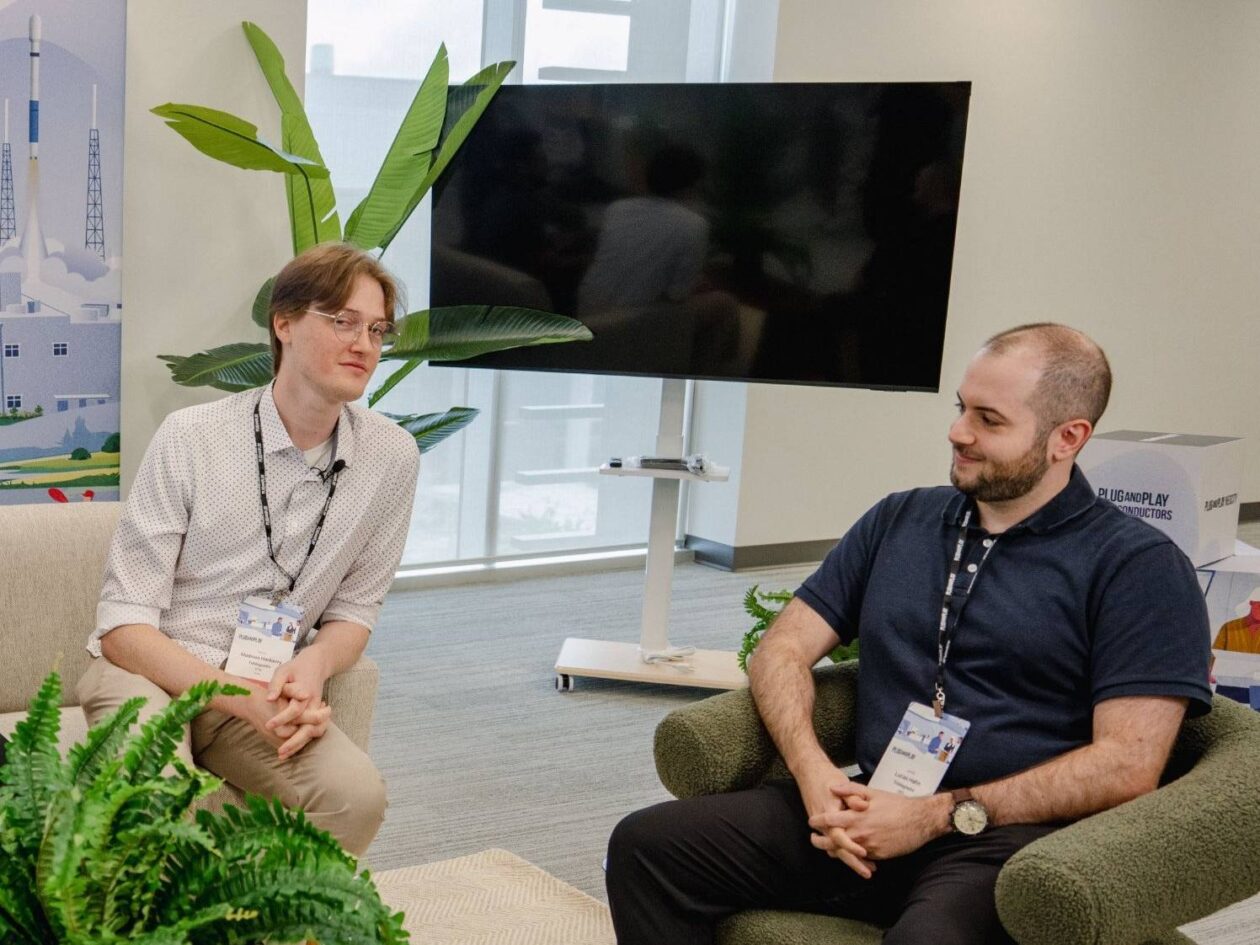
Seattle startup TriMagnetix has secured $1 million to develop semiconductor chips that consume 800 times less energy and are radiation-resistant. The two-person company, leveraging nanomagnetic technology, is targeting space applications and data centers. With new funding and key partnerships, TriMagnetix aims for commercial sales within a year.