
WhatsApp Bows to Brazilian Antitrust Pressure on AI Chatbots
WhatsApp has capitulated to regulatory demands in Brazil, agreeing to allow rival AI chatbots on its platform, following a similar decision in Europe. Brazil's antitrust regulator, CADE, rejected Meta's appeal to block the policy, citing competitive harm. Developers express concern over Meta's new per-message pricing, despite the regulatory victory for market competition.

São Paulo, Brazil — WhatsApp, owned by Meta, has announced it will allow rival AI companies to offer their chatbots to users in Brazil, a move that follows intense regulatory pressure and comes just a day after a similar decision was made for European users. This policy reversal marks a significant moment for competition in the rapidly evolving AI landscape within popular messaging platforms.
The concession follows a definitive ruling by Brazil’s antitrust regulator, CADE (Conselho Administrativo de Defesa Econômica), which rejected Meta’s appeal to uphold its controversial policy. CADE had previously issued an order to suspend Meta's plan to bar third-party AI chatbots, asserting that such a ban would be disproportionate and could inflict competitive harm within Brazil's instant messaging market, where WhatsApp holds a dominant position. According to Councilor Carlos Jacques, the case rapporteur, evidence of legal plausibility and WhatsApp's market relevance underpinned the tribunal's decision.
Effective March 11, Meta will begin charging $0.0625 per “non-template message” for third-party AI chatbot services offered through the WhatsApp Business API in Brazil. A Meta spokesperson confirmed that the company would introduce this pricing "where we are legally required to provide AI chatbots through the WhatsApp business API," indicating a compliance-driven approach rather than a proactive strategic shift.
This development stems from a policy change Meta introduced in October 2025, which aimed to restrict general-purpose chatbots on its platform. The initial policy sparked several antitrust investigations globally, particularly because Meta itself offers its own AI chatbot, Meta AI, directly within WhatsApp. Meta had justified its earlier stance by arguing that the WhatsApp Business API was not designed to accommodate AI chatbots and that they placed an undue strain on the company's system.
While the regulatory outcome is a victory for competition, developers are expressing caution. Several have told TechCrunch that the new pricing structure is high, potentially leading to substantial costs for providers and users. This concern raises questions about the practical accessibility and viability of these third-party AI services even with Meta’s reluctant allowance.
Zapia, one of the companies that had filed a complaint with CADE, lauded the regulator's decision. In a statement, Zapia emphasized the importance of competition and preventing powerful entities from stifling innovation. The company reiterated its belief that users should have the freedom to choose their AI tools and that innovation flourishes when platforms remain open. Zapia further indicated its intent to challenge similar restrictions across other Latin American markets, suggesting that Brazil’s ruling could set a precedent for broader regional policy changes.
This sequence of events underscores the growing scrutiny global tech giants face regarding their competitive practices, particularly concerning the integration of emerging technologies like AI. Regulators are increasingly watchful of potential monopolistic behaviors that could limit choice and innovation within critical digital ecosystems.
FAQ
Q: Why did WhatsApp reverse its policy on third-party AI chatbots in Brazil? A: WhatsApp reversed its policy due to a ruling by Brazil's antitrust regulator, CADE. The regulator found that banning third-party AI chatbots would be anti-competitive and disproportionate, especially given WhatsApp's significant market presence in Brazil.
Q: Will users have to pay to use these third-party AI chatbots on WhatsApp? A: WhatsApp will charge AI companies $0.0625 per “non-template message” sent via the WhatsApp Business API in Brazil. It will be up to the individual AI chatbot providers to determine how (or if) they pass these costs on to their end-users.
Q: What was Meta's original reason for restricting third-party AI chatbots? A: Meta had stated that its WhatsApp Business API was not designed to support general-purpose AI chatbots and that these services placed a strain on its system. This policy also coincided with Meta offering its own AI chatbot, Meta AI, within the app.
Related articles
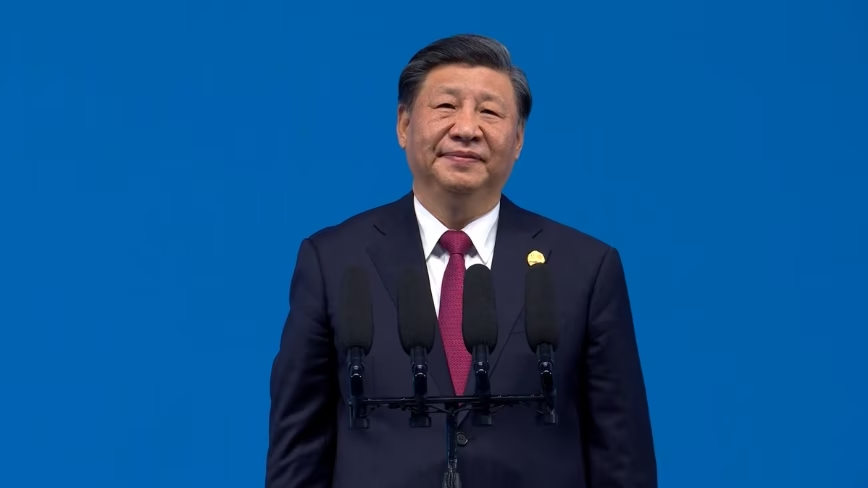
Xi pitches open-source AI to BRICS amid domestic curb debates
Chinese President Xi Jinping proposed a China-led open-source AI community and invited BRICS nations to join the World AI Cooperation Organization (WAICO) at the recent BRICS summit. This push for global collaboration contrasts sharply with Beijing's ongoing internal debates about restricting its own advanced AI models. Meanwhile, the EU's comprehensive AI Act, with its clear, enforceable rules for open-source AI, highlights a significant divergence in global AI governance approaches.

Tesla Set to Finally Unveil Second-Generation Roadster on October 1
The much-anticipated second generation of the Tesla Roadster, a halo vehicle promising revolutionary performance, is finally slated for a public unveiling on October 1. After years of delays and a protracted development

Seattle Warned on Big Tech Reliance; Microsoft/OpenAI Sued; Apple's
A new City of Seattle study warns of the city's risky economic over-reliance on a few dominant tech companies. Simultaneously, the Seattle Times and Newsday are suing Microsoft and OpenAI for alleged AI training data theft, while Apple's new foldable iPhone Duo evokes memories of Microsoft's defunct Surface Duo.

in-depth: The Best 3-in-1 Apple Charging Stations After Testing 30
Wired has released its top picks for 3-in-1 Apple charging stations, extensively tested for iPhone, Apple Watch, and AirPods. The guide highlights six leading models, from premium speedy options to budget-friendly and compact designs, all focused on decluttering and optimizing charging for Apple users.

Nscale Adds Former OpenAI Exec Fidji Simo to Board Ahead of IPO
Nscale, the U.K.-based AI data center startup, has appointed former OpenAI, Meta, and Instacart executive Fidji Simo to its board of directors. This high-profile addition comes as Nscale prepares for a potential IPO this fall, leveraging Simo's extensive experience in scaling major tech platforms and guiding a company through a successful public offering.

Microsoft comms chief Frank Shaw to exit after nearly three decades
Frank X. Shaw, Microsoft's long-serving chief communications officer, will exit at year-end after nearly three decades shaping the company's message through pivotal periods. Shaw, 64, is not retiring but plans a break before his next move, leaving behind a legacy of adapting communications for a digital age and embracing AI tools. Microsoft is now searching for his successor.