
Unpacking the Catch in Apple's New Upgrade Program
Apple's new Upgrade program offers seemingly low monthly payments for iPhones, iPads, Macs, and Watches, but our analysis reveals significant catches. While it provides accessibility, users face risks like potential debt collection for missed payments and loss of device resale value, making careful consideration essential.

Apple has just launched its new Upgrade program, a device leasing service designed to make the latest iPhones, iPads, Macs, and Watches more accessible with seemingly low monthly payments. The tech giant promises that customers won't pay more than the full retail price over the lease term, with some models even costing hundreds less. While this sounds like an unbeatable offer, a closer look reveals several catches that could significantly alter the perceived value for many consumers.
Understanding Apple's New Leasing Model
The program allows users to lease select Apple devices for one to three years, maintaining a consistent monthly payment throughout the contract. At the lease's conclusion, customers face three options: they can purchase the device outright by covering the difference between payments made and the remaining cost, return the device and end the contract, or immediately upgrade to a newer model with a new payment plan. For instance, leasing an iPhone Air for two years for $695.76 would necessitate an additional payment of $303.24 to own the $999 device.
The Fine Print: What You Need to Know
Beneath the surface of appealing monthly rates, the Apple Upgrade Program operates fundamentally as a loan, complete with terms and potential pitfalls. Financing is provided by Klarna, a "buy now, pay later" (BNPL) service. While Apple states there are no interest charges or standard late fees, Klarna's policy clarifies that missing three consecutive payments will terminate the lease and demand the full outstanding balance. If this balance remains unpaid, Klarna’s support pages suggest the debt could be sent to collection, though the specific application to this program is unconfirmed. Reassuringly, Apple has confirmed that devices will not enter a "Restricted Mode" for missed payments, quashing earlier rumors.
However, the financial risks associated with BNPL services are substantial. A LendingTree report from 2025 indicated that nearly half of all BNPL users failed to make at least one payment on time. Furthermore, Klarna leverages customer data to sell personalized advertisements, a detail often overlooked by users.
Device Ownership and Additional Costs
During the lease period, Klarna retains ownership of the device. This means lessees are responsible for any damage and will incur a fee if the device isn't returned in "good condition." To mitigate this, Apple actively encourages customers to subscribe to AppleCare, adding another recurring cost to the monthly payment. AppleCare plans start from $3.99 per month for Macs, $4.99 for Watches, $5.49 for iPads, and $9.99 for iPhones, with a multi-device option at $19.99 per month.
The program also includes early termination fees if a user wishes to return or upgrade their device before the contract's end. Critically, Apple provides a six-month window after the lease concludes for users to decide on their next step (upgrade, purchase, or exit). However, monthly payments continue during this grace period, diminishing the financial appeal if a decision isn't made promptly.
The Financial Trade-Off: Resale Value Lost
One of the most significant financial disadvantages of choosing to upgrade a leased device is the forfeiture of potential resale or trade-in value. Consider an iPhone 17 leased for two years at $551.76. If a user opts to upgrade to the next model rather than paying the extra $247.24 to purchase the iPhone 17 outright (total $799), they miss out on a valuable asset. Data from SellUp suggests iPhones typically lose 35 to 40 percent of their value over two years. Applying this, a two-year-old iPhone 17 could be resold for approximately $520. In this scenario, owning the device and reselling it would mean the user effectively paid only $279 to use the phone for two years ($799 original price - $520 resale value). By contrast, upgrading through the program means giving the device back and receiving none of that potential cash.
Is Apple's Upgrade Program Right for You?
Ultimately, Apple's Upgrade program presents a mixed bag. For those who prioritize flexibility and wish to retain the option of selling or trading in their devices independently, it may not be the most financially advantageous path. The program essentially funnels users into a continuous payment cycle, potentially costing more in the long run than simply buying a device and reselling it later.
However, in an era of escalating prices for new smartphones, tablets, and laptops, this leasing option does offer a viable alternative for consumers who cannot afford the upfront cost of a new device or prefer predictable, lower monthly payments. The key lies in understanding the associated risks, diligently managing payments, and being fully aware of the terms that govern device ownership, damage responsibility, and upgrade pathways. For informed users who are disciplined with their finances, the program can be a convenient way to always have the latest Apple tech.
FAQ
Q: Are there any interest charges or late fees with the Apple Upgrade program? A: Apple and Klarna state there are no interest charges or standard late fees. However, missing three consecutive monthly payments will result in the lease being terminated and the full outstanding balance becoming immediately due. Unpaid balances could be transferred to debt collection.
Q: What happens if my leased device gets damaged? A: As Klarna owns the device during the lease, you are responsible for any damage. You will be charged a fee if the device is not returned in "good condition." Apple encourages customers to purchase an AppleCare subscription to cover potential repair costs.
Q: Is it more cost-effective to upgrade through the program or buy the device outright and resell it? A: Financially, purchasing a device outright and then selling it after two years can be more cost-effective. For example, a two-year-old iPhone typically retains 60-65% of its value, allowing you to recoup a significant portion of your initial investment. Upgrading via the program means forfeiting this potential resale value.
Related articles
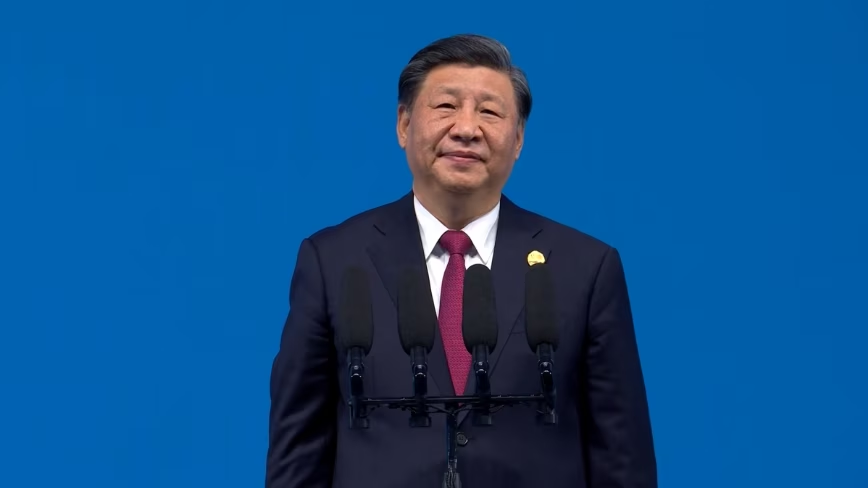
Xi pitches open-source AI to BRICS amid domestic curb debates
Chinese President Xi Jinping proposed a China-led open-source AI community and invited BRICS nations to join the World AI Cooperation Organization (WAICO) at the recent BRICS summit. This push for global collaboration contrasts sharply with Beijing's ongoing internal debates about restricting its own advanced AI models. Meanwhile, the EU's comprehensive AI Act, with its clear, enforceable rules for open-source AI, highlights a significant divergence in global AI governance approaches.

StarCraft Returns in 2030 as Open-World Shooter
Blizzard Entertainment announced a new StarCraft game, an open-world shooter, set to release in 2030. Unveiled at BlizzCon by VP Dan Hay, this marks the series' return after over a decade and a significant genre shift from its real-time strategy roots. The cinematic trailer showcased a gritty human-Zerg conflict, with many fans hoping for a traditional RTS follow-up.

Tesla Set to Finally Unveil Second-Generation Roadster on October 1
The much-anticipated second generation of the Tesla Roadster, a halo vehicle promising revolutionary performance, is finally slated for a public unveiling on October 1. After years of delays and a protracted development

Seattle Warned on Big Tech Reliance; Microsoft/OpenAI Sued; Apple's
A new City of Seattle study warns of the city's risky economic over-reliance on a few dominant tech companies. Simultaneously, the Seattle Times and Newsday are suing Microsoft and OpenAI for alleged AI training data theft, while Apple's new foldable iPhone Duo evokes memories of Microsoft's defunct Surface Duo.

in-depth: The Best 3-in-1 Apple Charging Stations After Testing 30
Wired has released its top picks for 3-in-1 Apple charging stations, extensively tested for iPhone, Apple Watch, and AirPods. The guide highlights six leading models, from premium speedy options to budget-friendly and compact designs, all focused on decluttering and optimizing charging for Apple users.

Nscale Adds Former OpenAI Exec Fidji Simo to Board Ahead of IPO
Nscale, the U.K.-based AI data center startup, has appointed former OpenAI, Meta, and Instacart executive Fidji Simo to its board of directors. This high-profile addition comes as Nscale prepares for a potential IPO this fall, leveraging Simo's extensive experience in scaling major tech platforms and guiding a company through a successful public offering.