
Uber’s Robotaxi Lobbying Effort Pits It Against Waymo in DC Battle
Uber and Waymo are clashing over a proposed D.C. robotaxi bill, with Uber pushing for a hybrid model that includes human drivers on ride-hailing platforms, while Waymo backs direct driverless deployment. This lobbying battle highlights fundamentally different visions for the future of autonomous transportation and could set a national precedent.

Uber and Waymo, once courtroom adversaries turned business partners, are now locked in a fierce lobbying battle in Washington, D.C., over the future of robotaxi regulation. This clash centers on a proposed bill to permit driverless autonomous vehicle operations in the district, with Uber advocating for a "hybrid" model that integrates robotaxis onto platforms alongside human drivers, while Waymo champions the bill's more direct deployment framework. The dispute, which will be spotlighted during a pivotal hearing on Monday, July 13, 2026, extends far beyond the nation's capital, serving as a critical test case for how autonomous vehicles will be regulated and deployed across the United States.
Councilmember Charles Allen's proposed bill aims to update the District's 2012 Autonomous Vehicle Act, empowering the District Department of Transportation (DDOT) to issue permits for driverless testing and commercial operations. Key requirements include a minimum of $5 million in liability insurance and timely crash data reporting. The legislation also proposes a $0.15 per mile "vehicles miles traveled" (VMT) tax, with revenues earmarked for public transit and workforce development programs for human drivers potentially displaced by robotaxis.
Uber vehemently opposes the current D.C. bill, arguing that its framework would establish a de facto monopoly for companies like Alphabet-owned Waymo and significantly displace human for-hire drivers. The ride-hailing giant's policy chief, Javi Correoso, highlighted concerns about robotaxis contributing to congestion through empty cruising and their inability to provide physical assistance to passengers. Uber's counter-proposal, a hybrid network, would require robotaxis to operate on platforms that also offer human-driven rides, ensuring consumer choice and the gradual integration of autonomous technology.
Waymo, currently the largest robotaxi operator in the U.S. with over 500,000 weekly rides, fully supports the D.C. bill. The company contends that the legislation is essential for the safe deployment of autonomous vehicles, promoting public transit, equitable access, and supporting workers without unduly restricting AV developers. Waymo spokesperson Ethan Teicher indicated the company would welcome changes that clarify different network types can operate, but they stand firm against efforts to limit AVs to specific network models.
The stakes are considerable, not just for Uber and Waymo, but for a broad coalition of interested parties. Representatives from Tesla, Lyft, powerful labor unions like Teamsters and SEIU, disability rights groups, and highway safety advocates are all slated to testify at Monday's hearing. The debate has even spurred an anti-robotaxi campaign by a New York-based organization, the Coalition for Accountability and Road Safety, whose funding and affiliations point towards labor interests.
Uber's Broader Strategy for AV Integration
Uber's lobbying in D.C. is a cornerstone of its wider strategy to maintain its market dominance in the evolving transportation landscape. While actively investing in and partnering with over 30 global AV technology companies and developing an "AV Labs" division to gather driving data, Uber is simultaneously pushing for regulatory frameworks that mandate its preferred hybrid model. This approach was formalized in a white paper published in May, and the company has since amplified its advocacy to policymakers.
This strategic shift marks a departure from Uber's earlier anti-regulation stance, a history acknowledged by COO Andrew MacDonald, who noted past "regulatory battles and a corporate crisis that damaged trust." Now, Uber aims to "partner with cities instead of confronting them," presenting its hybrid network as a compromise that addresses labor concerns by allowing human drivers and robotaxis to coexist on a single platform. The company plans to champion this vision in other cities and states as AV laws are developed or updated.
A History of 'Frenemies': Uber and Waymo's Rocky Relationship
The current regulatory showdown is not the first time Uber and Waymo have been at odds. In 2017, Waymo famously sued Uber for alleged trade secret theft, a high-profile case that settled after just five days of trial. Years later, their relationship evolved into a limited partnership, with Waymo deploying its robotaxis on Uber's app in Phoenix, then expanding to Austin and Atlanta. Notably, in the latter two cities, Waymo's service was exclusively accessible through the Uber app.
However, this partnership has recently soured. Earlier this year, Uber CTO Praveen Neppalli publicly criticized Waymo's robotaxi behavior on social media, and CEO Dara Khosrowshahi made thinly veiled critiques during an earnings call, raising concerns about AVs' interaction with city services and in emergency situations. The Phoenix partnership quietly concluded in May, fueling speculation about the future of their collaborations in other markets and underscoring the deep philosophical divide between the two tech giants now facing a looming robotaxi showdown in London as well.
Uber's head of AV policy, Harry Hartfield, articulated the company's vision in submitted testimony: "We think the future of our transportation system will be hybrid... Public policy should be designed around that reality, not around an AV-only future that does not exist." This statement encapsulates the core of the conflict, as both companies place their bets on fundamentally different futures for autonomous transportation.
FAQ
Q: What is Uber's proposed "hybrid model" for robotaxis?
A: Uber's "hybrid model" suggests that robotaxis should operate on ride-hailing networks that also include human drivers. This allows consumers to choose between an autonomous vehicle or a human-driven car within the same app, aiming to gradually integrate AVs, protect human driver jobs, and prevent monopolies by AV-only operators.
Q: How does Waymo's stance differ from Uber's regarding AV regulation in D.C.?
A: Waymo supports the D.C. bill, which would allow driverless testing and commercial operations for AV developers without mandating a hybrid network. Waymo argues this approach ensures safe deployment, supports public transit, and provides equitable access. While open to clarifying language about different network types, Waymo opposes restrictions that limit AVs to specific models like Uber's proposed hybrid.
Q: What are the broader implications of this lobbying battle beyond Washington, D.C.?
A: The D.C. legislative fight is a significant test case for future robotaxi regulation across the U.S. Its outcome could establish critical precedents for how autonomous vehicles are integrated into urban transportation systems, influencing policy development in other cities and states. It also highlights the intensifying competition between Uber and Waymo to define and dominate the future of autonomous ride-hailing.
Related articles

Apple Unveils iPhone Duo: Pricey Foldable Sees Soaring Demand
Apple has officially entered the foldable smartphone arena with the long-anticipated launch of the iPhone Duo. Priced starting at a hefty $1,999, the device features a 5.4-inch outer display and a larger 7.6-inch inner

in-depth: Chicago-Area Cops Helped HSI Spy on Minnesota Anti-ICE
Chicago-area law enforcement, including local police and HSI agents, conducted undercover surveillance on Minnesota anti-ICE activists at an April 2, 2022, talk in Chicago. This operation was part of a federal conspiracy probe into 15 Minnesota activists facing felony charges related to immigration enforcement resistance. Civil liberties advocates have condemned the surveillance as a troubling intrusion into protected political activity.

Mark Wahlberg on using AI in film ‘the right way’ and being open to
Actor Mark Wahlberg believes AI has a place in filmmaking if used responsibly for enhancement, not script generation or actor replacement. At TechCrunch Disrupt, he expressed openness to an AI likeness carrying on his legacy, managed by his family, and emphasized storytelling.
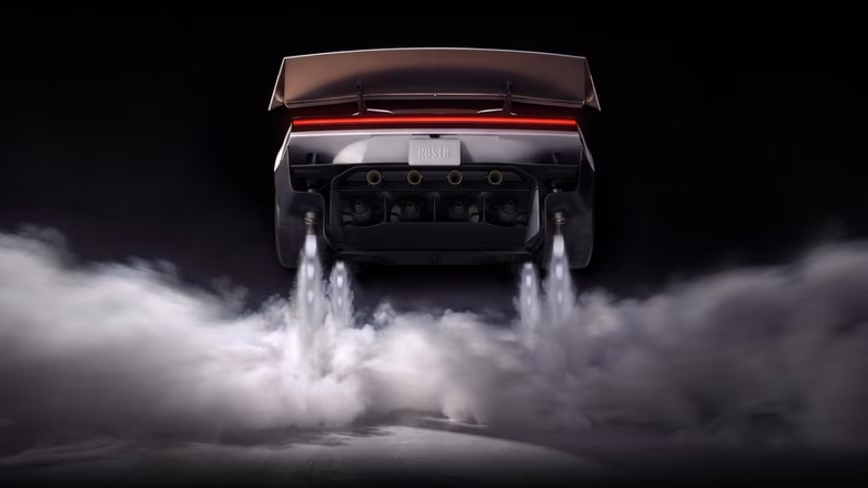
Tesla Unveils Thruster-Equipped Roadster, 2028 Production Targeted
Tesla has unveiled its second-generation Roadster, featuring cold-gas thrusters co-developed with SpaceX, enabling it to jump and flip. The electric sports car demonstrated 0-60mph in an astonishing 0.81 seconds, with production targeted for 2028. This highly anticipated reveal also serves as a key recruitment tool for Tesla's ambitious AI and robotics initiatives.

AI's Confidence vs. Formal Methods' Rigor: Design Flaws & Verification
While AI accelerates code generation, formal methods remain critical for ensuring system correctness. Languages like TLA+ and tools like Quint enable developers to model and verify system designs before coding, catching subtle flaws. Quint makes formal methods more accessible with developer-friendly syntax and executability. This approach is vital for verifying AI-generated code through trace validation and model-based testing, ensuring reliability against real-world data.

Amazon Prime Video Launches AI-Powered Prime 360 for NBA Coverage
Amazon Prime Video is elevating its NBA coverage with the introduction of Prime 360, an AI-powered replay system offering immersive, 'fly through' views of the action. Kicking off its second season, Prime Video also adds Yahoo fantasy integration and gains exclusive Eastern Conference Finals rights, expanding its tech-driven sports broadcast. The new features aim to deliver a unique and interactive viewing experience for basketball fans.