
Uber Eyes Sensor Grid: Turning Drivers Into Data Powerhouse for AVs
Uber's CTO revealed a long-term plan to equip its millions of drivers' cars with sensors, transforming them into a vast data collection grid for autonomous vehicle (AV) companies. This expansion of their AV Labs program aims to address the critical data bottleneck in AV development. The strategy positions Uber as a key infrastructure provider in the self-driving sector, potentially granting it significant leverage and financial benefit.

Uber is setting its sights on a monumental shift in the autonomous vehicle (AV) landscape, with its Chief Technology Officer Praveen Neppalli Naga revealing a long-term strategy to transform its vast network of human drivers into a global sensor grid. The ambitious plan, disclosed at a TechCrunch StrictlyVC event in San Francisco on Thursday night, aims to equip millions of Uber vehicles with sensors to gather real-world data, providing a crucial resource for AV companies and other AI model developers. This initiative marks a significant expansion of Uber's recently launched AV Labs program, positioning the ride-sharing giant as a potential data backbone for the future of self-driving technology.
Naga explained that this vision will evolve from the existing AV Labs, which currently operates a small, dedicated fleet of sensor-equipped cars managed directly by Uber. The ultimate goal, however, is far grander: integrating sensor kits into the vehicles of its extensive global driver base. Naga acknowledged regulatory hurdles concerning sensor implementation and data sharing that need to be addressed before this widespread deployment can occur.
The rationale behind this strategic pivot is rooted in the perceived bottleneck for AV development. According to Naga, the limiting factor is no longer the underlying technology itself, but rather the scarcity and cost of comprehensive real-world data. He highlighted that AV companies struggle to collect diverse scenarios and specific geographical data points needed to robustly train their models, lacking the capital to deploy the necessary data-collection fleets themselves.
This move could be a shrewd play for Uber, which famously divested from its own self-driving car ambitions years ago—a decision its co-founder Travis Kalanick has publicly regretted. Many industry observers questioned Uber's long-term relevance without its own AV technology. By becoming the central data provider, Uber aims to secure its future, transitioning from a direct competitor in AV development to an indispensable infrastructure provider for the entire sector.
Uber currently boasts partnerships with 25 AV companies, including Wayve in London. Through its evolving "AV cloud," the company is building a comprehensive library of labeled sensor data. This platform allows partner companies to query specific data sets for model training and even run their trained models in a "shadow mode" against actual Uber trips. This simulated environment lets them assess AV performance without deploying physical vehicles on public roads.
While Naga asserted that Uber's primary goal "is not to make money out of this data" but to "democratize it," the inherent commercial value and strategic implications are undeniable. Uber has already made direct equity investments in several AV players and plans to intensify these investments. Providing proprietary training data at an unprecedented scale could grant Uber substantial leverage over a burgeoning autonomous sector that relies heavily on its ride marketplace to reach consumers. This positions Uber to potentially exert significant influence and financial benefit from the AV revolution, even without developing its own self-driving cars.
FAQ
Q: What is Uber's long-term vision for its drivers? A: Uber's long-term vision is to transform its millions of human drivers' vehicles into a vast sensor grid. These cars would be equipped with sensors to collect real-world driving data for autonomous vehicle (AV) companies and other artificial intelligence (AI) models.
Q: Why is Uber pursuing this data collection strategy? A: According to Uber's CTO, Praveen Neppalli Naga, the primary bottleneck in AV development is the scarcity and cost of comprehensive driving data, not the technology itself. By collecting and aggregating this data at scale, Uber aims to "democratize" access to crucial training data for the entire AV ecosystem, making development more efficient.
Q: How does this strategy benefit Uber? A: This strategy allows Uber to solidify its position as a critical player in the autonomous driving future, even after exiting its own self-driving car development. By becoming the essential data layer for AV companies, Uber gains significant leverage, potential revenue streams, and a central role in connecting AV services to its extensive ride marketplace, ensuring its continued relevance.
Related articles

Apple Unveils iPhone Duo: Pricey Foldable Sees Soaring Demand
Apple has officially entered the foldable smartphone arena with the long-anticipated launch of the iPhone Duo. Priced starting at a hefty $1,999, the device features a 5.4-inch outer display and a larger 7.6-inch inner

in-depth: Chicago-Area Cops Helped HSI Spy on Minnesota Anti-ICE
Chicago-area law enforcement, including local police and HSI agents, conducted undercover surveillance on Minnesota anti-ICE activists at an April 2, 2022, talk in Chicago. This operation was part of a federal conspiracy probe into 15 Minnesota activists facing felony charges related to immigration enforcement resistance. Civil liberties advocates have condemned the surveillance as a troubling intrusion into protected political activity.

Mark Wahlberg on using AI in film ‘the right way’ and being open to
Actor Mark Wahlberg believes AI has a place in filmmaking if used responsibly for enhancement, not script generation or actor replacement. At TechCrunch Disrupt, he expressed openness to an AI likeness carrying on his legacy, managed by his family, and emphasized storytelling.
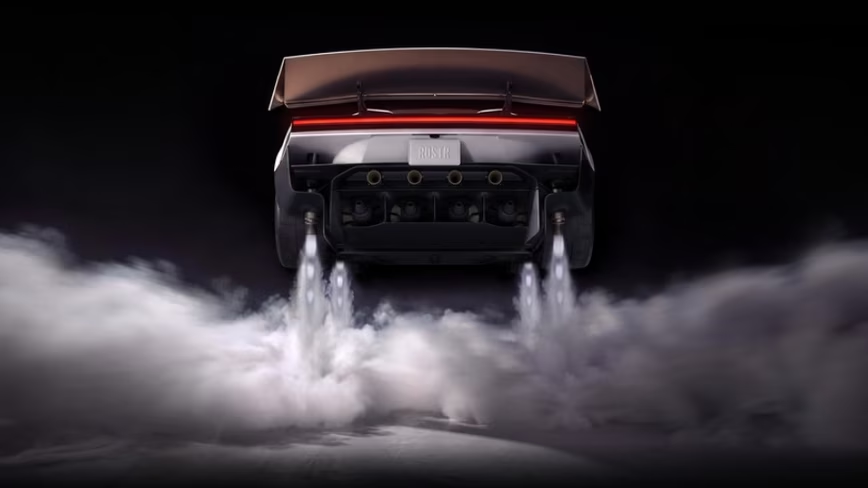
Tesla Unveils Thruster-Equipped Roadster, 2028 Production Targeted
Tesla has unveiled its second-generation Roadster, featuring cold-gas thrusters co-developed with SpaceX, enabling it to jump and flip. The electric sports car demonstrated 0-60mph in an astonishing 0.81 seconds, with production targeted for 2028. This highly anticipated reveal also serves as a key recruitment tool for Tesla's ambitious AI and robotics initiatives.

AI's Confidence vs. Formal Methods' Rigor: Design Flaws & Verification
While AI accelerates code generation, formal methods remain critical for ensuring system correctness. Languages like TLA+ and tools like Quint enable developers to model and verify system designs before coding, catching subtle flaws. Quint makes formal methods more accessible with developer-friendly syntax and executability. This approach is vital for verifying AI-generated code through trace validation and model-based testing, ensuring reliability against real-world data.

Amazon Prime Video Launches AI-Powered Prime 360 for NBA Coverage
Amazon Prime Video is elevating its NBA coverage with the introduction of Prime 360, an AI-powered replay system offering immersive, 'fly through' views of the action. Kicking off its second season, Prime Video also adds Yahoo fantasy integration and gains exclusive Eastern Conference Finals rights, expanding its tech-driven sports broadcast. The new features aim to deliver a unique and interactive viewing experience for basketball fans.