
Trump-Backed Crypto Firm Resells Restricted Chinese AI, Sparking
A crypto firm backed by Donald Trump's family is reportedly facilitating the sale of AI models from Chinese companies blacklisted by the US government. The Hong Kong platform, WorldClaw, accepts payments in the Trump family's stablecoin, USD1, creating a direct financial link. This arrangement raises significant questions about conflicts of interest, as it directly contradicts the administration's policy to restrict Chinese AI.
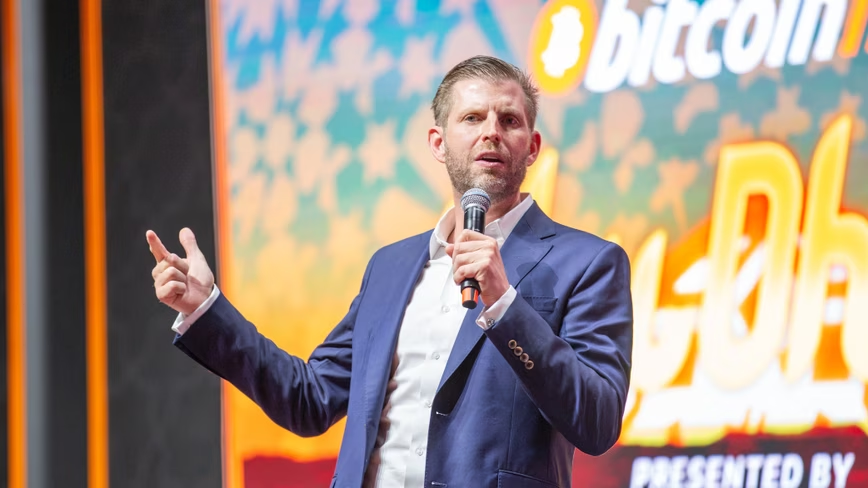
A crypto venture backed by Donald Trump and his family is enabling access to artificial intelligence models from Chinese companies blacklisted by the US government, according to a recent Reuters report. World Liberty Financial, the Trump-linked firm, is reportedly behind WorldClaw, a Hong Kong-based platform that resells these restricted AI models. This arrangement presents a stark contrast to the US administration's aggressive campaign to curtail China's AI industry, raising significant questions about conflicts of interest.
WorldClaw offers a catalog of approximately 90 AI models, with about 43 originating from Chinese developers. These include tech giants like Alibaba and Baidu, which the Pentagon has identified as aligned with China's military, and Z.ai, subject to US Commerce Department export restrictions. Additionally, models from DeepSeek and Moonshot, companies accused by American officials of developing systems using stolen US technology, are available alongside offerings from firms like OpenAI and Anthropic.
The financial mechanics of WorldClaw are central to the controversy. Customers can pay for these AI models using USD1, the dollar-pegged stablecoin issued by World Liberty Financial. Each transaction conducted with USD1 potentially benefits the Trump-linked venture, in which the Trump family is reported to hold a substantial stake of approximately 38%. This means the president's family could directly profit from the sale of Chinese AI that the US government actively seeks to block.
Policy Collision: Private Interests vs. National Security
The situation creates a direct collision between private financial interests and declared public policy. The current administration has made countering Chinese AI a cornerstone of its national strategy, implementing stringent export controls on advanced chips and publicly accusing Chinese laboratories of large-scale theft of American technology. A Trump-branded enterprise positioned to financially gain from the very models Washington aims to restrict represents a significant ethical dilemma.
The inherent tension is magnified by the administration's intensified efforts. As the government increases restrictions on specific Chinese AI labs, the value of an accessible, frictionless avenue to acquire those models, particularly through a politically connected entity, also rises.
Responses from World Liberty and the White House
Both World Liberty Financial and WorldClaw have pushed back against the framing of this arrangement. They assert their operational independence from each other and argue that simply listing an AI model on their platform does not equate to an endorsement of its developer, drawing a parallel to how an app store functions.
The White House has consistently defended the president, reiterating its stance that Trump acts solely in the public interest and is not subject to conflicts of interest. This position was reaffirmed in response to the recent reporting on WorldClaw.
Broader Implications in the Tech Landscape
World Liberty Financial has emerged as the most lucrative and closely scrutinized of the Trump family’s crypto ventures. Its expanding influence, including preliminary US approval for a national bank charter tied to its USD1 stablecoin, underscores its mainstream ambitions. However, the WorldClaw arrangement highlights a fundamental tension arising from the rapid evolution of cryptocurrency and artificial intelligence: global financial flows and digital access often outpace traditional regulatory frameworks.
Stablecoins enable value transfer across borders with minimal friction, allowing a Hong Kong-based reseller to offer a restricted Chinese AI model to a US buyer in just a few clicks. Export controls, traditionally designed for physical goods or data centers, are ill-equipped to manage such digital transactions. While the activities described are not explicitly unlawful, the optics of the Trump family's indirect financial involvement are striking. This episode is expected to intensify ongoing debates about the compatibility of the family's expanding crypto empire with the powers and ethical standards of the presidency.
Ultimately, the same government striving to erect barriers against Chinese AI finds itself in a paradoxical situation, where its first family is positioned, however indirectly, to receive a share of the profits when Americans bypass those very restrictions to purchase it. This development underscores the complex challenges at the intersection of technology, finance, and political ethics.
FAQ
Q: What is World Liberty Financial's connection to WorldClaw and Chinese AI models?
A: World Liberty Financial, a crypto venture backed by the Trump family (who hold an estimated 38% stake), is reportedly behind WorldClaw, a Hong Kong-based platform. WorldClaw resells AI models from US-restricted Chinese companies, and customers can pay using World Liberty Financial's stablecoin, USD1, potentially benefiting the Trump-linked firm.
Q: Why is this arrangement controversial given US policy?
A: The US government, under the current administration, has actively sought to block Chinese AI development through export controls, blacklisting companies, and alleging IP theft. This venture creates a perceived conflict of interest, as a firm linked to the president's family could profit from selling the very technology the government is trying to restrict.
Q: Are the activities of WorldClaw and World Liberty Financial illegal?
A: The report states that "None of this is unlawful on its face." The controversy primarily revolves around the ethical implications and optics of potential conflicts of interest between private business ventures and public policy.
Related articles

Apple Unveils iPhone Duo: Pricey Foldable Sees Soaring Demand
Apple has officially entered the foldable smartphone arena with the long-anticipated launch of the iPhone Duo. Priced starting at a hefty $1,999, the device features a 5.4-inch outer display and a larger 7.6-inch inner

in-depth: Chicago-Area Cops Helped HSI Spy on Minnesota Anti-ICE
Chicago-area law enforcement, including local police and HSI agents, conducted undercover surveillance on Minnesota anti-ICE activists at an April 2, 2022, talk in Chicago. This operation was part of a federal conspiracy probe into 15 Minnesota activists facing felony charges related to immigration enforcement resistance. Civil liberties advocates have condemned the surveillance as a troubling intrusion into protected political activity.

Mark Wahlberg on using AI in film ‘the right way’ and being open to
Actor Mark Wahlberg believes AI has a place in filmmaking if used responsibly for enhancement, not script generation or actor replacement. At TechCrunch Disrupt, he expressed openness to an AI likeness carrying on his legacy, managed by his family, and emphasized storytelling.

Tesla Unveils Thruster-Equipped Roadster, 2028 Production Targeted
Tesla has unveiled its second-generation Roadster, featuring cold-gas thrusters co-developed with SpaceX, enabling it to jump and flip. The electric sports car demonstrated 0-60mph in an astonishing 0.81 seconds, with production targeted for 2028. This highly anticipated reveal also serves as a key recruitment tool for Tesla's ambitious AI and robotics initiatives.

AI's Confidence vs. Formal Methods' Rigor: Design Flaws & Verification
While AI accelerates code generation, formal methods remain critical for ensuring system correctness. Languages like TLA+ and tools like Quint enable developers to model and verify system designs before coding, catching subtle flaws. Quint makes formal methods more accessible with developer-friendly syntax and executability. This approach is vital for verifying AI-generated code through trace validation and model-based testing, ensuring reliability against real-world data.

Amazon Prime Video Launches AI-Powered Prime 360 for NBA Coverage
Amazon Prime Video is elevating its NBA coverage with the introduction of Prime 360, an AI-powered replay system offering immersive, 'fly through' views of the action. Kicking off its second season, Prime Video also adds Yahoo fantasy integration and gains exclusive Eastern Conference Finals rights, expanding its tech-driven sports broadcast. The new features aim to deliver a unique and interactive viewing experience for basketball fans.