
The plan to quietly kill Coyote v. Acme blew up in David Zaslav’s
Warner Bros. Discovery's attempt to quietly kill *Coyote v. Acme* for a tax write-off was thwarted. Public and filmmaker outcry against CEO David Zaslav's controversial strategy forced a reconsideration, giving the film a chance for release.

Warner Bros. Discovery's controversial strategy of shelving completed films for tax write-offs has encountered significant public resistance, particularly with the animated-live-action hybrid Coyote v. Acme. CEO David Zaslav's attempt to quietly discard the movie was met with swift public outcry and criticism from filmmakers, ultimately forcing a reconsideration and giving the film a potential path to release.
Under Zaslav's leadership, WBD has increasingly utilized tax write-offs to alleviate its substantial debt and operational expenses. This financial maneuver involves cancelling nearly finished projects to claim a tax benefit. Previous high-profile casualties of this strategy include the live-action Batgirl feature, which cost an estimated $90 million and was intended as part of Warner Bros.' interconnected DC Extended Universe, and the animated film Scoob! Holiday Haunt.
While Scoob! Holiday Haunt's cancellation went relatively unnoticed by the wider public, the abrupt shelving of Batgirl in 2022 sparked considerable surprise and concern within the industry. Zaslav himself notably defended the decision to scrap Batgirl, stating it took "courage" to prioritize the studio's financial health over releasing completed creative works.
However, the proposed shelving of Coyote v. Acme in 2023 proved to be a turning point. Unlike previous instances, the public and the creative community had grown acutely aware of Zaslav's willingness to sideline creative partners and projects for fiscal gain. This heightened awareness transformed a previously quiet corporate strategy into a public relations challenge.
The film, which was reportedly nearing completion, became a symbol of creative works being sacrificed for accounting purposes. As news of its potential cancellation spread, a significant online backlash erupted. Filmmakers and fans alike voiced their lament, challenging WBD's business practices and the perceived disrespect for the artistic effort invested in the project.
This collective outcry created immense pressure on Warner Bros. Discovery. The attempt to quietly dispose of Coyote v. Acme for a tax advantage demonstrably "blew up" in Zaslav's face, preventing the anticipated silence surrounding its disappearance. The momentum generated by public and industry opposition successfully pushed WBD to reverse its course, offering Coyote v. Acme a crucial opportunity to be seen by audiences.
This incident highlights a growing tension between corporate financial strategies and the cultural value of creative content. It demonstrates that while studios may wield significant power in content decisions, an informed and vocal public, alongside aggrieved creators, can occasionally influence those outcomes. For Coyote v. Acme, this intervention means the film now stands a chance to "speak for itself," moving beyond its initial fate as merely a tax deduction.
FAQ
Q: What was Warner Bros. Discovery's original plan for Coyote v. Acme?
A: Warner Bros. Discovery initially intended to shelve the nearly completed Coyote v. Acme film as a tax write-off, a strategy the company had previously employed for other projects.
Q: What caused the reversal of WBD's plan for Coyote v. Acme?
A: The reversal was primarily due to swift and widespread public outcry and criticism from filmmakers who became aware of and vocally opposed David Zaslav's practice of cancelling completed movies for financial gain.
Q: Is this the first time WBD has shelved a completed film for a tax write-off?
A: No, WBD, under David Zaslav, had previously shelved other nearly completed projects for tax write-offs, most notably the live-action Batgirl movie and Scoob! Holiday Haunt.
Related articles
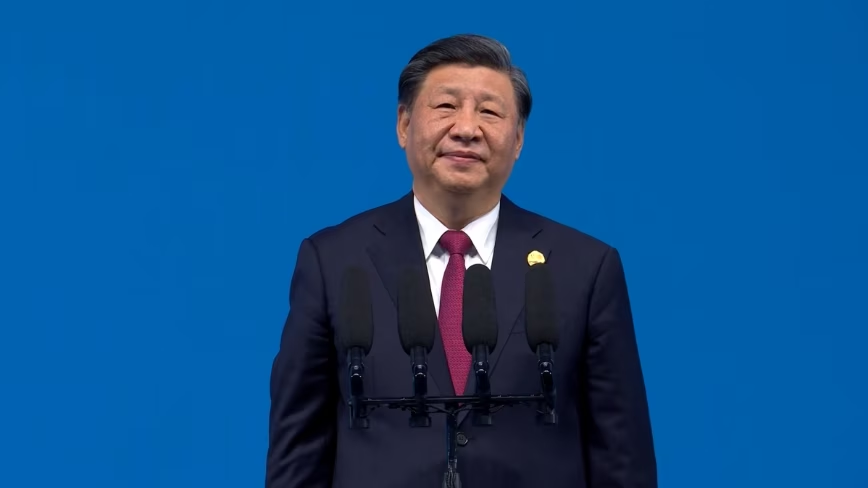
Xi pitches open-source AI to BRICS amid domestic curb debates
Chinese President Xi Jinping proposed a China-led open-source AI community and invited BRICS nations to join the World AI Cooperation Organization (WAICO) at the recent BRICS summit. This push for global collaboration contrasts sharply with Beijing's ongoing internal debates about restricting its own advanced AI models. Meanwhile, the EU's comprehensive AI Act, with its clear, enforceable rules for open-source AI, highlights a significant divergence in global AI governance approaches.

StarCraft Returns in 2030 as Open-World Shooter
Blizzard Entertainment announced a new StarCraft game, an open-world shooter, set to release in 2030. Unveiled at BlizzCon by VP Dan Hay, this marks the series' return after over a decade and a significant genre shift from its real-time strategy roots. The cinematic trailer showcased a gritty human-Zerg conflict, with many fans hoping for a traditional RTS follow-up.

Tesla Set to Finally Unveil Second-Generation Roadster on October 1
The much-anticipated second generation of the Tesla Roadster, a halo vehicle promising revolutionary performance, is finally slated for a public unveiling on October 1. After years of delays and a protracted development

Seattle Warned on Big Tech Reliance; Microsoft/OpenAI Sued; Apple's
A new City of Seattle study warns of the city's risky economic over-reliance on a few dominant tech companies. Simultaneously, the Seattle Times and Newsday are suing Microsoft and OpenAI for alleged AI training data theft, while Apple's new foldable iPhone Duo evokes memories of Microsoft's defunct Surface Duo.

in-depth: The Best 3-in-1 Apple Charging Stations After Testing 30
Wired has released its top picks for 3-in-1 Apple charging stations, extensively tested for iPhone, Apple Watch, and AirPods. The guide highlights six leading models, from premium speedy options to budget-friendly and compact designs, all focused on decluttering and optimizing charging for Apple users.

Nscale Adds Former OpenAI Exec Fidji Simo to Board Ahead of IPO
Nscale, the U.K.-based AI data center startup, has appointed former OpenAI, Meta, and Instacart executive Fidji Simo to its board of directors. This high-profile addition comes as Nscale prepares for a potential IPO this fall, leveraging Simo's extensive experience in scaling major tech platforms and guiding a company through a successful public offering.