
startups: Sam Altman says an AI jobs apocalypse is unlikely: OpenAI
OpenAI CEO Sam Altman now states that a widespread AI-driven jobs apocalypse is improbable, a softer stance than his previous warnings. He predicts significant churn within sectors and specific job displacements, but not an economy-wide collapse, a view supported by initial labor market data.
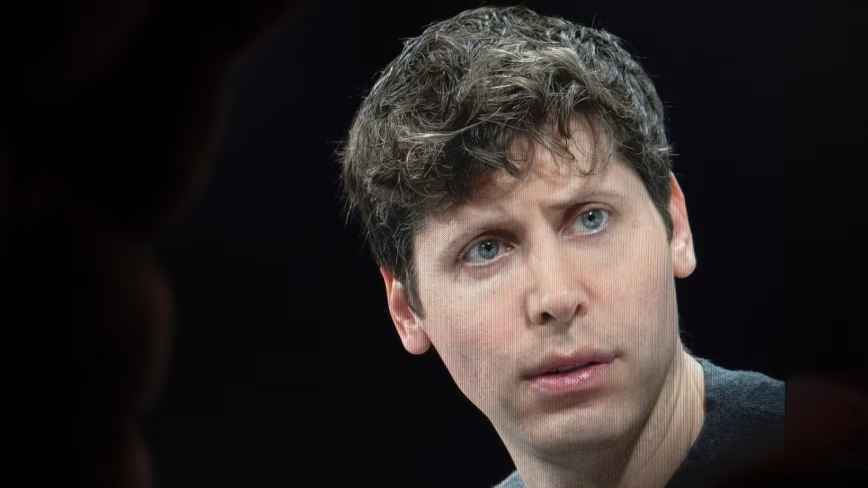
OpenAI CEO Sam Altman has indicated that a widespread AI-driven jobs apocalypse is improbable, marking a notable shift from his earlier, more alarmist warnings about technological unemployment. Speaking recently from an Asia-Pacific appearance, Altman conceded that while certain job categories, such as customer support, are likely to be largely automated, the economy as a whole is not expected to experience a broad collapse in employment numbers. This updated perspective, reported by Reuters, suggests a nuanced view of AI's impact, emphasizing significant sectoral churn rather than an overall headcount reduction.
Altman's latest remarks reflect a growing tendency among leading AI executives to temper previous dramatic predictions of labor disruption. Just a year ago, the OpenAI chief frequently spoke of customer service roles being "totally, totally gone" in the near future and suggested traditional work skills had a mere "two-to-three year half-life." His current message, reiterated during recent visits to India, Japan, and South Korea, delineates a different future: one characterized by substantial shifts within industries and job functions, but not an overarching economic downturn driven by job losses.
Crucially, this revised outlook aligns with existing research on AI's current impact on the labor market. The Yale Budget Lab, which meticulously tracks AI's effects on US employment since ChatGPT's introduction, has reported no significant changes in occupational mix or unemployment durations for workers in highly AI-exposed jobs through March 2026. Similarly, data from Anthropic incorporated into the lab's February update did not alter this picture, and the Brookings Institution reached an identical conclusion earlier this year: "no apocalypse, at least not yet."
Despite the softened macro framing, Altman has been consistently direct about the inevitable displacement in specific job categories. He foresees customer service work, particularly that conducted via phone or computer, being fully replaced and improved by AI within the next few years. The coding profession is already undergoing transformation, with engineers increasingly dedicating their time to architectural design, system oversight, and reviewing AI-generated code, rather than foundational coding tasks. Altman also noted in February that some companies might be engaging in "AI washing," attributing layoffs to AI when they would have occurred regardless.
The evolution in Altman's public statements does not entirely contradict OpenAI's own internal policy work. Earlier in 2026, the company released a comprehensive 13-page policy document that presumed significant future labor-market disruption. This document advocated for progressive measures such as taxes on automated labor, the establishment of a national public wealth fund partially financed by AI companies, and trials of a 32-hour working week. Rather than a denial of disruption, Altman's recent pronouncements are best interpreted as a calibration of its timing and character – envisioning less of a singular, disruptive rupture and more of a protracted, rolling reshuffle where some roles vanish, others are profoundly altered, and overall employment figures may remain relatively stable.
Altman's recent global itinerary reflects the tailored nature of his message. His visits to Tokyo, where he met with SoftBank CEO Masayoshi Son and Japanese Prime Minister Shigeru Ishiba, and subsequently to Seoul for an OpenAI developer event, have consistently featured a stronger emphasis on the potential for new job creation, particularly when compared to his engagements in the United States. As the Yale Budget Lab prepares its next data update in the coming weeks, both the current aggregate labor market statistics and Altman's refined narrative suggest a period of stability, for now.
FAQ
Q: What is Sam Altman's current view on AI's impact on jobs?
A: Sam Altman, CEO of OpenAI, now suggests that a broad AI jobs apocalypse is unlikely. While specific roles like customer support are expected to be heavily impacted and even disappear, he predicts significant churn within sectors rather than an overall economic collapse in employment.
Q: Does current data support this outlook?
A: Yes, initial labor market data largely supports this view. Studies by the Yale Budget Lab and the Brookings Institution indicate no meaningful widespread AI-related job displacement or changes in unemployment durations for high AI-exposure jobs through early 2026.
Q: How does this current stance relate to OpenAI's earlier policy recommendations?
A: Altman's recent remarks are seen as a calibration of the timing and nature of AI's disruption, not a complete denial of it. OpenAI's earlier policy document, which proposed measures like automated labor taxes and a 32-hour work week, still presumes significant labor market changes but aligns with the idea of a long, rolling reshuffle rather than an immediate, catastrophic event.
Related articles

Apple Unveils iPhone Duo: Pricey Foldable Sees Soaring Demand
Apple has officially entered the foldable smartphone arena with the long-anticipated launch of the iPhone Duo. Priced starting at a hefty $1,999, the device features a 5.4-inch outer display and a larger 7.6-inch inner
Android 17 QPR2 Beta 7.1: The Performance Relief You've Been Waiting
Android 17 QPR2 Beta 7.1: Finally Fixing the QPR1 Performance Woes Verdict: Android 17 QPR2 Beta 7.1 is a crucial and highly anticipated software update for Google Pixel users, specifically targeting and resolving the

in-depth: Chicago-Area Cops Helped HSI Spy on Minnesota Anti-ICE
Chicago-area law enforcement, including local police and HSI agents, conducted undercover surveillance on Minnesota anti-ICE activists at an April 2, 2022, talk in Chicago. This operation was part of a federal conspiracy probe into 15 Minnesota activists facing felony charges related to immigration enforcement resistance. Civil liberties advocates have condemned the surveillance as a troubling intrusion into protected political activity.

TCG Pocket Responds: A Much-Needed Pace Shift for Pokémon Fans
Pokémon TCG Pocket is rolling out a major update for its second anniversary, primarily addressing player concerns about overwhelming content releases by shifting to a six-week set schedule. This aims to curb player decline and improve overall engagement by giving trainers more time to collect and strategize. The update also adds new collection methods, improved deck-building features, and enhanced trading functionality.

Mark Wahlberg on using AI in film ‘the right way’ and being open to
Actor Mark Wahlberg believes AI has a place in filmmaking if used responsibly for enhancement, not script generation or actor replacement. At TechCrunch Disrupt, he expressed openness to an AI likeness carrying on his legacy, managed by his family, and emphasized storytelling.

Apple iPhone Duo: A Daring Debut with Notable Compromises
Apple's highly anticipated iPhone Duo, priced at $2,000, has gone on pre-order. While hailed as "Apple's most exciting device in a decade" for its innovative foldable design and immersive display, it comes with significant drawbacks like the absence of FaceID and a premium camera.