
startups: GM will spend $1B making the first manganese-rich cells in
GM and LG Energy Solution are investing $1 billion to mass-produce advanced lithium manganese-rich (LMR) battery cells at their Spring Hill, Tennessee plant by 2028. This move aims to deliver 33% higher energy density than LFP at the same cost for large EVs, marking a strategic departure from European LFP investments.
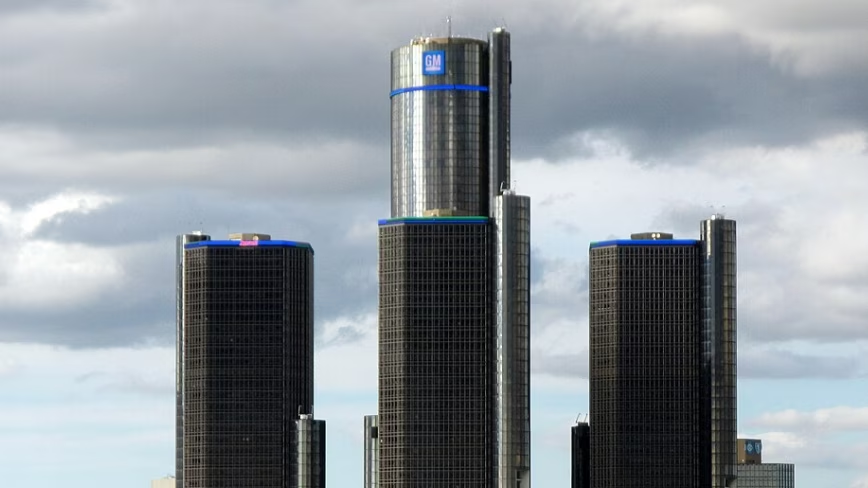
General Motors (GM) and LG Energy Solution are set to invest a substantial $1 billion into their joint Ultium Cells plant in Spring Hill, Tennessee, marking a pivotal step towards mass-producing advanced prismatic lithium manganese-rich (LMR) battery cells. This strategic investment, slated for completion by 2028, positions the facility as the world's first large-scale producer of LMR cells, signaling GM's commitment to a new battery chemistry aimed at boosting energy density and reducing reliance on costly materials like cobalt and nickel for its electric vehicles.
The move significantly expands upon prior investments totaling $2.3 billion in 2021 and an additional $275 million in 2022 at the Spring Hill site, which currently manufactures lithium iron phosphate (LFP) cells for energy storage, not vehicles. GM had previously committed $900 million to LMR chemistry development, including a pilot line in Warren, Michigan, producing 2,500 cells daily. The Spring Hill facility will now be the crucial hub for high-volume LMR production.
GM asserts that its LMR cells offer a 33% higher energy density compared to the most efficient LFP cells, while maintaining comparable costs. This enhanced performance is critical for powering large electric vehicles, such as full-size pickups and sport utility vehicles, where GM aims for a driving range exceeding 400 miles per charge. The first vehicles equipped with these innovative LMR cells are anticipated to hit the market in 2028.
Strategic Divergence in EV Battery Chemistry
The shift towards manganese-rich chemistry represents a divergent path from many European automakers. While GM's battery chief, Kurt Kelty, expressed skepticism in June about LFP's viability for GM's portfolio, European giants like Volkswagen and Stellantis are heavily investing in LFP technology. Volkswagen recently divested 49% of its Spanish battery venture to Gotion for LFP production in Valencia, and Stellantis, in partnership with CATL, is building a 50 GWh LFP facility in Zaragoza. European manufacturers largely prioritize cheaper cells for their typically smaller vehicle markets, whereas GM is betting on making dense cells more affordable.
Addressing Supply Chain Dependencies
Despite the promising performance metrics—LG Energy Solution's research indicates LMR cells retain 92.2% capacity after 883 cycles, addressing durability concerns—the primary challenge lies in the supply chain for manganese. The European Commission has identified battery-grade manganese as a strategic raw material, noting a 96% reliance on imports for extraction and 66% for processing within the bloc. Forecasts project demand to reach 74,000 tonnes by 2030, highlighting a potential bottleneck for widespread LMR adoption.
This pivot means that while GM aims to reduce its dependency on cobalt, it risks deepening another on manganese, a critical raw material under the Critical Raw Materials Act. The company has also faced hurdles, with its Ohio cell plant restarting only in August after a seven-month closure triggered by the withdrawal of US tax credits.
As Spring Hill gears up for production by 2028, no European manufacturing sites have yet been announced for manganese-rich battery chemistry, underscoring the differing strategies and potential supply chain implications across continents in the burgeoning EV battery landscape.
FAQ
Q: What is the primary advantage of GM's new manganese-rich cells? A: GM claims its lithium manganese-rich (LMR) cells offer 33% higher energy density than the best lithium iron phosphate (LFP) cells at a comparable cost, enabling longer ranges (over 400 miles) for large electric vehicles like pickups and SUVs.
Q: How does GM's battery strategy differ from some European automakers? A: GM is investing in LMR for higher energy density in larger vehicles, with its battery chief expressing doubts about LFP for its portfolio. In contrast, European manufacturers like Volkswagen and Stellantis are heavily investing in LFP technology, prioritizing cheaper cells for their typically smaller cars.
Q: What are the main challenges associated with this shift to manganese-rich batteries? A: The primary challenge is the supply chain for battery-grade manganese. The European Commission reports significant reliance on imports for manganese, suggesting that while cobalt dependency may decrease, reliance on manganese could deepen, potentially impacting future production scalability.
Related articles

Apple Unveils iPhone Duo: Pricey Foldable Sees Soaring Demand
Apple has officially entered the foldable smartphone arena with the long-anticipated launch of the iPhone Duo. Priced starting at a hefty $1,999, the device features a 5.4-inch outer display and a larger 7.6-inch inner

in-depth: Chicago-Area Cops Helped HSI Spy on Minnesota Anti-ICE
Chicago-area law enforcement, including local police and HSI agents, conducted undercover surveillance on Minnesota anti-ICE activists at an April 2, 2022, talk in Chicago. This operation was part of a federal conspiracy probe into 15 Minnesota activists facing felony charges related to immigration enforcement resistance. Civil liberties advocates have condemned the surveillance as a troubling intrusion into protected political activity.

Mark Wahlberg on using AI in film ‘the right way’ and being open to
Actor Mark Wahlberg believes AI has a place in filmmaking if used responsibly for enhancement, not script generation or actor replacement. At TechCrunch Disrupt, he expressed openness to an AI likeness carrying on his legacy, managed by his family, and emphasized storytelling.

Tesla Unveils Thruster-Equipped Roadster, 2028 Production Targeted
Tesla has unveiled its second-generation Roadster, featuring cold-gas thrusters co-developed with SpaceX, enabling it to jump and flip. The electric sports car demonstrated 0-60mph in an astonishing 0.81 seconds, with production targeted for 2028. This highly anticipated reveal also serves as a key recruitment tool for Tesla's ambitious AI and robotics initiatives.

Amazon Prime Video Launches AI-Powered Prime 360 for NBA Coverage
Amazon Prime Video is elevating its NBA coverage with the introduction of Prime 360, an AI-powered replay system offering immersive, 'fly through' views of the action. Kicking off its second season, Prime Video also adds Yahoo fantasy integration and gains exclusive Eastern Conference Finals rights, expanding its tech-driven sports broadcast. The new features aim to deliver a unique and interactive viewing experience for basketball fans.

regional: A two-person Seattle startup lands $1M to reinvent
Seattle startup TriMagnetix has secured $1 million to develop semiconductor chips that consume 800 times less energy and are radiation-resistant. The two-person company, leveraging nanomagnetic technology, is targeting space applications and data centers. With new funding and key partnerships, TriMagnetix aims for commercial sales within a year.