
SpaceX, Starlink, and Seattle Tech: Ambition Meets Reality
GeekWire's podcast dissects Elon Musk's Starlink ambitions, SpaceX's public debut, and Seattle's tech evolution. It reveals a landscape of bold claims, fierce space race competition, and the dynamic growth and risks within tech hubs.
Quick Verdict
This overview of the GeekWire Podcast delves into a multifaceted tech landscape, touching on Elon Musk's ambitious Starlink plans, SpaceX's financial performance as a newly public entity, and a nostalgic yet insightful look at Seattle's evolving tech ecosystem. The picture painted is one of immense potential, particularly with Starlink aiming to dominate global internet, juxtaposed with the inherent challenges and long timelines characteristic of groundbreaking tech ventures. While Musk's vision often outpaces immediate reality, the sheer scale of these endeavors demands attention, offering a blend of genuine innovation and strategic posturing.
Starlink's Bold Claims and SpaceX's Public Debut
Elon Musk's Starlink, a division of SpaceX, recently made headlines with its first quarter as a public company. The most striking claim from Musk himself is the assertion that Starlink could provide a majority of the world's internet connectivity within a decade. This audacious target is underpinned by Starlink's production facilities located in Redmond, highlighting a significant presence in the Pacific Northwest tech hub. Beyond satellite internet, Musk also outlined SpaceX's broader data center ambitions. He framed the challenges of terrestrial data infrastructure as "trivial" when compared to the complex feat of developing reusable rockets, signaling a wider strategic play that extends beyond simply beaming internet from space. This perspective underscores a confidence in their core rocketry capabilities to solve other large-scale infrastructure problems.
While the vision is grand, critics like Dominic Gates have pointed out the potential for a "Mars illusion" – a significant gap between Musk's future-forward vision and the practical timelines required for execution. This isn't just about Starlink's rollout, but also the broader implications for SpaceX's other lofty goals.
Pros:
- Global Reach Potential: Starlink aims to bring internet to underserved areas globally, a significant humanitarian and economic impact.
- Technological Prowess: Leveraging advanced reusable rocket technology for rapid satellite deployment.
- Integrated Strategy: Expansion into data centers suggests a comprehensive approach to internet infrastructure.
Cons:
- Ambitious Timelines: Musk's projections are often aggressive and may not align with practical implementation schedules.
- Intense Competition: The space and internet infrastructure sectors are highly competitive, with established cloud giants and other space ventures vying for market share.
The Shifting Landscape of the Space Race
The competitive environment for SpaceX is intense. While the source broadly pits SpaceX against "cloud giants," the direct rivalry in space infrastructure is perhaps best illustrated by the ongoing drama with Jeff Bezos's Blue Origin. The podcast touched upon a significant setback for Blue Origin, reporting that its New Glenn rocket exploded on the pad during a test, with Bezos vowing to rebuild. This incident highlights the inherent risks and brutal realities of space development, impacting not only Blue Origin but also associated projects like NASA missions and Amazon's Project Kuiper (referred to as Amazon Leo).
This isn't the first time an ambitious satellite internet project has been attempted. The discussion harked back to Teledesic, a venture by Craig McCaw, backed by Bill Gates, which aimed to beam internet from space decades before Starlink. Teledesic's eventual failure serves as a historical precedent and a cautionary tale, reminding us that vision alone isn't sufficient for success in this challenging domain.
Revisiting Seattle's Tech Universe
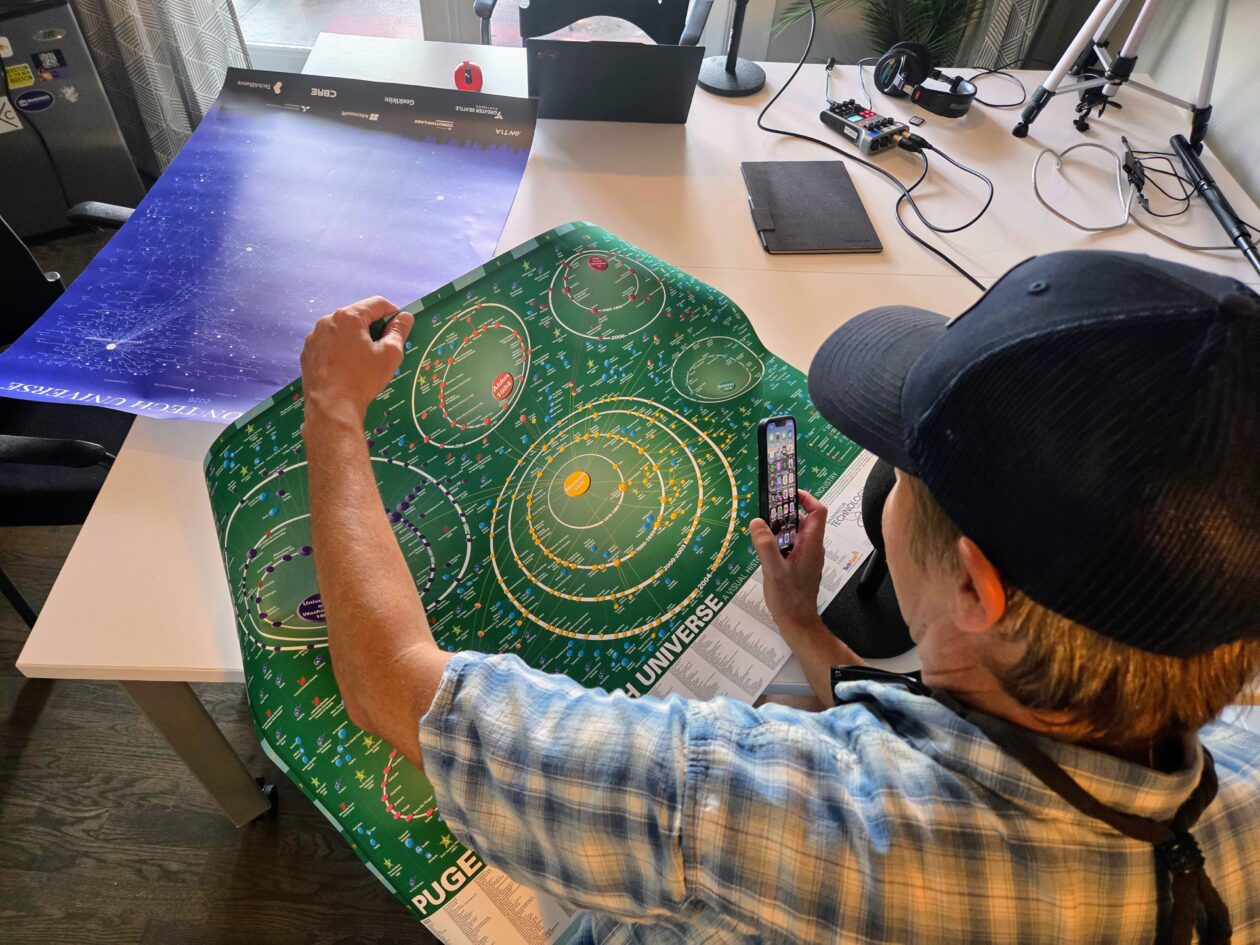
The podcast also took a fascinating dive into the evolution of Seattle's tech scene, comparing two "Washington tech universe" posters separated by 17 years (2009 and 2026). The older 2009 map revealed historical "gems," such as Boeing's unexpected connection to Classmates.com, a precursor to social media giants like Facebook, and the presence of RealNetworks. These maps effectively trace the state's tech landscape to a few key hubs, providing a visual history of how the ecosystem has grown and shifted.
Examining these maps prompts a critical question about "what's at risk" in the current environment. The rapid evolution, as seen in the comparison, means that once-dominant players can fade, and new ones emerge. This dynamic nature implies both opportunities for new startups (like HitchPiggy or AI tutors mentioned in related stories) and challenges for established companies, as evidenced by job cuts at Zillow, Google, and Salesforce/Tableau in Washington state.
The Big Picture: Ambition, Competition, and Evolution
What emerges from this snapshot of the tech world is a narrative of relentless ambition and fierce competition. Elon Musk's Starlink and SpaceX represent a bold push to redefine global connectivity and space transport, but they operate within a volatile landscape where even well-funded rivals like Blue Origin face significant hurdles. The historical perspective offered by Teledesic and the Seattle tech maps grounds these grand visions in the reality of past failures and the constant evolution of industry hubs.
For consumers, Starlink promises broader internet access, particularly in remote areas, a significant boon if its deployment scales as projected. For investors and industry observers, the public debut of SpaceX marks a new chapter, bringing greater scrutiny to its financial performance alongside its technological breakthroughs. The Seattle tech universe continues to demonstrate resilience and innovation, albeit with ongoing shifts and challenges in employment and company valuations.
Recommendation / Outlook
For those observing the tech industry, these developments signify an exciting, albeit uncertain, period. Starlink's potential to become a dominant global internet provider is a game-changer, but its success hinges on sustained execution and overcoming regulatory and competitive pressures. SpaceX's public offering positions it as a major player in space and potentially broader infrastructure, making it a company to watch closely for its disruptive potential. Meanwhile, the Seattle tech scene serves as a microcosm of the larger industry, demonstrating adaptability and continuous innovation despite economic ebbs and flows.
It's advisable to approach Musk's grand predictions with a healthy dose of realism, balancing the inspiring vision with the practical realities of engineering and business. However, ignoring the immense progress and strategic plays by companies like SpaceX would be a mistake. The future of global internet and space exploration is being shaped right now, with significant implications for everyone.
FAQ
Q: How realistic is Elon Musk's claim that Starlink will provide a majority of the world's internet within a decade? A: While incredibly ambitious, Musk's projections are historically optimistic. Starlink's capabilities and current deployment are impressive, particularly for underserved areas. However, achieving a "majority" of global internet connectivity in just ten years would require an unprecedented rate of expansion and adoption, facing significant regulatory, logistical, and competitive challenges from terrestrial and other satellite providers. It's a testament to the vision, but the timeline remains highly speculative.
Q: What do the Seattle tech universe maps tell us about the future of tech hubs? A: The comparison between the 2009 and 2026 maps illustrates the dynamic and evolving nature of tech hubs. It shows that while certain core companies and sectors remain strong, new players emerge, and older ones may recede. The maps highlight the importance of adaptability and innovation for a region to sustain its tech prominence. It also underscores that even established hubs face risks, including job market fluctuations and intense competition for talent and investment.
Q: What are the primary challenges facing companies like SpaceX and Blue Origin in the ongoing space race? A: Both companies face immense technical and financial hurdles. Blue Origin's recent rocket explosion serves as a stark reminder of the inherent risks in developing advanced launch systems. Beyond engineering, challenges include securing lucrative contracts (like NASA missions or satellite deployments), navigating complex regulatory environments, managing massive capital expenditures, and sustaining consistent innovation against well-funded competitors. The "Mars illusion" also points to the difficulty of meeting long-term, visionary goals within specific timelines.
Related articles
Android 17 QPR2 Beta 7.1: The Performance Relief You've Been Waiting
Android 17 QPR2 Beta 7.1: Finally Fixing the QPR1 Performance Woes Verdict: Android 17 QPR2 Beta 7.1 is a crucial and highly anticipated software update for Google Pixel users, specifically targeting and resolving the

DJI Solo Video Setups: Smart Choices for Lone Creators
This review delves into DJI's recommended solo video setups, highlighting the Osmo Pocket 3 Creator Combo as a top pick for its integrated camera, gimbal, and mic. It also covers stabilizers like the Osmo Mobile 8 and RS 4, and the DJI Mic Mini series for enhanced audio, providing honest pros, cons, and clear buying advice.

Mark Wahlberg on using AI in film ‘the right way’ and being open to
Actor Mark Wahlberg believes AI has a place in filmmaking if used responsibly for enhancement, not script generation or actor replacement. At TechCrunch Disrupt, he expressed openness to an AI likeness carrying on his legacy, managed by his family, and emphasized storytelling.

Ars Technica's Rocket Report: Your Essential Space Industry Briefing
Quick Verdict Ars Technica's Rocket Report, presented by veteran space reporter Stephen Clark, offers an invaluable and meticulously organized weekly (or similar frequency, implied by "Edition 9.15") digest of the most

Apple iPhone Duo: A Daring Debut with Notable Compromises
Apple's highly anticipated iPhone Duo, priced at $2,000, has gone on pre-order. While hailed as "Apple's most exciting device in a decade" for its innovative foldable design and immersive display, it comes with significant drawbacks like the absence of FaceID and a premium camera.

Tesla Unveils Thruster-Equipped Roadster, 2028 Production Targeted
Tesla has unveiled its second-generation Roadster, featuring cold-gas thrusters co-developed with SpaceX, enabling it to jump and flip. The electric sports car demonstrated 0-60mph in an astonishing 0.81 seconds, with production targeted for 2028. This highly anticipated reveal also serves as a key recruitment tool for Tesla's ambitious AI and robotics initiatives.