
Samsung, Union in Last-Ditch Talks to Avert Massive Chip Strike
Samsung Electronics and its largest labor union are engaging in crucial negotiations Monday to prevent an 18-day strike. The dispute centers on profit sharing from the AI boom, with the Prime Minister warning of severe economic repercussions and hinting at emergency government intervention.
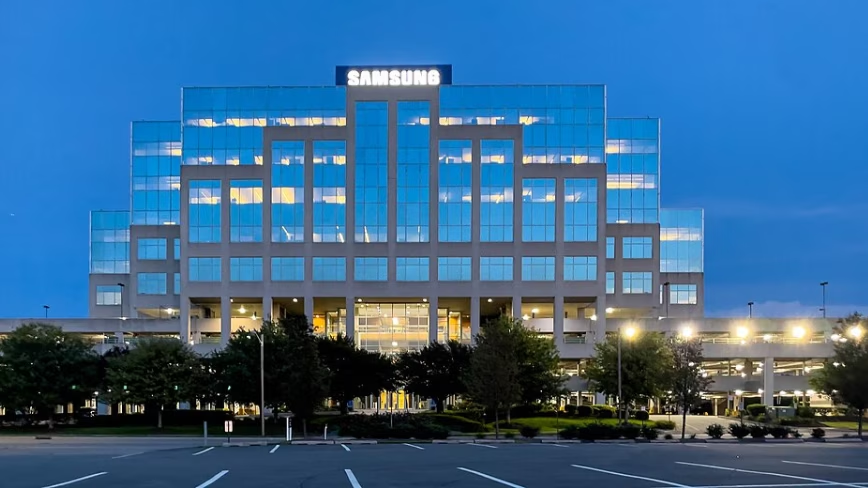
Samsung Electronics and its largest labor union are set to hold critical negotiations on Monday, a last-ditch effort to prevent an 18-day strike at the world's leading memory chipmaker. South Korean Prime Minister Kim Min-Seok has underscored the urgency, calling it "virtually the last chance" to avert a walkout by potentially over 50,000 workers scheduled for May 21. At the heart of the dispute is how Samsung will distribute the massive profits from the artificial intelligence (AI) boom to its workforce.
Government Intervention Amid High Stakes
The stakes for the South Korean economy and global technology supply chains are immense. Prime Minister Kim publicly warned that a strike could inflict "unimaginable" economic damage, estimating daily losses at Samsung's chip factories to be as high as 1 trillion won ($668 million). He also hinted at the unprecedented possibility of the government invoking emergency powers to prevent the industrial action, signifying the national importance of the negotiations.
Monday's talks will see the head of South Korea's National Labor Relations Commission mediate, elevating the dispute from a corporate issue to a matter of direct government intervention. This follows the collapse of previous negotiations on May 12 after a marathon 17-hour session that union representative Choi Seung-ho described as largely unproductive.
The Core of the Dispute: Profit Sharing
The union's core demands center on a greater share of Samsung's booming profits. They seek to abolish an existing cap on bonuses, allocate a fixed 15% of operating profit to worker bonuses, and embed these terms into employment contracts. Samsung, in response, has proposed allocating 10% of operating profit to bonuses alongside a special one-time compensation package.
Company executives argue that the union's higher demands would be unsustainable for the company in the long term. This 5% difference in operating profit allocation translates to a substantial ₩2.9 trillion ($1.9 billion) annually based on the company's recent first-quarter figures.
Record Profits vs. Worker Compensation
The union's firm stance comes amid a period of extraordinary financial success for Samsung. The company reported a record-breaking first quarter in 2026, with ₩133.9 trillion (approximately $90 billion) in revenue and an operating profit of ₩57.2 trillion – an eightfold year-on-year increase. The semiconductor division alone accounted for approximately 94% of this profit, largely fueled by demand for high-bandwidth memory (HBM) chips critical for AI infrastructure.
Samsung’s market capitalization recently surpassed $1 trillion, joining TSMC in the semiconductor elite. Furthermore, the wealth of the controlling Lee family has reportedly doubled to $45.5 billion within the last year. Workers argue that their compensation has not adequately reflected the company's surging performance or kept pace with inflation, citing a perceived gap between Samsung's bonus structure and that of rival chipmaker SK Hynix.
Corporate Apology and Global Economic Impact
Acknowledging the internal strife, Samsung Electronics Chair Jay Y. Lee issued a rare public apology at the weekend, stating, "Union members, Samsung family members, we are one body, one family." This gesture, along with unusual visits by executives to union facilities last week, highlights the company's recognition of the severity of the situation.
Beyond Samsung's walls, the strike threatens to destabilize South Korea's national economy, given that semiconductors constitute 37% of the nation's total exports, up from 20% a year earlier. Globally, an 18-day shutdown would severely impact the supply of critical DRAM and HBM chips, intensifying existing AI-driven memory shortages projected to last through 2027 and beyond, with hyperscalers already booking supply years ahead. Korean media estimate total losses could reach 40 trillion won if 50,000 workers participate in the strike.
The Path Forward
This impending strike represents the most significant challenge yet for Samsung's labor relations, building on a precedent set by the union's first general strike in 2024. That initial action demonstrated the willingness of technical and white-collar workers to walk out, and subsequent negotiations have tested the limits of their collective leverage.
The current "AI memory supercycle" has created historically unprecedented profits, intensifying the workers' demand for a larger share. The intervention and warnings from the Prime Minister add a formidable layer of government pressure, making it clear that a resolution is imperative for national economic stability. Monday's talks will reveal whether this elevated pressure can bridge the divide and avert a costly industrial crisis.
FAQ
Q: What are the key demands of Samsung's labor union? A: The union is demanding the elimination of the current bonus cap, an allocation of 15% of Samsung's operating profit to worker bonuses, and the formal inclusion of these terms in employment contracts.
Q: What is the potential economic impact of a strike? A: South Korean Prime Minister Kim Min-Seok has warned of "unimaginable" economic damage, estimating daily losses at Samsung's chip factories could reach up to 1 trillion won ($668 million). If 50,000 workers participate, total losses could hit 40 trillion won.
Q: Why is the South Korean government involved in these negotiations? A: Semiconductors account for 37% of South Korea's exports, and a strike at Samsung, the world's largest memory chipmaker, is viewed as a national economic emergency. The Prime Minister has intervened directly, and the head of the National Labor Relations Commission will mediate, signaling the government's intent to prevent significant economic disruption and potential global supply chain issues.
Related articles

Apple Unveils iPhone Duo: Pricey Foldable Sees Soaring Demand
Apple has officially entered the foldable smartphone arena with the long-anticipated launch of the iPhone Duo. Priced starting at a hefty $1,999, the device features a 5.4-inch outer display and a larger 7.6-inch inner

in-depth: Chicago-Area Cops Helped HSI Spy on Minnesota Anti-ICE
Chicago-area law enforcement, including local police and HSI agents, conducted undercover surveillance on Minnesota anti-ICE activists at an April 2, 2022, talk in Chicago. This operation was part of a federal conspiracy probe into 15 Minnesota activists facing felony charges related to immigration enforcement resistance. Civil liberties advocates have condemned the surveillance as a troubling intrusion into protected political activity.

Mark Wahlberg on using AI in film ‘the right way’ and being open to
Actor Mark Wahlberg believes AI has a place in filmmaking if used responsibly for enhancement, not script generation or actor replacement. At TechCrunch Disrupt, he expressed openness to an AI likeness carrying on his legacy, managed by his family, and emphasized storytelling.

Tesla Unveils Thruster-Equipped Roadster, 2028 Production Targeted
Tesla has unveiled its second-generation Roadster, featuring cold-gas thrusters co-developed with SpaceX, enabling it to jump and flip. The electric sports car demonstrated 0-60mph in an astonishing 0.81 seconds, with production targeted for 2028. This highly anticipated reveal also serves as a key recruitment tool for Tesla's ambitious AI and robotics initiatives.

Amazon Prime Video Launches AI-Powered Prime 360 for NBA Coverage
Amazon Prime Video is elevating its NBA coverage with the introduction of Prime 360, an AI-powered replay system offering immersive, 'fly through' views of the action. Kicking off its second season, Prime Video also adds Yahoo fantasy integration and gains exclusive Eastern Conference Finals rights, expanding its tech-driven sports broadcast. The new features aim to deliver a unique and interactive viewing experience for basketball fans.
regional: A two-person Seattle startup lands $1M to reinvent
Seattle startup TriMagnetix has secured $1 million to develop semiconductor chips that consume 800 times less energy and are radiation-resistant. The two-person company, leveraging nanomagnetic technology, is targeting space applications and data centers. With new funding and key partnerships, TriMagnetix aims for commercial sales within a year.