
Robotaxi Rules Spark Fierce Battle Between Uber and Waymo in D.C
Uber and Waymo are locked in a contentious battle over proposed robotaxi regulations in Washington D.C., with Uber pushing a "hybrid" model to protect human drivers and Waymo poised to gain a market advantage under the current bill. This regulatory clash highlights broader industry debates over autonomous vehicle deployment and market control. Simultaneously, Uber is expanding its global delivery presence with a $14.8 billion acquisition of Delivery Hero, while other mobility startups secure significant funding.

A heated regulatory conflict over autonomous vehicle (AV) operations is unfolding in Washington D.C., pitting ride-hailing giant Uber against self-driving pioneer Waymo. The dispute centers on a proposed D.C. Council bill designed to govern robotaxi services, which has revealed a deepening rift between the former partners in the burgeoning mobility sector.
TechCrunch Mobility sources indicate that Uber is actively lobbying against the D.C. bill, arguing it unfairly favors Waymo and could lead to a de facto monopoly while displacing human drivers. Uber is pushing for a "hybrid" operational model that would mandate robotaxis to function within existing ride-hailing networks alongside human-operated vehicles.
Such a hybrid system, if implemented, would present a significant challenge to AV developers like Waymo. It would force them to either integrate their self-driving fleets into platforms like Uber's or maintain human drivers in their costly, purpose-built robotaxi operations. Insiders suggest this hybrid approach faces an uphill battle to become law.
During a recent D.C. Council hearing, Waymo emerged as one of the few industry players largely in favor of the proposed legislation. The bill includes stringent requirements, such as a 180-day, 250,000-mile mandatory testing phase, a $1 million application fee, a $5 million permit fee, and a $0.15-per-mile tax. Waymo has already surpassed the testing mileage and duration requirements through its D.C. operations with safety operators, giving it a potential six-month market lead if the bill passes as written.
Conversely, many other AV developers, including Tesla, voiced strong opposition to various aspects of the bill. Tesla's senior policy adviser, India Herdman, highlighted concerns over the extensive testing requirements and high fees, advocating for testing miles accumulated in other jurisdictions to be recognized.
Beyond the D.C. regulatory showdown, the broader mobility landscape is seeing significant developments. Uber is set to expand its global footprint dramatically with a proposed $14.8 billion acquisition of Germany’s Delivery Hero, nearly doubling its delivery presence across Europe, the Middle East, Latin America, and Asia, pending regulatory approvals. Delivery Hero also agreed to sell off some businesses in markets where Uber Eats already operates to SSW Partners for $1.6 billion.
In the startup scene, Self Inspection, focused on AI-powered vehicle inspections, secured $10 million in funding led by Sheryl Sandberg’s family office. Senra, a company modernizing wire harness manufacturing, raised a substantial $65 million in a Series B round. Meanwhile, Indian fast-delivery firm Zepto is reportedly eyeing an IPO valuation significantly lower than its previous $7 billion peak.
Safety and policy continue to be central themes. The Los Angeles Police Department is reportedly ending its contract with Flock Safety, citing civil liberties and privacy concerns related to its license plate camera network. San Francisco Mayor Daniel Lurie has urged state regulators to tighten AV rules following an incident where Waymo robotaxis caused significant traffic congestion. Additionally, Zoox issued a software recall after one of its robotaxis was confused by smoke from a fire scene, and the NTSB confirmed a Tesla driver pressed the accelerator 100% in a fatal crash, overriding Full Self-Driving software.
Amidst these developments, Lucid Motors strongly denied reports of considering Chapter 11 bankruptcy, causing its stock to fluctuate before recovering. SpaceX also experienced an abrupt abort of its second Starship V3 launch attempt. The dynamic interplay of technological advancement, market consolidation, and evolving regulatory frameworks underscores the complex future of transportation.
FAQ
Q: Why are Uber and Waymo on opposing sides of the D.C. robotaxi bill?
A: Uber opposes the bill, arguing it could displace human drivers and grant Waymo a monopoly due to Waymo having already met the proposed bill's stringent testing requirements. Uber advocates for a hybrid model where robotaxis operate on ride-hailing apps alongside human drivers.
Q: What are the main objections from other AV developers to the D.C. bill?
A: Other AV developers, including Tesla, object to the bill's high application and permit fees, the $0.15-per-mile tax, and the mandatory 180-day, 250,000-mile testing requirement, especially asking for testing miles from other jurisdictions to count.
Q: What significant deal is Uber pursuing in the delivery sector?
A: Uber is in the process of acquiring Germany’s Delivery Hero in a $14.8 billion deal, which would nearly double its global delivery footprint across nearly 100 markets, subject to regulatory approvals.
Related articles
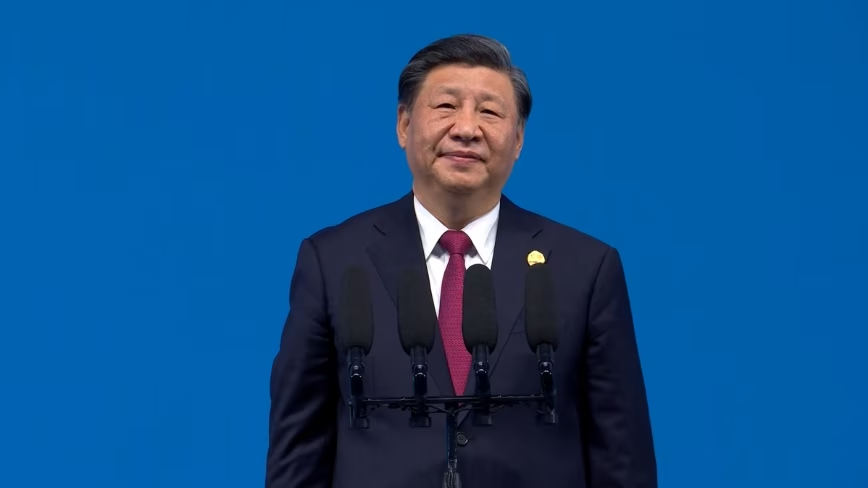
Xi pitches open-source AI to BRICS amid domestic curb debates
Chinese President Xi Jinping proposed a China-led open-source AI community and invited BRICS nations to join the World AI Cooperation Organization (WAICO) at the recent BRICS summit. This push for global collaboration contrasts sharply with Beijing's ongoing internal debates about restricting its own advanced AI models. Meanwhile, the EU's comprehensive AI Act, with its clear, enforceable rules for open-source AI, highlights a significant divergence in global AI governance approaches.

The Party's Back! Tales from '85 Unleashes Season 2 on Netflix
Stranger Things: Tales from '85, the animated spin-off, returns to Netflix on September 17th with 10 new episodes. Set between seasons 2 and 3 of the original live-action series, Season 2 sees The Party facing ghostly apparitions and strange creatures around Valentine's Day. While it received mixed reactions initially, it retains the 80s vibe and core characters.

StarCraft Returns in 2030 as Open-World Shooter
Blizzard Entertainment announced a new StarCraft game, an open-world shooter, set to release in 2030. Unveiled at BlizzCon by VP Dan Hay, this marks the series' return after over a decade and a significant genre shift from its real-time strategy roots. The cinematic trailer showcased a gritty human-Zerg conflict, with many fans hoping for a traditional RTS follow-up.

Tesla Set to Finally Unveil Second-Generation Roadster on October 1
The much-anticipated second generation of the Tesla Roadster, a halo vehicle promising revolutionary performance, is finally slated for a public unveiling on October 1. After years of delays and a protracted development

Seattle Warned on Big Tech Reliance; Microsoft/OpenAI Sued; Apple's
A new City of Seattle study warns of the city's risky economic over-reliance on a few dominant tech companies. Simultaneously, the Seattle Times and Newsday are suing Microsoft and OpenAI for alleged AI training data theft, while Apple's new foldable iPhone Duo evokes memories of Microsoft's defunct Surface Duo.

in-depth: The Best 3-in-1 Apple Charging Stations After Testing 30
Wired has released its top picks for 3-in-1 Apple charging stations, extensively tested for iPhone, Apple Watch, and AirPods. The guide highlights six leading models, from premium speedy options to budget-friendly and compact designs, all focused on decluttering and optimizing charging for Apple users.