
Polymarket: High Stakes, Higher Risks
Quick Verdict Polymarket, a prominent prediction market platform, has been thrust into the spotlight following allegations of insider trading involving a US Army soldier, Gannon Ken Van Dyke. While the platform swiftly

Quick Verdict
Polymarket, a prominent prediction market platform, has been thrust into the spotlight following allegations of insider trading involving a US Army soldier, Gannon Ken Van Dyke. While the platform swiftly identified the user and cooperated with authorities, this incident highlights the inherent risks and intense regulatory scrutiny faced by prediction markets. For those considering participation, Polymarket offers a decentralized betting experience on real-world events, but users must navigate significant legal, ethical, and reputational hazards. The platform's ability to facilitate large-scale, high-stakes wagers also exposes potential vulnerabilities, especially when classified information is involved.
Understanding Polymarket: Core Functionality and Incident Details
Polymarket operates as a prediction market where users can bet on the outcomes of future events. In this particular case, the platform facilitated wagers on geopolitical events, specifically the timing of Venezuelan President Nicolás Maduro's capture. The accused soldier, Gannon Ken Van Dyke, allegedly created a Polymarket account, funded it, and began trading around December 26, 2025. He placed approximately 13 bets between December 27, 2025, and January 26, 2026, all taking the "YES" position on outcomes like "US Forces in Venezuela… by January 31, 2026" or "Maduro out by… January 31, 2026."
Van Dyke reportedly used classified, nonpublic information about "Operation Absolute Resolve"—a US military operation to capture Maduro—to inform his bets. He invested roughly $33,034 and allegedly profited approximately $409,881. After Maduro's capture on January 3, 2026, and subsequent reports of unusual trading, Van Dyke attempted to conceal his identity by requesting his Polymarket account be deleted and changing the email associated with his cryptocurrency exchange account. The Department of Justice (DOJ) has indicted Van Dyke on multiple charges, including unlawful use of confidential government information, commodities fraud, and wire fraud, with potential penalties up to 60 years in prison. The Commodity Futures Trading Commission (CFTC) has also filed a civil complaint against him, seeking restitution, penalties, and trading bans, marking the first time the CFTC has charged insider trading in event contracts and used the "Eddie Murphy Rule" for misuse of government information.
Polymarket's statement confirmed it identified a user trading on classified information, referred the matter to the DOJ, and cooperated with the investigation, asserting that "insider trading has no place on Polymarket."
User Experience and Ethical Framework
From a user perspective, Polymarket provides a platform for engaging with real-world predictions, often leveraging cryptocurrency for transactions. This incident, however, starkly illustrates the dual nature of such platforms. On one hand, Polymarket's ability to track and, in this instance, apparently assist in identifying illicit activity points to some level of internal control or data logging. The company's swift public statement and cooperation with authorities indicate an attempt to maintain integrity and distance itself from unlawful acts by its users. This response is crucial for the platform's long-term viability and public trust.
On the other hand, the very existence of markets on sensitive geopolitical events creates a fertile ground for ethical dilemmas and potential misuse. The incident raises questions about the platform's responsibility in vetting market types and preventing information asymmetries that could be exploited for insider trading. While Polymarket asserts that insider trading has no place on its platform, the fact that such a substantial profit was made using classified government information, even if later detected, highlights a significant vulnerability. The "casino" analogy used by President Trump, while perhaps hyperbolic, captures the sentiment of risk associated with these markets, which can be seen as less about pure prediction and more about speculation with potentially dangerous real-world implications, especially when national security is involved.
Pros and Cons
Pros:
- Market Efficiency (Theoretical): Prediction markets are often lauded for their potential to aggregate information and reflect true probabilities of events.
- Platform Cooperation: Polymarket demonstrated a willingness to cooperate with law enforcement, identifying the alleged perpetrator and assisting in the investigation, which is a positive for accountability.
- Transparency (in identifying fraud): The fact that Polymarket's systems or processes led to the identification of unusual trading, prompting the referral to DOJ, suggests some level of monitoring.
Cons:
- Insider Trading Risk: The primary downside highlighted by this case is the significant risk of insider trading, especially when markets concern sensitive political or military events.
- Ethical and National Security Concerns: Allowing bets on military operations or political leadership captures creates profound ethical dilemmas and could potentially compromise national security or incentivize undesirable outcomes.
- Regulatory Scrutiny: Prediction markets face intense scrutiny, with states attempting to impose stricter regulations. The federal government, however, asserts jurisdiction, as seen in a ruling preventing New Jersey from prohibiting certain sports wagers on such platforms. This creates a complex and evolving legal landscape for users and operators.
- Reputational Damage: Incidents like this tarnish the reputation of prediction markets, fueling public perception as mere gambling platforms rather than tools for information aggregation.
- Legal Consequences for Users: As Van Dyke's case shows, engaging in insider trading on these platforms carries severe criminal and civil penalties.
Comparison to Alternatives
| Feature | Polymarket | Kalshi |
|---|---|---|
| Description | A prediction market for real-world events. | Another major prediction market. |
| Key Incident | Involved in alleged insider trading case regarding Maduro's capture. | Not implicated in this specific insider trading case. |
| Funding/Ties | Received strategic investment from a venture capital firm backed by Donald Trump Jr. | Donald Trump Jr. is a strategic advisor. |
| Regulatory | Faces ongoing regulatory challenges and federal jurisdiction debates. | Operates within the evolving regulatory landscape for event contracts. |
Both Polymarket and Kalshi are significant players in the burgeoning prediction market space. The notable similarity, based on the source, is the involvement of Donald Trump Jr. and firms associated with him in both platforms. This suggests a shared interest in the growth and acceptance of prediction markets, despite the regulatory headwinds and public controversies they sometimes generate.
Buying Recommendation
For potential users, the "product" here is the service of participating in a prediction market. While Polymarket offers a novel way to engage with current events and potentially profit from accurate predictions, this incident serves as a stark warning. The platform, despite its stated commitment against insider trading and cooperation with authorities, can become an arena for illicit activities with severe consequences for participants.
Proceed with extreme caution. If you are considering using Polymarket or similar prediction markets, understand that you are entering a highly scrutinized and legally complex environment. The risks extend far beyond losing your initial investment; they now include potential criminal charges for misuse of information, particularly if you have access to nonpublic data. For the average consumer looking for a casual betting experience, the ethical and legal complexities, coupled with the potential for national security implications, make prediction markets like Polymarket a high-risk proposition that may not be worth the potential reward. The regulatory landscape is still forming, and what might be permissible one day could be illegal the next. Given the current scrutiny, it's advisable to avoid participation, especially if your activities could even remotely touch upon sensitive information.
FAQ
Q: Is Polymarket generally a safe platform for betting on future events?
A: The platform itself states it identified the alleged insider trader and cooperated with authorities, suggesting some internal mechanisms for oversight. However, the incident highlights the inherent risks of such markets, particularly for insider trading, and the severe legal consequences if one misuses information. "Safe" depends heavily on the user's intent and knowledge.
Q: What are the legal implications of using prediction markets like Polymarket?
A: The legal landscape is complex. While the federal government asserts jurisdiction over prediction markets, individual states may attempt to impose stricter regulations. More critically, participating in these markets using classified or nonpublic information, as alleged in the Van Dyke case, can lead to serious criminal charges such as commodities fraud, wire fraud, and unlawful use of government information, carrying significant prison sentences and hefty fines.
Q: Does Donald Trump Jr.'s involvement with Polymarket (and Kalshi) affect the platforms' legitimacy?
A: Donald Trump Jr.'s firm invested in Polymarket, and he serves on Kalshi's advisory board. This association highlights a growing interest from high-profile figures in the prediction market space. While it may lend some visibility or financial backing, it doesn't inherently alter the platforms' regulatory status or the ethical and legal challenges they face regarding market integrity and potential for misuse, as evidenced by this case.
Related articles

Crystal Lake Series on Peacock: A Deep Dive into Horror's Past
Crystal Lake Series Review: A Deep Dive into Horror's Past Verdict: Is Crystal Lake Worth the Dive? The long-awaited Friday the 13th prequel, Crystal Lake, is finally arriving on Peacock, promising a fresh, in-depth
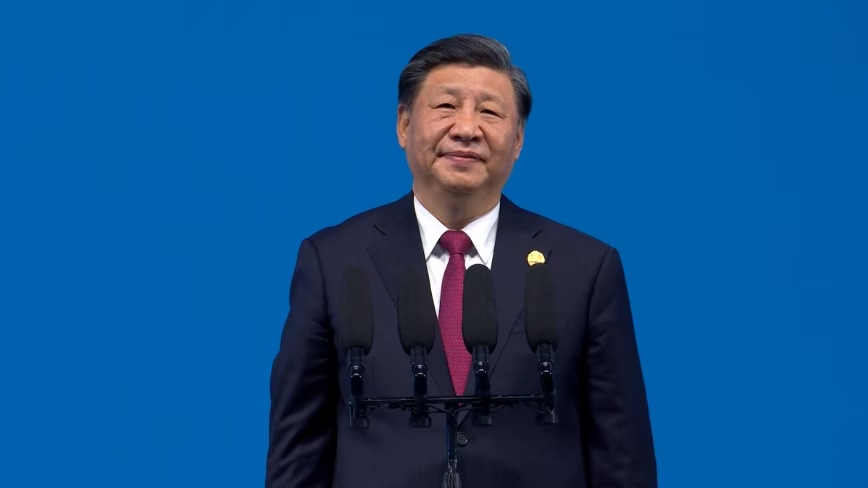
Xi pitches open-source AI to BRICS amid domestic curb debates
Chinese President Xi Jinping proposed a China-led open-source AI community and invited BRICS nations to join the World AI Cooperation Organization (WAICO) at the recent BRICS summit. This push for global collaboration contrasts sharply with Beijing's ongoing internal debates about restricting its own advanced AI models. Meanwhile, the EU's comprehensive AI Act, with its clear, enforceable rules for open-source AI, highlights a significant divergence in global AI governance approaches.
Google's AI Branding Fix: A Clearer Vision for Gemini
This article critiques Google's fragmented AI branding, proposing a unified 'Gemini Intelligence' system to simplify user experience and strengthen Gemini's identity.

Understanding the Anti-Woke Right's Challenge with Grand Theft Auto VI
Welcome to this guide on understanding the current cultural conversation surrounding the highly anticipated game, Grand Theft Auto VI. This resource is designed to help you navigate the specific challenges and

in-depth: The Best 3-in-1 Apple Charging Stations After Testing 30
Wired has released its top picks for 3-in-1 Apple charging stations, extensively tested for iPhone, Apple Watch, and AirPods. The guide highlights six leading models, from premium speedy options to budget-friendly and compact designs, all focused on decluttering and optimizing charging for Apple users.

Chuwi UniBox AI495 Pro Review: A Mini AI Powerhouse
Chuwi's UniBox AI495 Pro review: A powerful mini workstation with 192GB RAM and an AMD Ryzen AI chip for local LLM processing, packed into a compact, Mac Pro-esque design.