
policy: Before-and-after images show where SpaceX rocket crashed into
NASA has released images showing a new crater on the moon from an unintentional SpaceX Falcon 9 rocket impact. The upper stage crashed at 5,400 mph on August 5, 2026, after over a year in space. NASA describes lunar impacts as an "accepted and safe" disposal method, though public concern about space junk is rising.

NASA has released striking before-and-after images revealing a new crater on the moon's surface, the result of an unintentional impact by an upper stage of Elon Musk’s SpaceX Falcon 9 rocket earlier this month. The spacecraft, which had been adrift in space for over a year, slammed into the lunar ground at approximately 5,400 mph on August 5, 2026, prompting renewed discussion about space debris management. While the incident was not deliberate, NASA clarified that such lunar-surface impacts are an "accepted and safe" method for disposing of spent space hardware.
Visual Evidence of the Impact
The dramatic images, captured by NASA’s Lunar Reconnaissance Orbiter (LRO) spacecraft, vividly illustrate the changes to the lunar landscape, showcasing a fresh scar where the rocket met the surface. The LRO, a sophisticated robotic mission operating since 2009, is crucial for mapping the moon's topography and monitoring changes over time. Its ability to provide high-resolution "before-and-after" comparisons offers scientists invaluable data on impact mechanics and the moon's regolith.
The Falcon 9 upper stage, a booster component used in a 2015 launch, had been following an uncontrolled, elliptical trajectory around Earth and the moon for an extended period. Its eventual collision with the moon highlights a growing concern in space operations: the proliferation of orbital debris. While many discarded rocket stages are designed to perform controlled re-entries into Earth’s atmosphere, where they burn up safely, some, like this one, are left to drift on more unpredictable paths, eventually posing collision risks or impacting celestial bodies.
NASA's Stance and Precedents
NASA's stance, reassuring the public that lunar impacts are an "accepted and safe" disposal method, draws from historical precedents. Various mission-critical components and scientific probes, including Apollo mission stages and LRO's own companion spacecraft, LCROSS, have been intentionally crashed into the moon. These deliberate impacts are often conducted for research purposes, such as analyzing sub-surface materials through the ejecta plumes, or as a planned end-of-life disposal strategy to prevent future hazards in Earth orbit. The scientific community can glean valuable information from such events, including insights into lunar geology, seismic activity, and the composition of the lunar crust.
Public Reaction and Future Implications
However, the perception of this particular incident has been colored by its unintentional nature and the high profile of SpaceX. Public reaction, as reflected in numerous online comments, expresses considerable concern and criticism. Many individuals disapprove of the idea of "littering" the moon or turning it into a "landfill" for space junk. Elon Musk, the visionary but often controversial founder of SpaceX, has frequently been a focal point in these discussions, with many remarks tinged with sarcasm or outright disapproval regarding the environmental impact on Earth's celestial neighbor.
The unintentional lunar impact serves as a potent reminder of humanity's accelerating expansion into space and the complex long-term consequences of these endeavors. As global space exploration continues to intensify, with a growing number of governmental agencies and private companies vying for lunar missions and beyond, the need for robust international guidelines, enhanced debris tracking, and innovative solutions for space debris management will only become more critical. This incident underscores the delicate balance required to advance space technology while simultaneously preserving the pristine nature and scientific integrity of celestial bodies for future generations.
FAQ
Q: What part of the SpaceX rocket crashed into the moon?
A: The upper stage of a SpaceX Falcon 9 rocket, which had been in space for over a year, was responsible for the impact.
Q: Was the crash intentional, and is it a common practice?
A: The crash was unintentional. However, NASA has stated that lunar-surface impacts are considered an "accepted and safe" method for disposing of space hardware.
Q: At what speed did the Falcon 9 rocket stage impact the moon?
A: The Falcon 9 upper stage collided with the moon at approximately 5,400 mph.
Related articles

Apple Unveils iPhone Duo: Pricey Foldable Sees Soaring Demand
Apple has officially entered the foldable smartphone arena with the long-anticipated launch of the iPhone Duo. Priced starting at a hefty $1,999, the device features a 5.4-inch outer display and a larger 7.6-inch inner

in-depth: Chicago-Area Cops Helped HSI Spy on Minnesota Anti-ICE
Chicago-area law enforcement, including local police and HSI agents, conducted undercover surveillance on Minnesota anti-ICE activists at an April 2, 2022, talk in Chicago. This operation was part of a federal conspiracy probe into 15 Minnesota activists facing felony charges related to immigration enforcement resistance. Civil liberties advocates have condemned the surveillance as a troubling intrusion into protected political activity.

Mark Wahlberg on using AI in film ‘the right way’ and being open to
Actor Mark Wahlberg believes AI has a place in filmmaking if used responsibly for enhancement, not script generation or actor replacement. At TechCrunch Disrupt, he expressed openness to an AI likeness carrying on his legacy, managed by his family, and emphasized storytelling.
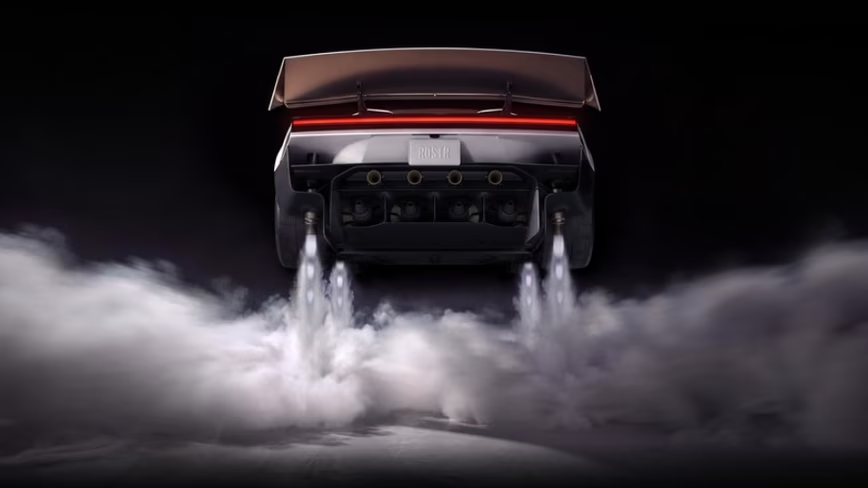
Tesla Unveils Thruster-Equipped Roadster, 2028 Production Targeted
Tesla has unveiled its second-generation Roadster, featuring cold-gas thrusters co-developed with SpaceX, enabling it to jump and flip. The electric sports car demonstrated 0-60mph in an astonishing 0.81 seconds, with production targeted for 2028. This highly anticipated reveal also serves as a key recruitment tool for Tesla's ambitious AI and robotics initiatives.

Amazon Prime Video Launches AI-Powered Prime 360 for NBA Coverage
Amazon Prime Video is elevating its NBA coverage with the introduction of Prime 360, an AI-powered replay system offering immersive, 'fly through' views of the action. Kicking off its second season, Prime Video also adds Yahoo fantasy integration and gains exclusive Eastern Conference Finals rights, expanding its tech-driven sports broadcast. The new features aim to deliver a unique and interactive viewing experience for basketball fans.

regional: A two-person Seattle startup lands $1M to reinvent
Seattle startup TriMagnetix has secured $1 million to develop semiconductor chips that consume 800 times less energy and are radiation-resistant. The two-person company, leveraging nanomagnetic technology, is targeting space applications and data centers. With new funding and key partnerships, TriMagnetix aims for commercial sales within a year.