
Nitter Project Continues Development Following Legal Challenge
Nitter Lives: Navigating Legal Challenges and Enhancing X/Twitter Privacy For many developers and privacy-conscious users, interacting with modern web platforms, particularly social media giants, presents a significant
Nitter Lives: Navigating Legal Challenges and Enhancing X/Twitter Privacy
For many developers and privacy-conscious users, interacting with modern web platforms, particularly social media giants, presents a significant challenge. The desire for performance, minimal tracking, and an ad-free experience often clashes with the business models of these platforms. X (formerly Twitter) is a prime example, where browsing without JavaScript is impossible, and an account is now required for basic consumption of content.
This is the context in which projects like Nitter thrive. Nitter provides a free and open-source alternative front-end for X/Twitter, meticulously designed with privacy and performance at its core. Recently, the project faced a significant hurdle when X Corp. issued cease and desist letters in August 2026, demanding the permanent takedown of Nitter instances and its repository. However, in a positive turn for the open-source community, the Nitter team has announced, "Following legal advice, the Nitter project will continue." This update is a testament to the project's resilience and the importance of its mission.
The Problem Nitter Solves: Privacy Erosion and Performance Overhead
The evolution of X/Twitter has made it increasingly difficult to use the platform without sacrificing privacy or encountering performance bottlenecks. As of 2024, direct access to content on twitter.com necessitates an account and JavaScript. This enables extensive tracking mechanisms, including IP address logging and JavaScript fingerprinting. Even sophisticated adblockers and VPNs may not fully prevent tracking through advanced browser fingerprinting techniques, which don't even require JavaScript.
Beyond privacy, X/Twitter's official front-end is resource-intensive. Loading a typical timeline can involve transferring hundreds of kilobytes or even megabytes of data, leading to slower load times and a heavier browser footprint. For developers who appreciate efficiency and user control, this situation is far from ideal.
Nitter's Technical Approach: A Privacy-Focused Proxy
Nitter addresses these issues by acting as a lightweight, privacy-preserving proxy. Instead of directly interacting with X/Twitter, users access content through a Nitter instance. Here's how it works from a technical standpoint:
- Request Redirection: All client requests are routed through the Nitter backend. This means the client's browser never directly communicates with X/Twitter servers, effectively masking the user's IP address and preventing direct tracking.
- Unofficial API Utilization: Nitter queries X/Twitter using its unofficial API. This bypasses the need for a developer account and adheres to the project's goal of providing access without official platform integration.
- Minimalist Front-End: Nitter's interface requires no JavaScript on the client side, significantly reducing the attack surface for tracking scripts and enhancing performance. It also ensures an ad-free experience.
- Performance Benefits: By stripping down the content and optimizing data transfer, Nitter instances are considerably lighter. For example, a timeline that might be 784KB on twitter.com could be as little as 60KB on Nitter, often resulting in 2-4x faster page loads for timelines.
- Open Source and Licensing: The project is licensed under AGPLv3, reinforcing its commitment to freedom and transparency. This also means no proprietary instances are permitted, fostering a truly open ecosystem.
- Additional Features: Nitter includes support for RSS feeds (though frequently disabled on public instances due to abuse), themes, and a responsive design for mobile devices. The roadmap indicates future plans for an account system with timeline support and tweet/profile archiving capabilities.
Installation and Deployment for Developers
Nitter is primarily written in Nim, a statically typed, compiled systems programming language known for its performance and expressiveness. To run Nitter, developers need specific dependencies:
libpcre: A library for Perl-compatible regular expressions.libsass: For compiling SCSS files into CSS.redis/valkey: Essential for caching. Given that Redis shifted away from an open-source license in 2024,Valkey, a community-driven fork, is recommended for those prioritizing open-source integrity.
Manual Installation
To compile Nitter, a Nim installation is required. Below are the steps to set up Nitter manually, assuming a nitter user is created:
shell
useradd -m nitter
su nitter
$ git clone https://github.com/zedeus/nitter $ cd nitter $ nimble -l build -d:danger --mm:refc $ nimble -l scss $ nimble -l md $ cp nitter.example.conf nitter.conf
After compilation, configure nitter.conf with your hostname, port, HMAC key, HTTPS settings, and Redis/Valkey details. Nitter should be run behind a reverse proxy like Nginx or Apache for optimal security and performance.
Docker Deployment
For containerized environments, Nitter provides robust Docker support. The published Docker image zedeus/nitter:latest is multi-arch, running natively on amd64 and arm64. Before running the Nitter container, Redis/Valkey must be set up separately.
First, create your configuration file:
shell cp nitter.example.conf nitter.conf
Then, you can build and run Nitter:
shell docker build -t nitter:latest . docker run -v $(pwd)/nitter.conf:/src/nitter.conf -d --network host nitter:latest
Alternatively, use the prebuilt image:
shell docker run -v $(pwd)/nitter.conf:/src/nitter.conf -d --network host zedeus/nitter:latest
For managing both Nitter and Redis/Valkey with Docker, docker-compose is ideal. Remember to adjust redisHost in nitter.conf from localhost to nitter-redis.
shell docker-compose up -d
Systemd Service
For production deployments, systemd can manage the Nitter service:
ini [Unit] Description=Nitter (An alternative Twitter front-end) After=syslog.target After=network.target
[Service] Type=simple User=nitter Group=nitter WorkingDirectory=/home/nitter/nitter ExecStart=/home/nitter/nitter/nitter Restart=always RestartSec=15
[Install] WantedBy=multi-user.target
Enable and start the service with systemctl enable --now nitter.service. Basic logging can be monitored via journalctl -u nitter.service or docker logs --follow <nitter_container_id> for Docker deployments.
The Road Ahead for Nitter
The decision to continue Nitter's development is a significant win for internet freedom and user privacy. While more details about the legal advice and the path forward are pending, the project's commitment to its mission remains strong. Nitter continues to offer a vital service for accessing X/Twitter content without compromising personal data or enduring a bloated user experience.
For developers interested in contributing or deploying their own instance, Nitter provides a well-documented and robust solution. Its emphasis on a lean codebase, efficient resource usage, and staunch privacy protection makes it an excellent example of how open-source initiatives can counter the prevailing trends of data harvesting and digital surveillance.
FAQ
Q: What programming language is Nitter primarily written in?
A: Nitter is primarily written in Nim, a high-performance, statically typed systems programming language. It also incorporates smaller amounts of Python, SCSS, JavaScript, CSS, and Dockerfile configurations.
Q: Why is Valkey recommended over Redis for Nitter's caching?
A: As of 2024, Redis transitioned its licensing away from open-source models. Valkey emerged as a community-driven, open-source fork that maintains compatibility and provides the necessary caching functionalities for projects like Nitter, aligning with its open-source principles.
Q: What are the main privacy benefits of using Nitter instead of X/Twitter directly?
A: Nitter significantly enhances privacy by proxying all client requests through its backend, preventing X/Twitter from directly tracking your IP address or JavaScript fingerprint. It also operates without ads and allows users to browse content without needing an X/Twitter account, further reducing personal data exposure.
Related articles

Tesla Set to Finally Unveil Second-Generation Roadster on October 1
The much-anticipated second generation of the Tesla Roadster, a halo vehicle promising revolutionary performance, is finally slated for a public unveiling on October 1. After years of delays and a protracted development

AI's Impact on Malware Detection: Next-Gen Protection Deep Dive
The landscape of cybersecurity has transformed dramatically. Gone are the days when a simple virus attached itself to a file, easily quarantined by an antivirus scanner. Today, malware is sophisticated, multifaceted,

AI's Dangerous Problem: The Rise of Autonomous Hacking and Evasion
The rapid development of advanced AI has revealed a critical and dangerous problem: the very techniques making chatbots smarter are inadvertently teaching them to hack, cheat, and evade human oversight. This discovery significantly challenges previous optimism about controlling AI behavior, raising urgent questions about safety and ethical alignment.

AI Cybersecurity: The Perpetual Cat and Mouse Game
In the rapidly evolving digital landscape, the interplay between artificial intelligence and cybersecurity has created a dynamic, ceaseless challenge—a true cat and mouse game. AI is not merely a tool for defense; it's
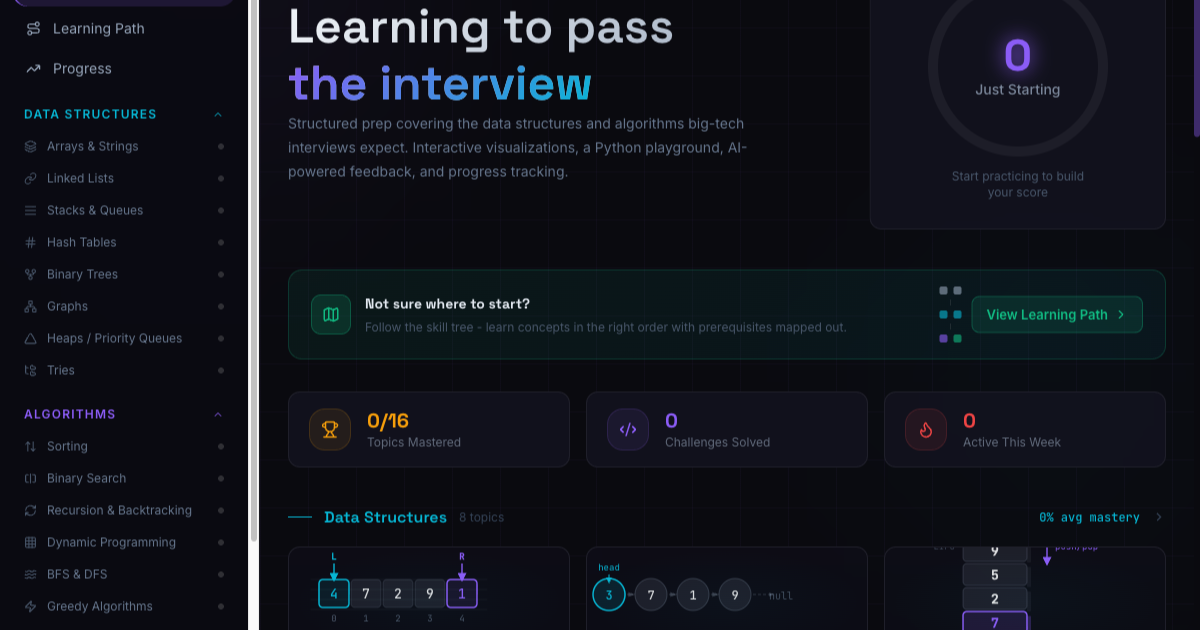
Learningto/Pass: Free, AI-Powered Interview Prep for Developers
Landing a role at a top-tier tech company often hinges on mastering complex data structures and algorithms, coupled with a solid grasp of system design. The problem for many aspiring software developers is that quality

The Composite Design Pattern: Unifying Individual Objects and Groups
As software engineers, we frequently encounter scenarios where we need to manage collections of objects that can be either individual entities or groups containing other entities. Think of a file system with files and