
NASA's Optical Laser Comms: Your High-Def Moonshots Are Coming
Verdict NASA's Optical Laser Communications system, successfully demonstrated during the Artemis II mission, is a game-changer for space data transmission. While still in its experimental phase and facing challenges
Verdict
NASA's Optical Laser Communications system, successfully demonstrated during the Artemis II mission, is a game-changer for space data transmission. While still in its experimental phase and facing challenges like atmospheric interference, this technology promises vastly higher bandwidth, significantly lower power consumption, and smaller hardware compared to traditional radio communications. It's the critical step towards live, high-definition (and even 4K) broadcasts from the Moon and beyond, making future lunar missions feel much closer and more immediate for viewers on Earth.
Introduction: Beyond Low-Def Lunar Views
For decades, our connection to space explorers, from Apollo to much of Artemis II, has largely relied on radio waves, offering a somewhat grainy, low-definition window into the cosmos. While thrilling, these visuals often leave something to be desired in an era of ubiquitous HDTV and 4K displays. The good news? NASA and its commercial partners are rapidly advancing a solution: optical laser communications. The recent Artemis II mission served as a crucial proving ground for this technology, hinting at a future where lunar landings and deep-space explorations are streamed with stunning clarity.
Key Details and Technical Specifications
The core of this advancement lies in the shift from radio frequency (RF) to optical laser communication. Let's break down the significant improvements seen:
-
Data Rates:
- Apollo (Radio): Approximately 50 KB per second.
- Orion S-band (Radio): A modest improvement to 3MB to 5MB per second for most of Artemis II.
- Optical Laser Comms (Orion): A staggering leap to 260 Mbps. To put this in perspective, this speed could transmit a full high-definition movie to Earth in mere seconds.
-
Power Consumption:
- S-band Transmitter: Required 5 to 20 watts of power.
- Laser Communications Transmitter: Used a remarkably efficient single watt.
-
Wavelength: The optical lasers operate at 1550 nm.
-
Ground Stations: Initially, NASA deployed three primary ground stations capable of receiving these laser signals: two in the United States (White Sands Complex in New Mexico and Table Mountain Facility in California) and one experimental commercial terminal in Australia.
-
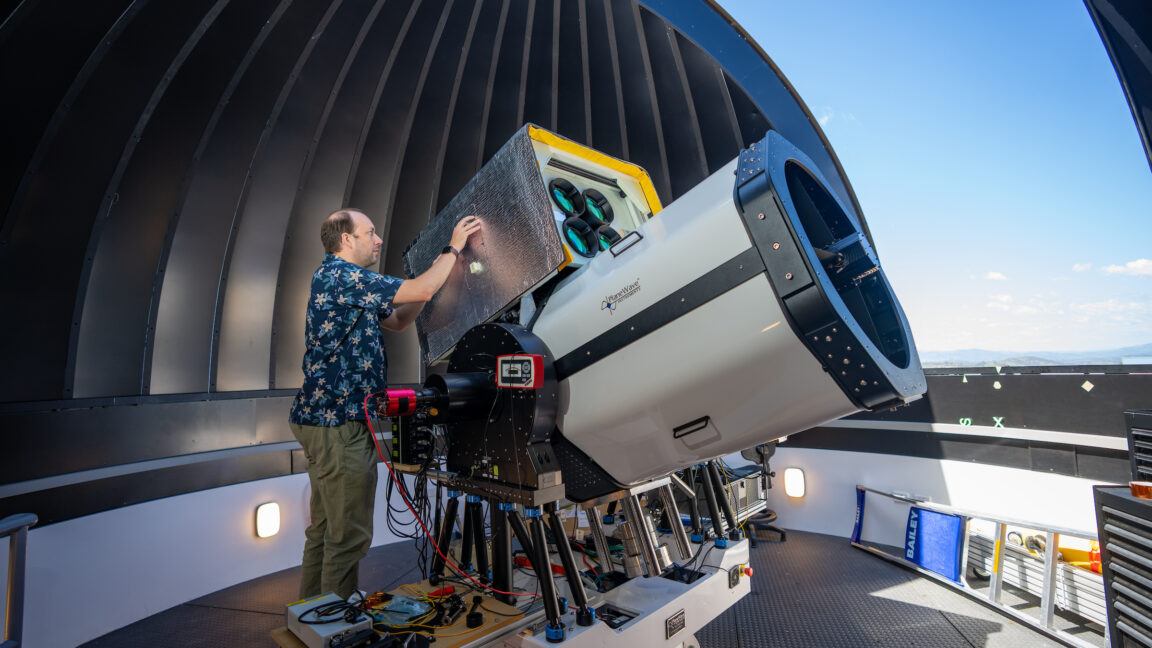
Commercial Contributions: A key experimental component involved a lower-cost optical terminal at Mount Stromlo, Australia. This system utilized an off-the-shelf 70 cm telescope from Observable Space and a backend detection system from Quantum Opus, featuring superconducting nanowire single-photon detectors. This commercial setup successfully achieved the system's maximum rate of 260MB per second.
Operational Experience and User Impact
The operational experience during Artemis II demonstrated the immense potential of optical laser communications. While the crew primarily used lower-definition radio communications, they periodically switched to the optical system to transmit batches of much higher-resolution data, including stunning photographs of the Moon's far side and a solar eclipse. This wasn't just a theoretical success; it was a practical deployment that delivered tangible improvements in data quality.
For future missions like Artemis IV, the successful integration of optical comms means a vastly improved user experience for those on Earth. We can anticipate live broadcasts from the lunar surface in high definition, and potentially even 4K, offering an unprecedented level of immersion and detail. This transforms space exploration from a distant concept into a more immediate, visually rich experience.
However, a significant challenge remains: cloud cover. Laser photons at 1550 nm are easily scattered by clouds, meaning a single ground station needs clear skies for a steady signal. This susceptibility necessitates a global network of ground stations – an estimated 40 worldwide – to ensure continuous, always-on laser communication for future Artemis missions. The success of the lower-cost commercial terminal in Australia is crucial here, as it demonstrates a viable path to rapidly scale this global network.
Pros and Cons
Pros:
- Massive Bandwidth Increase: Enables data rates up to 100 times greater than traditional radio systems, allowing for HD and 4K video streams.
- Lower Power Consumption: Significantly more energy-efficient, requiring only a fraction of the power of S-band transmitters.
- Smaller Transmitters: Optical systems require smaller and lighter hardware, which is critical for spacecraft mass and power budgets.
- Enhanced Visuals: Paves the way for stunning, high-resolution imagery and live video from space, vastly improving public engagement.
- Scalability Potential: Commercial, off-the-shelf components tested on Artemis II show promise for deploying a cost-effective global network of ground stations.
Cons:
- Cloud Susceptibility: Laser signals are easily blocked or scattered by clouds, requiring a large network of ground stations for reliable, continuous operation.
- Experimental Nature: While successful, the system is still relatively new and requires further integration and optimization for routine use.
- Initial Ground Station Cost/Complexity: Although commercial options are emerging, the technology for advanced photon detection (e.g., superconducting nanowire detectors) is specialized, and building a robust network requires significant investment and coordination.
Comparison to Alternatives
The primary alternative discussed is the long-standing radio frequency (RF) communication, specifically the S-band used by Orion and earlier by Apollo. The comparison highlights the dramatic leap forward that optical laser communications represent.
| Feature | Radio Frequency (S-band, Orion) | Optical Laser Communications (Orion) |
|---|---|---|
| Data Rate (Typical) | 3-5 MB per second (Orion) / 50 KB per second (Apollo) | 260 Mbps (equivalent to 32.5 MB per second) |
| Power Consumption | 5-20 watts | 1 watt |
| Transmitter Size | Larger | Smaller |
| Cloud Impact | Low (less susceptible) | High (easily scattered by clouds) |
| Future Capability | Limited by bandwidth, established for basic comms | High-bandwidth, enabling HD/4K, quantum applications |
| Ground Station Cost | High-cost, large dish infrastructure (established) | Evolving, potential for lower-cost, off-the-shelf components |
Buying Recommendation (Adoption Recommendation)
For NASA and other space agencies, the adoption of optical laser communications isn't merely a recommendation; it's a strategic imperative. The successful Artemis II demonstration makes it clear that this technology is no longer just experimental; it's a vital bedrock for the future of deep-space communication. The benefits in bandwidth, power efficiency, and hardware footprint are too significant to ignore, especially as missions generate exponentially more data.
While the cloud susceptibility remains a challenge, the validation of lower-cost commercial ground stations provides a clear pathway to mitigate this issue through a distributed network. Investing in and scaling this technology, alongside commercial partners like Observable Space and Quantum Opus, will be essential for realizing the promise of high-definition space exploration for both scientific endeavors and public engagement. This is the unequivocal future of how we'll connect with our explorers beyond Earth.
FAQ
Q: Why is this new communication system necessary if radio waves have worked for decades?
A: While radio waves have served us well, they offer limited bandwidth and higher power consumption. As space missions generate increasing amounts of high-resolution data (images, videos, scientific telemetry), radio communication simply can't keep up. Optical laser communications provide significantly higher data rates, enabling HD and 4K video, and are much more power-efficient, which is crucial for spacecraft operations.
Q: How will NASA overcome the problem of clouds blocking laser signals?
A: To ensure continuous communication despite cloud cover, NASA plans to establish a global network of approximately 40 ground stations. This distributed network increases the probability that at least one station will have clear skies at any given time to receive signals. The success of using lower-cost, commercial-off-the-shelf components for ground stations, as demonstrated in Australia, suggests that building this extensive network is a feasible and cost-effective approach.
Q: Will this technology only be used for Moon missions, or does it have broader applications?
A: While prominently tested with lunar missions like Artemis II, optical laser communication has much broader applications. NASA has previously demonstrated it from the International Space Station and even the Psyche spacecraft in deep space. Its high bandwidth and efficiency make it ideal for future Mars missions, asteroid exploration, and any scenario where massive amounts of data need to be transmitted from far distances. It also holds potential for applications beyond space communication, such as in quantum computing, due to its ability to detect single photons.
Related articles
How to Use Kodi: The Simple, Server-Free Way to Watch Your Media
Learn to set up Kodi to watch your personal media library directly on your TV, bypassing complex servers and subscription fees, in just a few steps.

Crystal Lake Series on Peacock: A Deep Dive into Horror's Past
Crystal Lake Series Review: A Deep Dive into Horror's Past Verdict: Is Crystal Lake Worth the Dive? The long-awaited Friday the 13th prequel, Crystal Lake, is finally arriving on Peacock, promising a fresh, in-depth
Google's AI Branding Fix: A Clearer Vision for Gemini
This article critiques Google's fragmented AI branding, proposing a unified 'Gemini Intelligence' system to simplify user experience and strengthen Gemini's identity.

Chuwi UniBox AI495 Pro Review: A Mini AI Powerhouse
Chuwi's UniBox AI495 Pro review: A powerful mini workstation with 192GB RAM and an AMD Ryzen AI chip for local LLM processing, packed into a compact, Mac Pro-esque design.

Microsoft comms chief Frank Shaw to exit after nearly three decades
Frank X. Shaw, Microsoft's long-serving chief communications officer, will exit at year-end after nearly three decades shaping the company's message through pivotal periods. Shaw, 64, is not retiring but plans a break before his next move, leaving behind a legacy of adapting communications for a digital age and embracing AI tools. Microsoft is now searching for his successor.

How to Quote Movies Accurately - Avoid Common Misquotes
Learn to identify and correct 10 frequently misquoted movie lines to impress your friends and become a true cinematic aficionado.