
Nadella Honored as U.S. Halts Microsoft's Green Card Path for Workers
Microsoft CEO Satya Nadella was honored with a national medal by President Trump, just hours after the administration suspended Microsoft from the PERM program, a critical pathway for foreign workers to gain permanent residency. Vice President JD Vance accused Microsoft of abusing the system, a move that starkly contrasts with Nadella's own journey from an H-1B visa to U.S. citizenship and leadership of a major tech company.
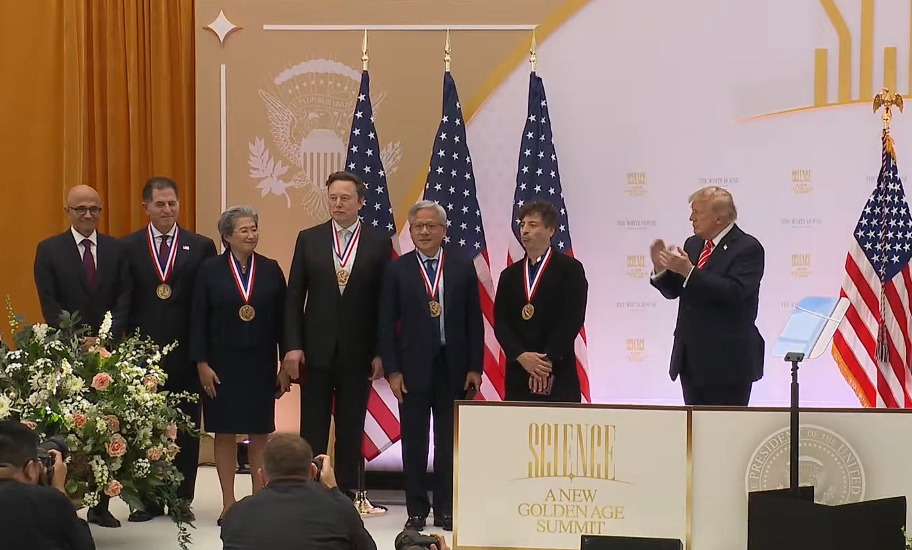
Microsoft CEO Satya Nadella received the National Medal of Technology and Innovation from President Trump on Thursday, hours after the Trump administration controversially suspended Microsoft from a key federal program that helps its foreign workers obtain permanent residency. The move sparked accusations of hypocrisy, highlighting Nadella's own journey from an H-1B temporary work visa to U.S. citizenship and the top role at Microsoft.
Vice President JD Vance announced the suspension of Microsoft from the PERM program, accusing the tech giant of abusing the system by allegedly laying off American workers while hiring foreign talent. Vance described H-1B workers as "foreign indentured servants" during a White House news conference.
The Immigration Programs at Play
It's crucial to distinguish between the two primary immigration programs at the center of this controversy. The suspension does not affect Microsoft's ability to hire foreign workers on H-1B visas. These are temporary work visas, typically granted for three years and generally limited to six years, with some exceptions. They fall under the purview of U.S. Citizenship and Immigration Services.
The program from which Microsoft was suspended is known as PERM, managed by the Labor Department. PERM is usually the initial phase for a company sponsoring an employee for permanent residency. Employers must demonstrate that no qualified, available U.S. worker can fill the position after advertising it. Most PERM applications are for individuals already working in the U.S. on H-1B visas.
Microsoft has been the leading user of the PERM program, with the Labor Department ruling on 3,161 of its applications in fiscal year 2025 and 1,683 in the first nine months of fiscal year 2026. In contrast, Amazon and Google, while significant users of H-1B visas, largely reduced their PERM applications after 2023.
A Path Now Blocked
The suspension carries significant implications, particularly for Microsoft employees currently on H-1B visas who depend on the company to initiate the permanent residency process to extend their temporary visas beyond the typical six-year limit. The Labor Department has stated it will not process Microsoft's pending PERM applications, leaving many workers in limbo and uncertain about their future in the U.S., as reported by The Seattle Times.
The White House has yet to provide specific evidence of fraud by Microsoft, a point that has been raised by various reports.
Microsoft's Stance and Nadella's Personal Story
In response to the administration's actions, Microsoft issued a statement pushing back on criticisms, focusing primarily on its H-1B practices. The company stated that approximately 80% of its roughly 6,000 H-1B applications in the last fiscal year were for extending or changing the status of existing employees, not for new hires. The remaining applications were for new hires already legally residing in the U.S., representing about 1% of Microsoft's U.S. workforce. Microsoft emphasized that it adheres to strict visa standards, pays competitive wages, and that the vast majority of its U.S. employees are American citizens.
The irony of the situation is underscored by Satya Nadella's own immigration narrative. Nadella arrived from India in 1988 on a temporary work visa to pursue computer science. He eventually became a permanent resident and then a U.S. citizen, steadily climbing the ranks at Microsoft to become CEO. In his 2017 book, "Hit Refresh," Nadella wrote, "I don't think my story would be possible anywhere else. I am proud today to call myself an American citizen."
Nadella's path was not without its complexities. He once temporarily relinquished his permanent residency for an H-1B visa so his wife could join him sooner, a move he described as a response to the "perverse logic of this immigration law." This personal history highlights the very challenges that many foreign-born tech workers now face due to the recent policy change.
A Broader Context of Innovation
President Trump's medal ceremony further highlighted the contributions of immigrants to American technology. Five of the six individuals honored with the National Medals of Science and Technology and Innovation were born outside the U.S., including Nadella, Dell Technologies CEO Michael Dell, Google co-founder Sergey Brin, Nvidia CEO Jensen Huang, and AMD CEO Lisa Su. This context adds another layer of complexity to the administration's crackdown on immigration programs that enable such talent to thrive in the U.S.
FAQ
Q: What is the core difference between an H-1B visa and the PERM program?
A: An H-1B visa is a temporary, non-immigrant work visa, typically granted for up to six years. The PERM program is the initial step for an employer to sponsor a foreign worker for permanent residency (a green card), requiring the employer to prove no qualified U.S. worker is available for the role.
Q: What does Microsoft's suspension from the PERM program mean for its foreign workers?
A: The suspension means Microsoft cannot initiate new PERM applications to sponsor foreign employees for permanent residency. The Labor Department also stated it will not process pending applications, potentially impacting current H-1B visa holders who rely on PERM to extend their visas past the usual six-year limit.
Q: Why did the Trump administration suspend Microsoft from the PERM program?
A: Vice President JD Vance stated the suspension was due to alleged abuse of the system, claiming Microsoft laid off American workers while simultaneously hiring foreign workers. The White House, however, has not yet provided specific evidence to support these claims of fraud.
Related articles

Apple Unveils iPhone Duo: Pricey Foldable Sees Soaring Demand
Apple has officially entered the foldable smartphone arena with the long-anticipated launch of the iPhone Duo. Priced starting at a hefty $1,999, the device features a 5.4-inch outer display and a larger 7.6-inch inner

in-depth: Chicago-Area Cops Helped HSI Spy on Minnesota Anti-ICE
Chicago-area law enforcement, including local police and HSI agents, conducted undercover surveillance on Minnesota anti-ICE activists at an April 2, 2022, talk in Chicago. This operation was part of a federal conspiracy probe into 15 Minnesota activists facing felony charges related to immigration enforcement resistance. Civil liberties advocates have condemned the surveillance as a troubling intrusion into protected political activity.

Mark Wahlberg on using AI in film ‘the right way’ and being open to
Actor Mark Wahlberg believes AI has a place in filmmaking if used responsibly for enhancement, not script generation or actor replacement. At TechCrunch Disrupt, he expressed openness to an AI likeness carrying on his legacy, managed by his family, and emphasized storytelling.

Tesla Unveils Thruster-Equipped Roadster, 2028 Production Targeted
Tesla has unveiled its second-generation Roadster, featuring cold-gas thrusters co-developed with SpaceX, enabling it to jump and flip. The electric sports car demonstrated 0-60mph in an astonishing 0.81 seconds, with production targeted for 2028. This highly anticipated reveal also serves as a key recruitment tool for Tesla's ambitious AI and robotics initiatives.

Amazon Prime Video Launches AI-Powered Prime 360 for NBA Coverage
Amazon Prime Video is elevating its NBA coverage with the introduction of Prime 360, an AI-powered replay system offering immersive, 'fly through' views of the action. Kicking off its second season, Prime Video also adds Yahoo fantasy integration and gains exclusive Eastern Conference Finals rights, expanding its tech-driven sports broadcast. The new features aim to deliver a unique and interactive viewing experience for basketball fans.

regional: A two-person Seattle startup lands $1M to reinvent
Seattle startup TriMagnetix has secured $1 million to develop semiconductor chips that consume 800 times less energy and are radiation-resistant. The two-person company, leveraging nanomagnetic technology, is targeting space applications and data centers. With new funding and key partnerships, TriMagnetix aims for commercial sales within a year.