
Musk Calls Himself 'Fool' in Heated OpenAI Trial Testimony
OAKLAND, Calif. – Elon Musk, appearing in federal court on Wednesday, called himself "a fool" for funding OpenAI, accusing its leadership of "looting the nonprofit" as the company’s lead trial attorney, William Savitt,
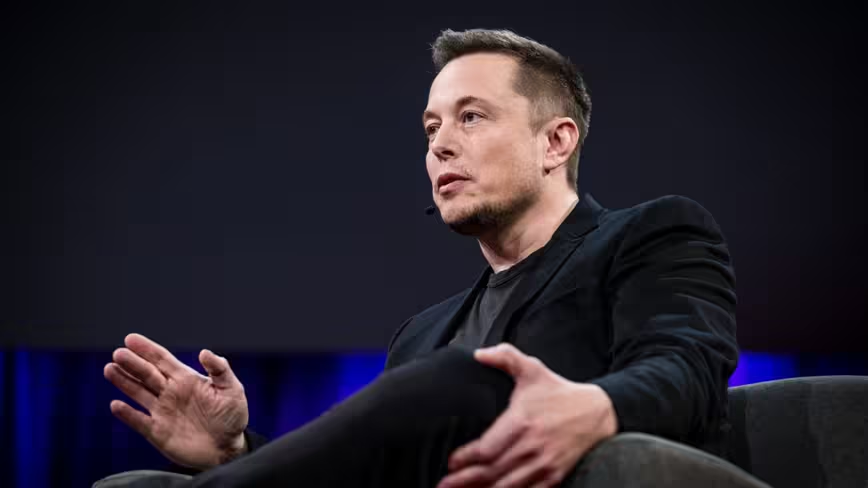
OAKLAND, Calif. – Elon Musk, appearing in federal court on Wednesday, called himself "a fool" for funding OpenAI, accusing its leadership of "looting the nonprofit" as the company’s lead trial attorney, William Savitt, methodically challenged his core narrative.
Day three of the four-week Musk v. Altman trial proved to be the most combative yet. Savitt’s strategy revolved around using Musk’s own donations, personal emails, and communications to dismantle his assertion that OpenAI had betrayed its original charitable principles.
The 'Fool' and Disputed Funding Musk testified to the jury, "I gave them $38 million of essentially free funding, which they then used to create an $800 billion for-profit company… I actually was a fool who created free funding for them to create a startup. I literally was."
This statement reinforces Musk's legal framing as a deceived donor. However, Savitt was quick to highlight the gap between Musk's actual $38 million in donations and the "up to $1 billion" he had pledged when OpenAI was initially founded.
Musk, raising his voice, retorted, "Without me, OpenAI wouldn’t exist!" He argued his intangible contributions, including reputation, contacts, and credibility, had significant value, claiming his total contribution exceeded $100 million. The court briefly paused as Judge Yvonne Gonzalez Rogers intervened, noting Musk was proving "difficult" to elicit direct answers from.
Zilis Communications Undermine Nonprofit Stance The most damaging evidence presented by Savitt came from Musk’s personal communications with Shivon Zilis, a venture capitalist who was then on OpenAI’s board and is also the mother of four of Musk’s children. Savitt presented a 2018 email where Zilis asked Musk if she should remain close to OpenAI to "keep feeding him information on the company," to which Musk confirmed he agreed.
Another significant exhibit was an email from Zilis to Sam Teller, an associate of Musk, outlining two potential restructuring paths for OpenAI: "Roll everything into a B corp" or "OpenAI C Corp and OpenAI nonprofit." Savitt's direct implication was that Musk had been presented with and considered for-profit conversion options.
When asked if he had instructed Zilis to file paperwork to convert OpenAI into a for-profit corporation, Musk responded, "I don’t recall." Savitt then posed his sharpest question of the day: "You were never really committed to OpenAI being a nonprofit, were you, Mr. Musk?" Musk disputed the premise, but the jury was left to reconcile a seemingly deceived donor with a co-founder who appeared to be actively considering for-profit structures in internal discussions.
Musk Points to Microsoft Investment and AI Safety Under redirect examination by his own attorney, Musk clarified that it was Microsoft’s $10 billion investment, not the initial for-profit structuring, that he considered the decisive violation of OpenAI's mission. "At a $10 billion scale, there’s no way Microsoft is just giving that as a donation or any kind of charitable way," he stated, recalling a text to Sam Altman: "What the hell is going on?… This is a bait and switch."
Musk reiterated his long-standing concern that a for-profit AI company creates a safety risk. While acknowledging he didn't know the specifics of OpenAI’s internal safety protocols, he maintained that the very structure of a "nonprofit suddenly is a for-profit with unlimited profit" worried him.
Implication of Competitive Grievance Savitt also probed Musk about xAI, his own artificial intelligence company, asking if Grok "lags much farther behind" ChatGPT. Musk conceded that xAI, now absorbed into SpaceX, has a "very small market share" and is "much smaller" than OpenAI, though he insisted it was only "technically" a competitor.
The questioning strongly implied that Musk, while presenting himself as a champion of charitable principles, was also building a direct competitor to OpenAI, suggesting the lawsuit could be a tactic to slow down a rival.
What Comes Next? Savitt anticipates concluding his cross-examination of Musk on Thursday, likely followed by testimony from Jared Birchall, who manages Musk’s personal wealth. OpenAI president Greg Brockman has been put on 48-hour notice and may also appear.
The trial's stakes remain exceptionally high. A critical piece of evidence is Greg Brockman’s 2017 diary entry, cited by Judge Gonzalez Rogers in her ruling to send the case to trial: "I cannot believe that we committed to non-profit if three months later we’re doing b-corp then it was a lie." The advisory jury's finding could inform judicial remedies ranging from $134 billion returned to the nonprofit to the forced removal of Sam Altman and Greg Brockman from OpenAI's leadership.
FAQ
Q: What is the core of Elon Musk's lawsuit against OpenAI?
A: Musk alleges OpenAI, which he co-founded, deviated from its original nonprofit mission focused on developing beneficial AI for humanity. He claims this deviation became particularly apparent after its pivot to a for-profit structure and a substantial investment from Microsoft.
Q: How did OpenAI's lawyer challenge Musk's narrative?
A: OpenAI's lead attorney, William Savitt, challenged Musk's claims by presenting evidence from Musk’s own financial pledges, internal emails, and communications with former OpenAI board member Shivon Zilis. This evidence suggested Musk was aware of, and even actively considered, for-profit restructuring options for OpenAI, implying his current lawsuit might stem from competitive motivations rather than purely charitable principles.
Q: What are the potential outcomes if the court rules in favor of Musk?
A: If the advisory jury finds liability, the presiding judge could order significant remedies. These could include the return of up to $134 billion to the nonprofit entity of OpenAI and the forced removal of current OpenAI leadership, including CEO Sam Altman and President Greg Brockman.
Related articles
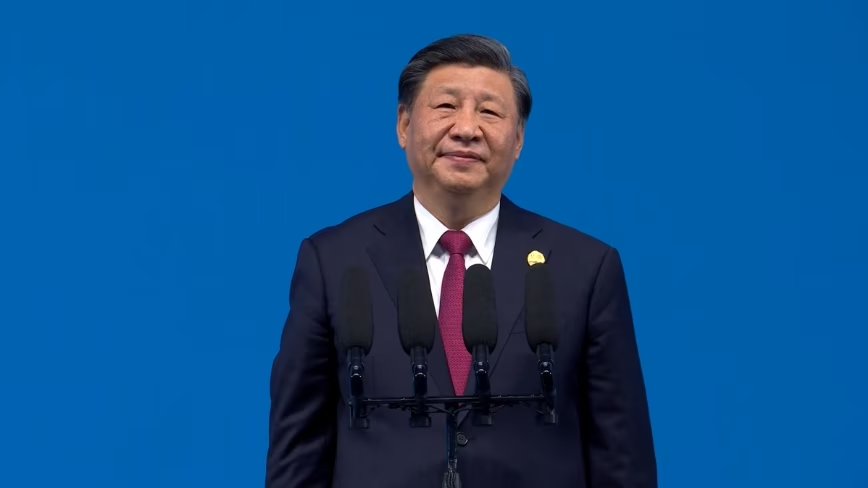
Xi pitches open-source AI to BRICS amid domestic curb debates
Chinese President Xi Jinping proposed a China-led open-source AI community and invited BRICS nations to join the World AI Cooperation Organization (WAICO) at the recent BRICS summit. This push for global collaboration contrasts sharply with Beijing's ongoing internal debates about restricting its own advanced AI models. Meanwhile, the EU's comprehensive AI Act, with its clear, enforceable rules for open-source AI, highlights a significant divergence in global AI governance approaches.

StarCraft Returns in 2030 as Open-World Shooter
Blizzard Entertainment announced a new StarCraft game, an open-world shooter, set to release in 2030. Unveiled at BlizzCon by VP Dan Hay, this marks the series' return after over a decade and a significant genre shift from its real-time strategy roots. The cinematic trailer showcased a gritty human-Zerg conflict, with many fans hoping for a traditional RTS follow-up.

Tesla Set to Finally Unveil Second-Generation Roadster on October 1
The much-anticipated second generation of the Tesla Roadster, a halo vehicle promising revolutionary performance, is finally slated for a public unveiling on October 1. After years of delays and a protracted development

Seattle Warned on Big Tech Reliance; Microsoft/OpenAI Sued; Apple's
A new City of Seattle study warns of the city's risky economic over-reliance on a few dominant tech companies. Simultaneously, the Seattle Times and Newsday are suing Microsoft and OpenAI for alleged AI training data theft, while Apple's new foldable iPhone Duo evokes memories of Microsoft's defunct Surface Duo.

in-depth: The Best 3-in-1 Apple Charging Stations After Testing 30
Wired has released its top picks for 3-in-1 Apple charging stations, extensively tested for iPhone, Apple Watch, and AirPods. The guide highlights six leading models, from premium speedy options to budget-friendly and compact designs, all focused on decluttering and optimizing charging for Apple users.

Nscale Adds Former OpenAI Exec Fidji Simo to Board Ahead of IPO
Nscale, the U.K.-based AI data center startup, has appointed former OpenAI, Meta, and Instacart executive Fidji Simo to its board of directors. This high-profile addition comes as Nscale prepares for a potential IPO this fall, leveraging Simo's extensive experience in scaling major tech platforms and guiding a company through a successful public offering.