
Mastering Production RAG with LangChain & Vector Databases — Key
Building a Retrieval Augmented Generation (RAG) system often begins with exciting prototypes, quickly demonstrating the power of injecting external knowledge into large language models (LLMs). However, the journey from

Building a Retrieval Augmented Generation (RAG) system often begins with exciting prototypes, quickly demonstrating the power of injecting external knowledge into large language models (LLMs). However, the journey from a functional prototype to a robust, scalable, and secure production-grade RAG application is fraught with complexities that many introductory tutorials overlook. This transition demands a deep understanding of infrastructure, optimization, and advanced architectural patterns.
The real challenge lies in addressing critical aspects like scaling, efficient debugging, stringent security, and thorough observability. Without a comprehensive strategy for these elements, a RAG system, no matter how promising in development, will struggle in a production environment. This calls for a structured approach that moves beyond basic implementations to tackle the nuanced requirements of real-world deployment.
The Production RAG Pipeline: A Holistic View
Transitioning to production RAG requires a comprehensive understanding of the entire pipeline. It's not just about querying an LLM; it involves meticulously managing data, optimizing retrieval, ensuring system reliability, and safeguarding against vulnerabilities. Key areas include intelligent document processing, efficient vector database management, strategic embedding choices, and sophisticated retrieval techniques.
LangChain emerges as a powerful framework to orchestrate these complex interactions, providing abstractions that simplify the development of sophisticated RAG chains. When combined with purpose-built vector databases, it forms the backbone for resilient RAG applications capable of handling real-world loads and diverse data types.
Foundations: Vector Databases and Indexing
At the heart of any RAG system is the vector database, responsible for storing and efficiently retrieving document embeddings. The choice and optimization of this database are paramount for performance and cost-effectiveness. For initial hands-on development, tools like Chroma offer a convenient local solution. However, for production, scalable and persistent options like Supabase with PGVector become essential, providing robust infrastructure for vector storage and retrieval.
Effective indexing begins with the Document Loader, which ingests data from various sources. This is followed by a Document Processing Pipeline, where raw data is transformed into chunks suitable for embedding. A deep dive into Embedding Dimensions is crucial, as the choice of embedding model directly impacts retrieval accuracy and computational cost. Once processed, these document chunks are embedded and stored, enabling Similarity Search with Scores to quantify the relevance of retrieved information. Understanding these scores is vital for refining retrieval strategies.
Optimizing Retrieval and System Performance
Efficient retrieval is more than just a basic similarity search. Hybrid Search, combining keyword and semantic search, often yields superior results by leveraging both precision and recall. Token Budgeting is another critical consideration, ensuring that retrieved context fits within the LLM's input window and managing costs associated with larger contexts.
RAG Optimization is an ongoing process, involving strategies to improve both retrieval quality and generation coherence. This includes evaluating different chunking strategies, adjusting embedding models, and fine-tuning retrieval parameters. Addressing these aspects is vital for Scaling RAG Systems effectively, anticipating increased query volumes and growing data sets without compromising performance. Understanding The Real Costs of Vector Search—including storage, compute for embeddings, and query execution—is fundamental for budget planning and resource allocation in production environments.
Ensuring Robustness, Observability, and Security
Debugging RAG systems can be complex due to the interplay of multiple components. Tools like LangSmith are invaluable for providing Observability into the RAG pipeline, offering detailed traces and analytics that help identify bottlenecks or errors in retrieval, prompt construction, or generation. This level of visibility is one of the Three Pillars of Production Visibility, essential for maintaining system health and performance.
For deployment, considering Production Hosting options that offer scalability, reliability, and ease of management is key. Crucially, a Security Layer must be integrated and rigorously tested. This involves setting up appropriate access controls, data encryption, and input validation to protect sensitive information and prevent malicious use. A comprehensive Security Checklist ensures all potential vulnerabilities are addressed before deployment.
Advanced RAG Architectures and Evolution
The field of RAG is rapidly evolving, moving beyond simple retrieval to more sophisticated patterns. A key discussion point is Long Context Models vs. RAG, exploring scenarios where one might be favored over the other, or how they can complement each other. Techniques like Contextual Retrieval and the nuanced choice between Late Chunking vs. Early Chunking further refine how context is prepared and presented to the LLM.
Agentic RAG, exemplified by architectures built with LangGraph, introduces Self-Correcting Retrieval, where an agent can iteratively refine its search query or re-evaluate retrieved documents for better results. GraphRAG enables Multi-hop Reasoning, allowing the system to follow chains of thought across interconnected documents to answer complex queries. The emergence of Multimodal RAG, such as ColPali for vision-based document RAG, extends these capabilities to process and retrieve information from diverse data types, marking a significant step in the RAG Evolution.
Mastering these production-grade considerations ensures that RAG applications are not only innovative but also reliable, secure, and performant, ready to deliver real value in demanding environments.
FAQ
Q: What is the primary benefit of using Hybrid Search over simple similarity search in a production RAG system? A: Hybrid search enhances retrieval by combining the strengths of both semantic (vector-based) and keyword (lexical) search. Semantic search excels at understanding the meaning and context of a query, while keyword search ensures precise matching of specific terms. This combination often leads to more comprehensive and relevant retrieval, improving the overall quality of context provided to the LLM, especially for queries that benefit from both conceptual understanding and exact term matching.
Q: How do Embedding Dimensions impact a RAG system's performance and cost? A: The choice of embedding dimensions significantly affects both the performance and cost of a RAG system. Higher embedding dimensions can capture more nuanced semantic relationships, potentially leading to better retrieval accuracy, but they also result in larger vector sizes. This increases storage requirements in the vector database and computational load during similarity searches, leading to higher inference times and increased infrastructure costs. Conversely, lower dimensions are more cost-effective and faster but might sacrifice some semantic fidelity.
Q: What is Agentic RAG and how does it differ from a basic RAG setup? A: Agentic RAG, often built with frameworks like LangGraph, introduces a layer of intelligent decision-making and self-correction into the retrieval process. Unlike a basic RAG setup that performs a single retrieval step, an agentic system can analyze the initial query, perform iterative searches, reformulate queries based on partial results, or even decide which tools to use for retrieval. This enables more complex reasoning and Self-Correcting Retrieval, allowing the system to adapt and refine its understanding to provide more accurate and comprehensive answers, especially for ambiguous or multi-faceted questions.
Related articles

Tesla Unveils Thruster-Equipped Roadster, 2028 Production Targeted
Tesla has unveiled its second-generation Roadster, featuring cold-gas thrusters co-developed with SpaceX, enabling it to jump and flip. The electric sports car demonstrated 0-60mph in an astonishing 0.81 seconds, with production targeted for 2028. This highly anticipated reveal also serves as a key recruitment tool for Tesla's ambitious AI and robotics initiatives.

AI's Confidence vs. Formal Methods' Rigor: Design Flaws & Verification
While AI accelerates code generation, formal methods remain critical for ensuring system correctness. Languages like TLA+ and tools like Quint enable developers to model and verify system designs before coding, catching subtle flaws. Quint makes formal methods more accessible with developer-friendly syntax and executability. This approach is vital for verifying AI-generated code through trace validation and model-based testing, ensuring reliability against real-world data.
Ephemeral PR Preview Environments on GKE: A Deep Dive
Every development team eventually grapples with the limitations of shared staging environments. The familiar scenario: multiple features deployed simultaneously, database migrations clashing, and the phrase "it works on
Secure Internal API Access for AI Agents with MCP
AI agents accessing internal APIs directly pose significant risks, including identity loss, unrestricted queries, and security bypasses. The Model Context Protocol (MCP) offers a solution by defining explicit tools. A secure architecture involves an MCP server wrapping the API with strict input validation, coupled with a gateway that handles authentication, rate limiting, and audit logging, ensuring safe and accountable access.

Nvidia's RTX 5090 Reportedly Scrapped: Is AI Eating Our Flagship GPUs
Nvidia has reportedly halted production of the GeForce RTX 5090, with leaked factory notices suggesting its core chip will be repurposed for AI and data center cards. This move positions the RTX 5080 24GB as the new flagship gaming GPU in the 50-series. The decision is linked to an industry-wide memory shortage, heavily influenced by surging AI demand, impacting consumer tech across the board.
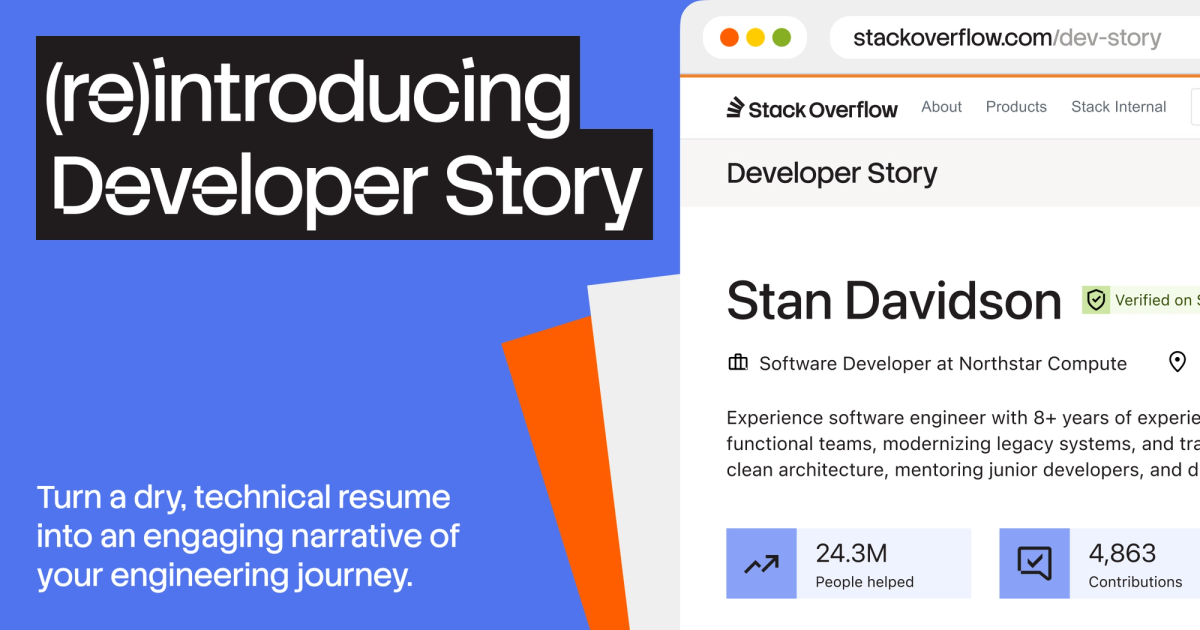
Beyond the Resume Noise: Developer Story Rethinks Tech Hiring
Stack Overflow is addressing the growing challenges in tech hiring, exacerbated by AI's influence leading to untrustworthy and generic resumes. Their solution, the re-introduced Developer Story, offers a platform for developers to authentically showcase their work, expertise, and impact through verifiable contributions and personal projects. This aims to provide hiring teams with more objective insights and help genuine talent stand out in a crowded market.