
Intel Arc 140T DLSS 5 Port: A Glimpse into AI-Powered Potential
An AI developer successfully ported DLSS 5 Neural Rendering to Intel Arc 140T integrated graphics, achieving 360p at 10.5 FPS. This technical marvel, aided by AI coding, is a groundbreaking proof-of-concept, but currently impractical for real-time gaming due to severe performance limitations and varied visual results based on game art style.
Quick Verdict
Uzbekunknown's unofficial port of NVIDIA's DLSS 5 Neural Rendering to Intel's Arc 140T integrated graphics (specifically tested on Arc 140V on Lunar Lake) is a monumental technical achievement, showcasing the impressive versatility of AI-assisted development and Intel's Xe architecture. However, in its current proof-of-concept state, the performance — a mere 10.5 frames per second at 360p resolution in an old game — renders it entirely impractical for real-time gameplay. While a fascinating glimpse into future possibilities, this isn't a consumer-ready feature.
A Groundbreaking Technical Achievement
The project, dubbed "dlss-nr-on-intel" on GitHub by developer "Uzbekunknown," aims to bring NVIDIA's advanced DLSS 5 Neural Rendering technology to Intel's integrated Xe architecture. Unlike many community-made modifications that often act as wrappers around existing NVIDIA DLLs, this endeavor stands apart. Uzbekunknown has fully reimplemented the intricate 71-block U-Net neural network that underpins DLSS 5. This is a formidable feat of reverse engineering and optimization, demonstrating a deep understanding of both NVIDIA's proprietary tech and Intel's hardware capabilities.
The implementation specifically targets the Intel Arc 140T's Xe XMX units, leveraging the Vulkan extension VK_KHR_cooperative_matrix for execution. A key challenge overcome was Intel's Xe2 architecture's lack of native FP8 support, necessitating the model to run entirely in FP16 with FP32 accumulate. This technical detail highlights the ingenuity required to adapt a technology designed for specific NVIDIA hardware onto a different platform, showcasing the developer's skill and the flexibility of modern GPU programming interfaces.
The AI That Coded the AI
Perhaps one of the most intriguing aspects of this project is the role of artificial intelligence in its development. Uzbekunknown explicitly credits Anthropic's Claude and OpenAI's GPT-6 Astra for contributing significantly to the codebase. The human developer notes that these AI agents "supplied the machine, the binary, and the direction, and made the decisions," essentially serving as collaborative partners in the coding process. This offers a compelling case study for AI-assisted software development, pushing the boundaries of what's possible when human expertise is augmented by powerful language models. Amusingly, the developer also chose to document the "wrong turns" taken during development, including a non-existent hallucinated driver bug from the AI that consumed three phases of the project — a candid and insightful detail into the evolving nature of AI collaboration.
Performance: Far from Playable
While the technical accomplishment is undeniable, the practical performance paints a stark picture of its current limitations. Testing on an Intel Arc 140V integrated graphics solution within a Lunar Lake system, Uzbekunknown managed to run Tekken 7, a game over a decade old, at a resolution of 640x360 pixels (one-ninth of Full HD). Even at this extremely low resolution, the neural rendering process yielded only approximately 10.5 frames per second.
To put this into perspective, for the DLSS 5 pass alone to process a Full HD image on the Arc 140V, it requires a staggering 412 milliseconds. This means that, even if the game itself rendered instantaneously, the absolute maximum frame rate achievable with DLSS 5 enabled would be a meager 2.4 frames per second. Such figures unequivocally categorize this as a proof-of-concept rather than a viable solution for real-time gaming. The demanding nature of neural rendering, even with specialized hardware, clearly pushes integrated graphics far beyond their current limits for interactive experiences.
Visual Impact: A Mixed Bag for Art Styles
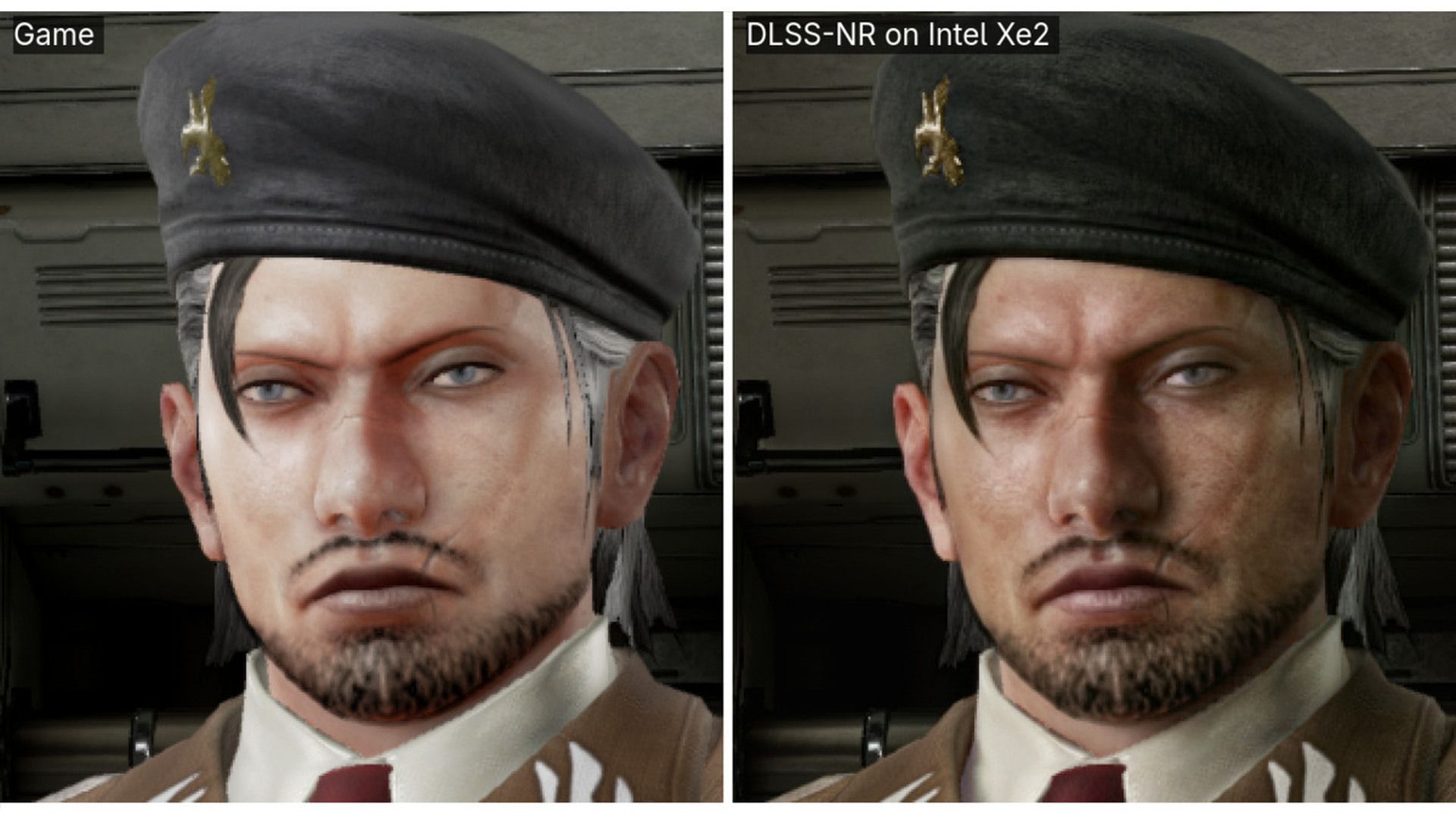
DLSS 5 Neural Rendering is inherently trained to produce a photorealistic aesthetic. This characteristic yields varying results depending on the original game's art style. In titles like Mortal Kombat 1 and Tekken 7, which lean towards a more realistic visual presentation, the DLSS 5 output can appear to add detail and enhance textures, even if the developer's assessment of Mortal Kombat 1 losing detail might be statistically accurate. Visually, for a reviewer's eye, it often appears more refined, aligning with the photorealistic goal.
However, for games with distinct stylized art, such as Dead or Alive 5 Last Round, the photorealistic training of DLSS 5 can clash with the game's original artistic intent. The project's output for Dead or Alive characters was observed to make them "look older and less appealing," altering their anime-inspired appearance in a way that diverges from the game's established visual identity. This highlights an important consideration for neural rendering techniques: while they can enhance fidelity, they can also impose a different artistic interpretation, which may not always be desired.
Future Prospects and Practicality
Currently, the "dlss-nr-on-intel" project requires a Linux environment to run. While this might deter some Windows users, it's a common starting point for cutting-edge development and community mods. The developer acknowledges that the current iteration is too slow for actual gameplay, suggesting its primary immediate utility might be in areas like game photo modes, where a user can toggle the neural rendering effect with a keystroke to capture enhanced stills, rather than needing constant high frame rates.
Looking ahead, there are stated efforts to port this work to discrete Intel Arc GPUs and even AMD cards. This holds significant promise, especially for AMD's upcoming RDNA 4 graphics, which are expected to support FP8, potentially allowing for more efficient execution of neural rendering models. Such cross-platform compatibility could democratize access to advanced rendering techniques, even if the ultimate goal of achieving playable frame rates on integrated or even mid-range discrete GPUs remains a significant challenge. This project serves as a crucial stepping stone, demonstrating that it can be done, paving the way for further optimization and broader implementation.
Pros and Cons
Pros:
- Technical Breakthrough: Successfully ports a complex, proprietary neural rendering technology to a different hardware architecture.
- AI-Assisted Development: Showcases the potential of large language models (Claude, GPT-6 Astra) in complex coding tasks.
- Cross-Platform Potential: Opens doors for DLSS 5-like capabilities on non-NVIDIA GPUs (Intel Arc, AMD Radeon).
- Foundational Work: A crucial proof-of-concept that can inspire further optimization and broader implementations.
- Vulkan Integration: Utilizes open standards like Vulkan for broader compatibility.
Cons:
- Impractical Performance: Extremely low frame rates (10.5 FPS at 360p) make it unusable for real-time gaming.
- Artistic Clash: Photorealistic training can negatively alter the aesthetics of stylized games.
- Platform Limitation: Currently requires Linux.
- Proof-of-Concept Only: Not a consumer-ready feature or performance enhancer for daily use.
Recommendation
For the vast majority of PC users and gamers, this project is not a practical solution. You won't be using it to boost your game's frame rates or visual fidelity in a playable manner today. However, for enthusiasts, developers, and those keenly interested in the bleeding edge of AI, graphics, and reverse-engineering, Uzbekunknown's "dlss-nr-on-intel" project is nothing short of fascinating. It's a powerful demonstration of innovation, open-source spirit, and the collaborative potential of AI. It signals a future where advanced rendering technologies might not be locked to a single vendor, even if that future is still many optimization cycles away for integrated graphics.
FAQ
Q: Can I use this DLSS 5 port to play games on my Intel Arc 140T integrated graphics?
A: No, not practically. While the port technically runs, it achieves extremely low frame rates (around 10 frames per second at 360p resolution in an old game). This performance is far too low for any enjoyable real-time gameplay experience. It's currently a proof-of-concept, not a performance enhancer.
Q: Does this mean Intel integrated graphics will soon have competitive neural rendering?
A: This project demonstrates the possibility of running neural rendering on Intel's Xe architecture, which is a significant step. However, achieving competitive performance that rivals dedicated GPUs or even official implementations will require substantial further optimization, potentially hardware improvements, and more efficient algorithms. It's a promising start, but not an immediate indicator of consumer-ready competitive performance.
Q: How was AI involved in the development of this port?
A: The developer, Uzbekunknown, explicitly stated that AI models like Anthropic's Claude and OpenAI's GPT-6 Astra played a significant role in coding, decision-making, and directing the project. This highlights a novel approach to software development, where AI acts as a collaborative partner in complex reverse-engineering tasks. While helpful, it also led to some "wrong turns," including a hallucinated driver bug that impacted development.
Related articles
EverQuest Legends: 27 Years On, Norrath's Magic Lives Anew
The Past is the Future: EverQuest Legends Revitalizes Norrath Remember those days of endless possibility, when logging into an MMO felt like stepping into a truly different universe? For many, that universe was Norrath,

Street Fighter Popcorn Bucket: A Gloriously Goofy Collectible
Quick Verdict In an era where cinema experience accessories are becoming increasingly elaborate, the Street Fighter movie popcorn bucket stands out. Shaped like Guile's iconic, gravity-defying flattop hairstyle, this
Prusa CORE One L+ Review: More Precise, Minor but Meaningful Upgrade
Tom's Hardware Verdict The Prusa CORE One L+ introduces small but impactful refinements to an already stellar 3D printer. The addition of a new nozzle wiper and enhanced GT1.5 belts boosts print quality and operational

Meta’s Copyright System Weaponized Against Albanian Protesters
Meta's Instagram platform is under fire as Albanian anti-government protesters face mass account suspensions due to what appears to be a coordinated campaign of false copyright complaints. European lawmakers are calling for an investigation, with evidence suggesting individuals were paid to file the reports. The European Commission is already scrutinizing Meta's content moderation practices under the Digital Services Act.

Anthropic Bio Lab: Ambition Meets Uncertainty
Anthropic's Leap into the Physical: A New Era for AI in Biology Verdict: Anthropic's establishment of a physical bio research lab marks a pivotal, albeit opaque, moment for AI's expansion into tangible scientific

howto: 3 Home Assistant projects to build multipurpose devices this
Build smarter, multipurpose Home Assistant devices this weekend (Sep 18-20)! Learn to combine presence sensing, smart buttons, and status lights into one unit, add displays to Bluetooth proxies, and integrate your standing desk with presence tracking for a cleaner, more efficient smart home.