
in-depth: States Want ICE Agents to Show Their Faces. The Trump
The Trump administration is suing several states and Philadelphia over laws requiring ICE agents to show faces and wear identifiers during raids, citing unproven threats from facial recognition and doxing sites. WIRED's investigation reveals the cited tools are outdated and ineffective. States emphasize accountability as their primary motivation.

The Trump administration has initiated legal action against at least five states—New York, Virginia, Connecticut, New Jersey, and a similar prior lawsuit against California—alongside the city of Philadelphia. These lawsuits challenge state and city ordinances that aim to enhance accountability for law enforcement, including Immigration and Customs Enforcement (ICE) officers, by prohibiting them from wearing masks and requiring individual identification during raids. The administration argues that these measures would dangerously expose ICE agents to doxing and harassment, a claim that is now under scrutiny.
Federal lawyers contend that mandating ICE officers to show their faces would enable individuals to photograph them and use facial recognition applications and doxing websites to uncover personal information. They specifically cite an art project called ICESpy as a tool that purportedly facilitates these activities. The Department of Justice (DOJ) maintains that such tools are used to "identify and harass federal law enforcement officers," though they have not provided concrete examples to support the use of ICESpy in such incidents.
However, an investigation by WIRED reveals significant discrepancies in the federal government's claims, particularly regarding the efficacy of ICESpy. According to its creator, artist Kyle McDonald, the face-recognition software behind ICESpy is largely incapable of identifying most active ICE agents. The project relies on a dataset compiled nearly a decade ago, comprising names, job titles, and photos of individuals who self-identified as ICE employees on LinkedIn in 2018.
This outdated database contains just over 700 entries, predominantly listing executive, administrative, or legal roles such as "assistant chief counsel." Only 39 individuals in the dataset had "deportation officer" in their title, with a handful more holding related enforcement positions. Crucially, ICE announced a substantial increase in its agent workforce in early 2026, nearly doubling its numbers from 10,000 to 22,000. None of these new recruits would be present in ICESpy's 2018 data. McDonald dismisses the idea of ICESpy posing an active threat to current officers as "absurd," noting its minimal recent activity with only 84 page views and two failed face-match attempts during a recent week-long period.
The Trump administration's lawsuits also mention ICE List, another site described as an accountability initiative. ICE List tracks individuals associated with immigration enforcement, as well as vehicles and incidents during operations. While the site does feature agent pages with names, job titles, and field office associations, it primarily relies on manual research and publicly available LinkedIn data, similar to ICESpy. Its maintainer, Dominick Skinner, acknowledges that while a small group attempts to use facial recognition, its success has been "overblown," confirming a lack of advanced computational analysis tools.
Skinner emphasizes that ICE List does not engage in traditional doxing, as it does not publish agents' home addresses or family information, a practice more commonly found on data broker sites that face less federal scrutiny. The recent identification of agent David Brouillette, involved in a fatal shooting in Maine, through ICE List was achieved by soliciting information from the local community, rather than through technological means.
State lawmakers argue that their laws requiring identification and prohibiting masks are vital for ensuring accountability and protecting residents from potential misconduct. Virginia State Senator Saddam Salim, whose state successfully paused its new law with an injunction, highlighted the importance of these restrictions in addressing issues of democracy and justice. He suggested the Department of Justice should prioritize investigating poorly trained ICE agents and other federal corruption, rather than challenging state efforts for transparency.
These legal battles unfold against a backdrop of increasing calls for transparency in federal immigration enforcement. Recent incidents, such as the fatal shootings by ICE officers in Maine and Texas, revealed that congressionally mandated body cameras were not being worn, complicating investigations. Furthermore, federal officials reportedly delayed providing evidence to Minnesota investigators for nearly six months regarding other fatal shootings until compelled by court orders. Adding to the concern, ICE's internal watchdog, the Office of Professional Responsibility, has been reportedly investigating online critics of federal immigration policies.
The clash between state-level transparency mandates and the federal government's claims of agent endangerment underscores a broader debate over law enforcement accountability and civil liberties. As these lawsuits progress, they will likely shape the future of oversight for federal immigration agents and the public's right to information.
FAQ
Q: Why is the Trump administration suing states over these laws? A: The Trump administration argues that state laws requiring ICE agents to show their faces and wear identifiers during immigration raids would endanger officers by making them vulnerable to identification through facial recognition apps and doxing sites.
Q: How effective are the facial recognition tools cited by the Trump administration? A: According to the creator of ICESpy, one of the main tools cited, its facial recognition software is largely ineffective and outdated, based on data from nearly a decade ago. Another site, ICE List, primarily relies on manual research rather than advanced computational analysis for identification.
Q: What is the states' rationale for these laws? A: States argue that these laws are necessary to hold law enforcement, including ICE agents, accountable for their actions, address issues of democracy and justice, and protect their residents from potential misconduct.
Related articles

Crystal Lake Series on Peacock: A Deep Dive into Horror's Past
Crystal Lake Series Review: A Deep Dive into Horror's Past Verdict: Is Crystal Lake Worth the Dive? The long-awaited Friday the 13th prequel, Crystal Lake, is finally arriving on Peacock, promising a fresh, in-depth
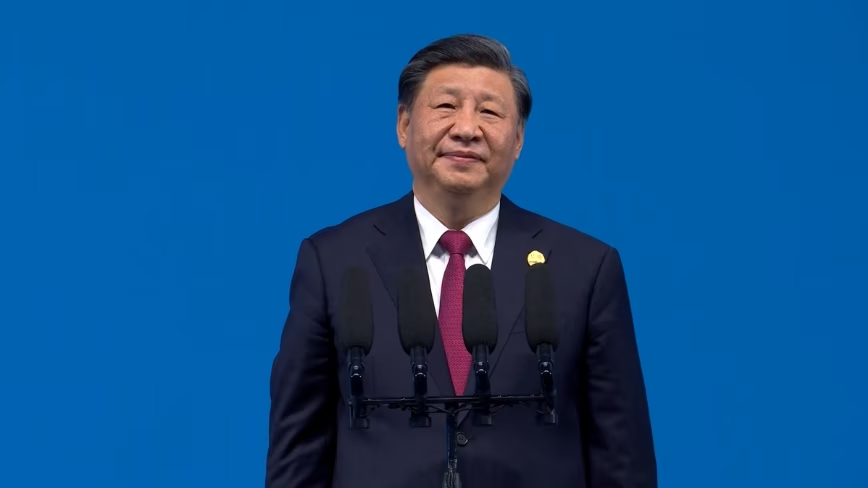
Xi pitches open-source AI to BRICS amid domestic curb debates
Chinese President Xi Jinping proposed a China-led open-source AI community and invited BRICS nations to join the World AI Cooperation Organization (WAICO) at the recent BRICS summit. This push for global collaboration contrasts sharply with Beijing's ongoing internal debates about restricting its own advanced AI models. Meanwhile, the EU's comprehensive AI Act, with its clear, enforceable rules for open-source AI, highlights a significant divergence in global AI governance approaches.

StarCraft Returns in 2030 as Open-World Shooter
Blizzard Entertainment announced a new StarCraft game, an open-world shooter, set to release in 2030. Unveiled at BlizzCon by VP Dan Hay, this marks the series' return after over a decade and a significant genre shift from its real-time strategy roots. The cinematic trailer showcased a gritty human-Zerg conflict, with many fans hoping for a traditional RTS follow-up.

Tesla Set to Finally Unveil Second-Generation Roadster on October 1
The much-anticipated second generation of the Tesla Roadster, a halo vehicle promising revolutionary performance, is finally slated for a public unveiling on October 1. After years of delays and a protracted development

Seattle Warned on Big Tech Reliance; Microsoft/OpenAI Sued; Apple's
A new City of Seattle study warns of the city's risky economic over-reliance on a few dominant tech companies. Simultaneously, the Seattle Times and Newsday are suing Microsoft and OpenAI for alleged AI training data theft, while Apple's new foldable iPhone Duo evokes memories of Microsoft's defunct Surface Duo.

in-depth: The Best 3-in-1 Apple Charging Stations After Testing 30
Wired has released its top picks for 3-in-1 Apple charging stations, extensively tested for iPhone, Apple Watch, and AirPods. The guide highlights six leading models, from premium speedy options to budget-friendly and compact designs, all focused on decluttering and optimizing charging for Apple users.