
in-depth: NASA’s Nancy Grace Roman Space Telescope Has a Hidden
NASA's Nancy Grace Roman Space Telescope features a groundbreaking coronagraph designed to directly image exoplanets. This instrument incorporates adaptive optics and active deformable mirrors, marking a first for space missions. It's a critical step toward future telescopes capable of finding Earth-like worlds, overcoming immense challenges to reveal distant planets.

The Nancy Grace Roman Space Telescope, poised for launch, carries an instrument designed to fundamentally reshape our understanding of the universe. While its primary mission will inform nearly every facet of astrophysics, a hidden gem within the telescope, a specialized coronagraph, represents a monumental technological leap. This experimental apparatus aims to achieve an unprecedented feat: directly capturing light reflected off an exoplanet's surface, a crucial step toward eventually imaging Earth-like worlds orbiting distant stars.
This pioneering effort is designed to test advanced techniques in space that have been previously confined to ground-based observatories. "We'll test them in space for the first time, and we'll understand what work still is left to go," explains Vanessa Bailey, an astrophysicist at NASA’s Jet Propulsion Laboratory and instrument scientist for the coronagraph. The success of this experiment is vital for future missions seeking to find and characterize potentially habitable exoplanets.
Unveiling the Hidden Technology
At its heart, a coronagraph functions as a sophisticated sunshade, blocking the intense glare of a star to reveal much fainter objects orbiting it. While instruments like those on the Hubble and James Webb space telescopes carry coronagraphs, Roman’s version is dramatically more advanced. This sophistication stems from its integration of adaptive optics, a technology that actively deforms the telescope’s mirror to precisely cancel out light distortions. This marks the first time such active deformable mirrors will be flown in space by NASA.
The critical components are two palm-sized mirrors, each equipped with approximately 2,300 tiny actuators. These actuators expand when subjected to a small jolt of electricity, infinitesimally reshaping the mirror's surface. This minute adjustment is key to reversing interference, allowing for clearer observations of distant exoplanets.
Tackling an Astronomical Challenge
The challenge faced by Roman's coronagraph is immense, likened by NASA to photographing a firefly perched next to a floodlight from across an entire country. Margaret Turnbull, an exoplanet scientist at the SETI Institute who leads a Roman coronagraph science team, underscores the precision required: "Any little bit of starlight that gets in the wrong place could just destroy a whole portion of the image."
Adaptive optics is a proven technology on advanced ground-based telescopes like the Very Large Telescope in Chile and the Keck Observatory in Hawaii, where it combats distortions caused by Earth's turbulent atmosphere. However, space telescopes, by virtue of being above the atmosphere, traditionally haven't required this technology. Roman’s deployment of adaptive optics is unique because it's designed to search for older, cooler planets illuminated solely by reflected starlight – a task never before attempted from space.
Beyond Mirrors: A Symphony of Innovation
The adaptive mirrors, while central, are part of a larger, integrated system. The coronagraph relies on supersensitive detectors capable of amplifying the signal from individual photons, essential given the minuscule number of photons expected from distant planets. Additionally, the instrument features exquisitely designed masks, or "star shades," which Bruce Macintosh, an astronomer leading a Roman coronagraph science team, describes as "beautiful, complicated shapes." These stand in stark contrast to the "brute force" metal pieces used on older telescopes like Hubble.
Guiding the Next Generation of Exploration
Roman's coronagraph operations will generate extensive test data, providing engineers with crucial insights into its performance in space and identifying any issues for future iterations. Scientists plan to validate the instrument by attempting to spot a handful of known exoplanets. As Turnbull notes, "If we go through the whole thing and we don’t see them, then we know something is wrong with the coronagraph, because those planets are there." The instrument will also observe stars surrounded by dust or debris clouds, potentially revealing gaps caused by undiscovered planets and offering new perspectives on our own solar system's composition.
This groundbreaking technology will directly inform the design and capabilities of subsequent space telescopes. The Habitable Worlds Observatory, envisioned by NASA for the 2040s, will require a coronagraph up to 100 times more effective than Roman’s. Similarly, the planned Lazuli Space Observatory, announced by ex–Google CEO Eric Schmidt's research institution, will feature an adaptive optics coronagraph nearly as sensitive as Roman’s. Beyond exoplanet hunting, coronagraphs could eventually enable astronomers to study binary stars or objects obscured by bright quasars.
Roman represents a critical first stride towards a future where humanity might glimpse other Earths. Its anticipated scientific discoveries will not only advance our knowledge of the cosmos but also pave the way for an even more ambitious future of space exploration. Julie McEnery, an astrophysicist at NASA’s Goddard Space Flight Center and senior project scientist for Roman, succinctly puts it: "Obviously, the best way of demonstrating that something works is to do something interesting scientifically."
FAQ
Q: What is the main purpose of Roman's coronagraph?
A: The main purpose of Roman's specialized coronagraph is to directly capture starlight reflected off the surface of exoplanets for the first time, paving the way for future telescopes to image Earth-like planets orbiting other stars.
Q: How is Roman's coronagraph different from previous ones?
A: Roman’s coronagraph is significantly more sophisticated due to its use of adaptive optics, which includes active deformable mirrors (NASA's first time flying them in space) to cancel light distortions. It also features highly sensitive detectors and intricately designed star masks, unlike simpler "brute force" versions on older telescopes.
Q: What future missions will benefit from this technology?
A: The data and lessons learned from Roman's coronagraph will inform the development of future space telescopes, including NASA's Habitable Worlds Observatory (projected for the 2040s) and the Lazuli Space Observatory, both of which will require advanced coronagraph technology for exoplanet observation.
Related articles

Apple Unveils iPhone Duo: Pricey Foldable Sees Soaring Demand
Apple has officially entered the foldable smartphone arena with the long-anticipated launch of the iPhone Duo. Priced starting at a hefty $1,999, the device features a 5.4-inch outer display and a larger 7.6-inch inner

in-depth: Chicago-Area Cops Helped HSI Spy on Minnesota Anti-ICE
Chicago-area law enforcement, including local police and HSI agents, conducted undercover surveillance on Minnesota anti-ICE activists at an April 2, 2022, talk in Chicago. This operation was part of a federal conspiracy probe into 15 Minnesota activists facing felony charges related to immigration enforcement resistance. Civil liberties advocates have condemned the surveillance as a troubling intrusion into protected political activity.

Mark Wahlberg on using AI in film ‘the right way’ and being open to
Actor Mark Wahlberg believes AI has a place in filmmaking if used responsibly for enhancement, not script generation or actor replacement. At TechCrunch Disrupt, he expressed openness to an AI likeness carrying on his legacy, managed by his family, and emphasized storytelling.

Ars Technica's Rocket Report: Your Essential Space Industry Briefing
Quick Verdict Ars Technica's Rocket Report, presented by veteran space reporter Stephen Clark, offers an invaluable and meticulously organized weekly (or similar frequency, implied by "Edition 9.15") digest of the most
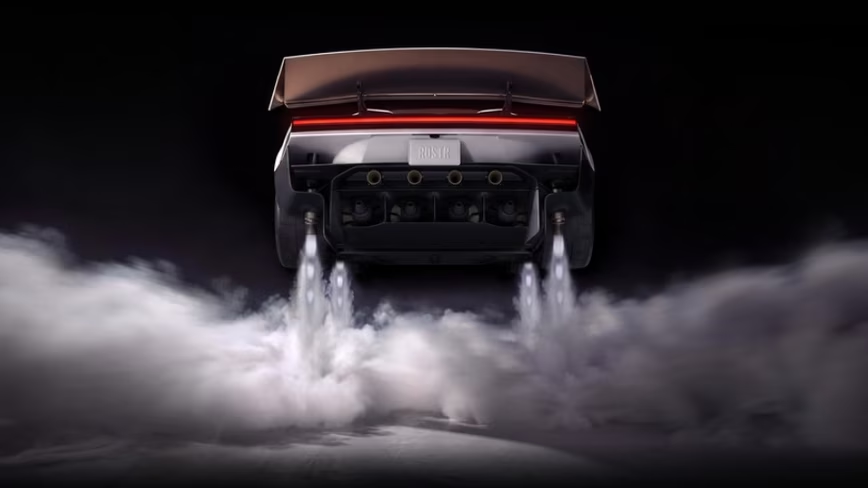
Tesla Unveils Thruster-Equipped Roadster, 2028 Production Targeted
Tesla has unveiled its second-generation Roadster, featuring cold-gas thrusters co-developed with SpaceX, enabling it to jump and flip. The electric sports car demonstrated 0-60mph in an astonishing 0.81 seconds, with production targeted for 2028. This highly anticipated reveal also serves as a key recruitment tool for Tesla's ambitious AI and robotics initiatives.

Amazon Prime Video Launches AI-Powered Prime 360 for NBA Coverage
Amazon Prime Video is elevating its NBA coverage with the introduction of Prime 360, an AI-powered replay system offering immersive, 'fly through' views of the action. Kicking off its second season, Prime Video also adds Yahoo fantasy integration and gains exclusive Eastern Conference Finals rights, expanding its tech-driven sports broadcast. The new features aim to deliver a unique and interactive viewing experience for basketball fans.