
in-depth: Create Custom Windows 11 Notifications to Remind Yourself
Wired has unveiled a comprehensive guide by David Nield on September 6, 2026, detailing how Windows 11 users can create custom desktop alerts. This new capability allows for recurring reminders and notifications triggered by specific events, offering unprecedented control over desktop management. The article, available on Wired's platform, promises to enhance user productivity and personalization.

Windows 11 users are poised to gain unprecedented control over their digital desktop experience, with new capabilities emerging for highly personalized and automated notifications. A recent report by technology journalist David Nield, published on Wired on September 6, 2026, details how individuals can now "take full control of your desktop alerts by sending yourself recurring reminders and custom notifications triggered by specific events."
This development marks a significant step towards enhancing user productivity and organizational efficiency within the Windows 11 ecosystem. Traditionally, operating system notifications have been somewhat rigid, often tied to application-specific alerts or basic calendar functions. However, the introduction of a robust framework for custom and event-driven alerts empowers users to transform their desktop into a dynamic personal assistant.
The essence of this innovation lies in its flexibility. The ability to set up "recurring reminders" addresses a common user need for consistent prompts for daily routines, weekly tasks, or periodic check-ins without the need for external software. This could range from remembering to take a break every hour to prompting weekly report submissions, seamlessly integrating into the user's workflow directly from their operating system.
Even more impactful is the prospect of "custom notifications triggered by specific events." While the detailed mechanics are outlined in Wired's guide, the principle suggests a sophisticated level of interaction where system events, application states, or even data changes could initiate a personalized alert. This could mean a notification when a specific file is modified, a certain application is opened, or a predefined condition is met within the operating environment, offering a proactive layer of desktop management previously unavailable.
For anyone looking to optimize their digital workspace, these enhanced notification features present a powerful tool. By moving beyond generic alerts, users can tailor their Windows 11 experience to precisely match their personal and professional demands. This level of granular control helps minimize distractions from irrelevant notifications while ensuring that crucial information and reminders are delivered promptly and effectively.
Wired, renowned for its focus on the intersection of technology, power, and culture, continues to provide valuable insights for navigating the ever-evolving tech landscape. This article, categorized under "Gear" and tagged with "notifications," "tips," "Change This Setting," "how-to," "Windows," and "software," exemplifies Wired's commitment to delivering practical advice and highlighting advancements that shape the user experience. The publication prides itself on rigorous investigations and game-changing reporting, aiming to lead the story of the present and explain how these forces forge the future.
David Nield, the author, brings over two decades of experience as a tech journalist from Manchester in the UK, specializing in apps and gadgets. His extensive background provides a credible foundation for the detailed guide on mastering Windows 11 notifications, ensuring that readers receive expert-tested advice for customizing their desktop alerts.
Users eager to implement these advanced notification strategies can find the comprehensive guide on Wired's platform. It's important to note that access to the full article may require a subscription or a free trial, aligning with Wired's model of offering premium content. This ensures that in-depth how-to articles, such as this one, are supported by a commitment to quality journalism.
Ultimately, these new capabilities empower Windows 11 users to move beyond passive consumption of system alerts to active control over their digital reminders. The ability to define exactly what, when, and how they are notified represents a significant leap forward in personalizing the computing experience, contributing to a more organized, productive, and less stressful digital life.
FAQ
Q: What specific types of custom notifications can Windows 11 users now create?
A: According to the recently published guide, Windows 11 users can now create recurring reminders and custom notifications that are triggered by specific events, allowing for a comprehensive control over desktop alerts.
Q: Who authored the guide on custom Windows 11 notifications and where was it published?
A: The guide was authored by David Nield, a seasoned tech journalist, and was published by Wired on September 6, 2026.
Q: What is the main benefit for Windows 11 users who implement these custom notification features?
A: The primary benefit is gaining full control over desktop alerts, enabling users to personalize their digital environment to better manage tasks, events, and personal reminders, thereby enhancing productivity and organization.
Related articles
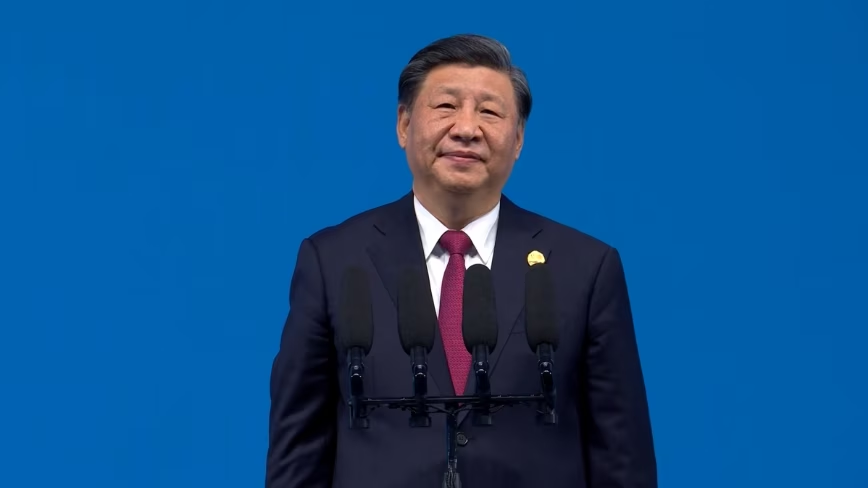
Xi pitches open-source AI to BRICS amid domestic curb debates
Chinese President Xi Jinping proposed a China-led open-source AI community and invited BRICS nations to join the World AI Cooperation Organization (WAICO) at the recent BRICS summit. This push for global collaboration contrasts sharply with Beijing's ongoing internal debates about restricting its own advanced AI models. Meanwhile, the EU's comprehensive AI Act, with its clear, enforceable rules for open-source AI, highlights a significant divergence in global AI governance approaches.

Tesla Set to Finally Unveil Second-Generation Roadster on October 1
The much-anticipated second generation of the Tesla Roadster, a halo vehicle promising revolutionary performance, is finally slated for a public unveiling on October 1. After years of delays and a protracted development

Seattle Warned on Big Tech Reliance; Microsoft/OpenAI Sued; Apple's
A new City of Seattle study warns of the city's risky economic over-reliance on a few dominant tech companies. Simultaneously, the Seattle Times and Newsday are suing Microsoft and OpenAI for alleged AI training data theft, while Apple's new foldable iPhone Duo evokes memories of Microsoft's defunct Surface Duo.

in-depth: The Best 3-in-1 Apple Charging Stations After Testing 30
Wired has released its top picks for 3-in-1 Apple charging stations, extensively tested for iPhone, Apple Watch, and AirPods. The guide highlights six leading models, from premium speedy options to budget-friendly and compact designs, all focused on decluttering and optimizing charging for Apple users.

Nscale Adds Former OpenAI Exec Fidji Simo to Board Ahead of IPO
Nscale, the U.K.-based AI data center startup, has appointed former OpenAI, Meta, and Instacart executive Fidji Simo to its board of directors. This high-profile addition comes as Nscale prepares for a potential IPO this fall, leveraging Simo's extensive experience in scaling major tech platforms and guiding a company through a successful public offering.

Microsoft comms chief Frank Shaw to exit after nearly three decades
Frank X. Shaw, Microsoft's long-serving chief communications officer, will exit at year-end after nearly three decades shaping the company's message through pivotal periods. Shaw, 64, is not retiring but plans a break before his next move, leaving behind a legacy of adapting communications for a digital age and embracing AI tools. Microsoft is now searching for his successor.