
Grammarly's 'Expert Review' Lacks Actual Human Experts
Grammarly, the popular writing assistant, has come under scrutiny for its recently launched “Expert Review” feature, which purports to offer writing suggestions from the perspective of renowned authors and influential

Grammarly, the popular writing assistant, has come under scrutiny for its recently launched “Expert Review” feature, which purports to offer writing suggestions from the perspective of renowned authors and influential thinkers. However, a closer look reveals that these purported experts, including prominent tech journalists, are not actually involved in generating the feedback, raising significant questions about authenticity and consent in AI-powered tools.
The feature, rolled out in August 2025 as part of a broader suite of AI enhancements, appears in the sidebar of Grammarly’s main writing assistant. It promises to refine user writing by delivering revision advice seemingly channeled through the voices of various subject matter experts, aiming to elevate the quality and impact of the user's text.
Reports from outlets like Wired and The Verge quickly highlighted the contentious nature of this new functionality. Users have observed feedback attributed to well-known literary figures, some long deceased, alongside contemporary tech journalists from publications such as Wired, The Verge, Bloomberg, and The New York Times. The core issue lies in the fact that these individuals have neither contributed to the feature nor granted Grammarly permission to use their names.
TechCrunch’s own Anthony Ha explored the feature, attempting to elicit advice from his colleagues. Instead, he received suggestions framed as if from figures like Casey Newton, advising on ethical context; Kara Swisher, prompting to “leverage the anecdote for reader alignment”; and Timnit Gebru, suggesting users “pose the bigger accountability question.” The article playfully notes the author’s disappointment that no TechCrunch journalists were cited, even while acknowledging the feature's flawed premise.
Grammarly’s parent company, Superhuman, addressed the concerns through its vice president of product and corporate marketing, Alex Gay. Gay stated that these experts are referenced because “their published works are publicly available and widely cited,” implying a derivation of style rather than direct collaboration or endorsement.
Further clarifying its position, Grammarly’s user guide for the feature explicitly states, “References to experts in Expert Review are for informational purposes only and do not indicate any affiliation with Grammarly or endorsement by those individuals or entities.” This disclosure aims to manage user expectations, though critics argue it doesn't fully mitigate the misleading nature of the branding.
The lack of actual expert involvement has drawn sharp criticism. Historian C.E. Aubin, speaking to Wired, underscored the fundamental problem: “These are not expert reviews, because there are no ‘experts’ involved in producing them.” This statement cuts to the heart of the controversy, challenging Grammarly’s nomenclature and the implied authority of its AI-generated advice.
This development in Grammarly’s AI offerings highlights a growing ethical dilemma in the artificial intelligence landscape. As AI models become increasingly sophisticated at mimicking human styles and generating content, companies face the challenge of clearly distinguishing between AI-derived insights and genuine human expertise. The “Expert Review” feature, while potentially innovative in its approach to stylistic analysis, risks undermining user trust by creating a facade of human endorsement where none exists.
Ultimately, the rollout of Grammarly’s “Expert Review” serves as a case study for the transparency and ethical considerations vital for AI tools. The line between inspiration and appropriation, especially when leveraging the intellectual and reputational capital of real individuals, remains a critical area for technology companies to navigate carefully as AI capabilities expand.
FAQ
Q: What is Grammarly's "Expert Review" feature?
A: Launched in August 2025, Grammarly's "Expert Review" is an AI-powered feature that provides writing revision suggestions, purporting to offer advice from the "perspective" of various subject matter experts, including well-known authors and journalists.
Q: Are actual human experts involved in generating the advice from Grammarly's "Expert Review"?
A: No, the individuals whose names are referenced (such as famous authors or prominent tech journalists) are not directly involved in or endorsing the "Expert Review" feature. Grammarly states that these references are for informational purposes, based on publicly available works, and do not imply any affiliation or endorsement.
Q: Why is Grammarly's "Expert Review" feature controversial?
A: The controversy stems from the feature's attribution of advice to specific individuals without their consent or direct involvement, creating an impression of expert endorsement that is not genuine. Critics argue this raises ethical questions regarding intellectual property, user trust, and the authenticity of AI-generated content presented under the guise of human expertise.
Related articles
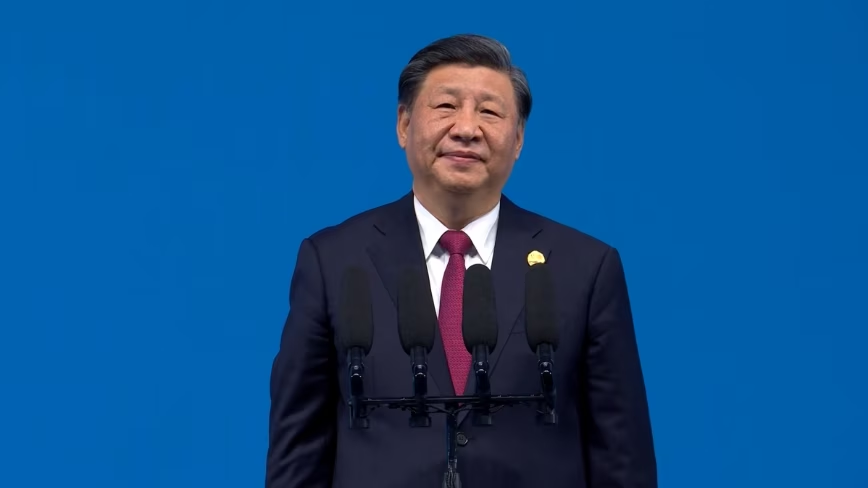
Xi pitches open-source AI to BRICS amid domestic curb debates
Chinese President Xi Jinping proposed a China-led open-source AI community and invited BRICS nations to join the World AI Cooperation Organization (WAICO) at the recent BRICS summit. This push for global collaboration contrasts sharply with Beijing's ongoing internal debates about restricting its own advanced AI models. Meanwhile, the EU's comprehensive AI Act, with its clear, enforceable rules for open-source AI, highlights a significant divergence in global AI governance approaches.

Tesla Set to Finally Unveil Second-Generation Roadster on October 1
The much-anticipated second generation of the Tesla Roadster, a halo vehicle promising revolutionary performance, is finally slated for a public unveiling on October 1. After years of delays and a protracted development

Seattle Warned on Big Tech Reliance; Microsoft/OpenAI Sued; Apple's
A new City of Seattle study warns of the city's risky economic over-reliance on a few dominant tech companies. Simultaneously, the Seattle Times and Newsday are suing Microsoft and OpenAI for alleged AI training data theft, while Apple's new foldable iPhone Duo evokes memories of Microsoft's defunct Surface Duo.
Google's AI Branding Fix: A Clearer Vision for Gemini
This article critiques Google's fragmented AI branding, proposing a unified 'Gemini Intelligence' system to simplify user experience and strengthen Gemini's identity.

in-depth: The Best 3-in-1 Apple Charging Stations After Testing 30
Wired has released its top picks for 3-in-1 Apple charging stations, extensively tested for iPhone, Apple Watch, and AirPods. The guide highlights six leading models, from premium speedy options to budget-friendly and compact designs, all focused on decluttering and optimizing charging for Apple users.

Chuwi UniBox AI495 Pro Review: A Mini AI Powerhouse
Chuwi's UniBox AI495 Pro review: A powerful mini workstation with 192GB RAM and an AMD Ryzen AI chip for local LLM processing, packed into a compact, Mac Pro-esque design.