
Google's Maps Update Puts Gemini in the Passenger Seat
Google Maps introduces its biggest update in a decade with "Ask Maps," a Gemini-powered conversational AI feature, and "Immersive Navigation," which delivers photorealistic 3D turn-by-turn directions. This overhaul allows users to pose complex queries and experience a more visually intuitive journey, rolling out initially in the US and India.
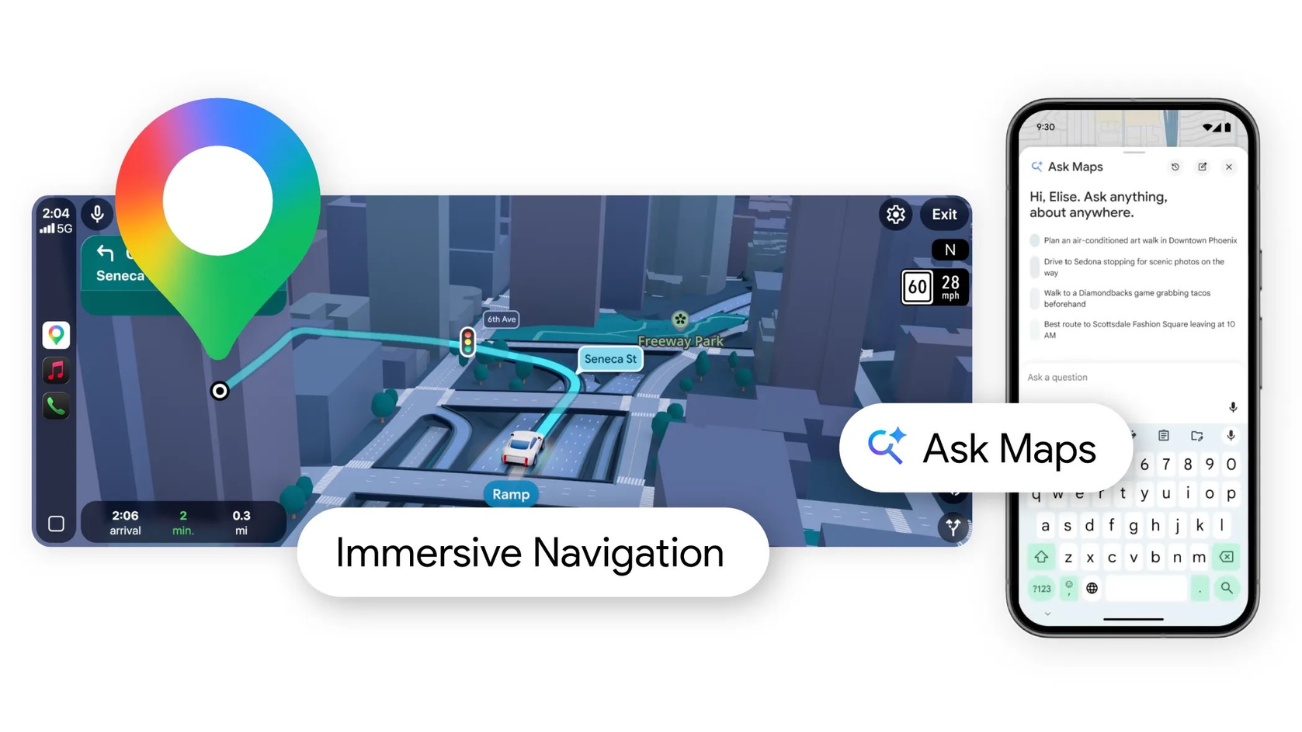
Google Maps is rolling out its most significant update in over a decade, integrating advanced conversational AI powered by Gemini and introducing a visually stunning 3D navigation experience. This dual overhaul, featuring "Ask Maps" and "Immersive Navigation," aims to transform how users interact with the world around them, making digital cartography more intelligent and intuitive.
The update, announced on March 12 and now commencing its rollout, introduces a new era of personalized guidance. Ask Maps leverages Google's Gemini AI to understand complex, natural language queries, moving beyond simple keyword searches. For instance, users can now ask intricate questions like, "My phone is dying, where can I charge it without a long wait for coffee?" or "Is there a public tennis court with lights on that I can play at tonight?" The system processes these requests by drawing on personalization signals, including a user’s saved places and past searches, to provide highly relevant and contextual answers.
Initially, Ask Maps is becoming available to users in the United States and India on both Android and iOS devices, with a desktop version slated for a later release. Google has yet to provide a timeline for its wider international expansion.
A New Dimension of Navigation
Complementing the AI-driven search is Immersive Navigation, a complete redesign of the turn-by-turn directions. This feature replaces the traditional flat-map overlay with a photorealistic 3D view that accurately renders nearby buildings, overpasses, and terrain. Essential visual cues such as lane markings, traffic lights, crosswalks, and stop signs are incorporated directly into the 3D environment, offering a more intuitive visual guide than abstract text instructions.
Voice guidance has also been refined to utilize landmark-based phrasing, such as, "Go past this exit and take the next one for Illinois 43 South," instead of relying solely on distance-based prompts. This shift aims to make directions clearer and more natural to follow in real-world scenarios.
This deployment of detailed 3D rendering for navigation brings Google Maps closer to the visual depth offered by competitors like Apple Maps, which introduced similar features years ago. The delay reflects the significant computational cost of real-time 3D rendering on mobile devices and the extensive effort required to build the underlying high-resolution map data.
The Strategic Importance of AI in Maps
The integration of Ask Maps represents Gemini's most direct deployment into a Google product used by over a billion people monthly. Previously, Gemini's presence in Maps was limited to AI-powered summaries of places and reviews. This expansion into full conversational navigation positions Google in more direct competition with AI-native tools like Perplexity, which has developed search-style answers for location-based queries.
The update also arrives as Apple continues to enhance its Maps intelligence and OpenAI explores location-aware features within ChatGPT. For Google, a company that derives a substantial portion of its advertising revenue from local search queries, maintaining Maps as the primary interface for spatial intent is strategically critical. Ask Maps is a clear statement of Google's intent to defend and expand its dominance in this crucial area.
While the technological infrastructure for conversational navigation is now firmly in place, the open question remains whether users will fully embrace talking to their maps or continue to default to the familiar search box. Google has introduced conversational search features in the past, with adoption sometimes proving slower than initial product announcements might suggest. Nevertheless, this update signals a profound shift in the capabilities and potential of digital mapping, setting a new benchmark for what users can expect from their navigation tools.
FAQ
Q: What are the two main new features introduced in this Google Maps update?
A: The two main features are "Ask Maps," a conversational AI powered by Gemini, and "Immersive Navigation," which provides photorealistic 3D turn-by-turn directions.
Q: Where is Ask Maps currently available?
A: Ask Maps is rolling out now in the US and India on both Android and iOS devices. A desktop version is expected to follow, but there is no timeline yet for wider international expansion.
Q: How does Ask Maps use AI to answer user queries?
A: Ask Maps uses Gemini AI to understand complex, natural language questions. It processes these queries by leveraging personalization signals, such as a user's saved places and past searches, to provide highly contextual and relevant answers.
Related articles

Xi pitches open-source AI to BRICS amid domestic curb debates
Chinese President Xi Jinping proposed a China-led open-source AI community and invited BRICS nations to join the World AI Cooperation Organization (WAICO) at the recent BRICS summit. This push for global collaboration contrasts sharply with Beijing's ongoing internal debates about restricting its own advanced AI models. Meanwhile, the EU's comprehensive AI Act, with its clear, enforceable rules for open-source AI, highlights a significant divergence in global AI governance approaches.

Tesla Set to Finally Unveil Second-Generation Roadster on October 1
The much-anticipated second generation of the Tesla Roadster, a halo vehicle promising revolutionary performance, is finally slated for a public unveiling on October 1. After years of delays and a protracted development

Seattle Warned on Big Tech Reliance; Microsoft/OpenAI Sued; Apple's
A new City of Seattle study warns of the city's risky economic over-reliance on a few dominant tech companies. Simultaneously, the Seattle Times and Newsday are suing Microsoft and OpenAI for alleged AI training data theft, while Apple's new foldable iPhone Duo evokes memories of Microsoft's defunct Surface Duo.
Google's AI Branding Fix: A Clearer Vision for Gemini
This article critiques Google's fragmented AI branding, proposing a unified 'Gemini Intelligence' system to simplify user experience and strengthen Gemini's identity.

in-depth: The Best 3-in-1 Apple Charging Stations After Testing 30
Wired has released its top picks for 3-in-1 Apple charging stations, extensively tested for iPhone, Apple Watch, and AirPods. The guide highlights six leading models, from premium speedy options to budget-friendly and compact designs, all focused on decluttering and optimizing charging for Apple users.

Chuwi UniBox AI495 Pro Review: A Mini AI Powerhouse
Chuwi's UniBox AI495 Pro review: A powerful mini workstation with 192GB RAM and an AMD Ryzen AI chip for local LLM processing, packed into a compact, Mac Pro-esque design.