
Google-backed Pixxel Secures $100M, Setting India's Space Tech Record
Indian hyperspectral imaging specialist Pixxel has achieved a significant milestone, raising $100 million in a Series C funding round. This landmark investment, led by Singapore's state investor Temasek and the
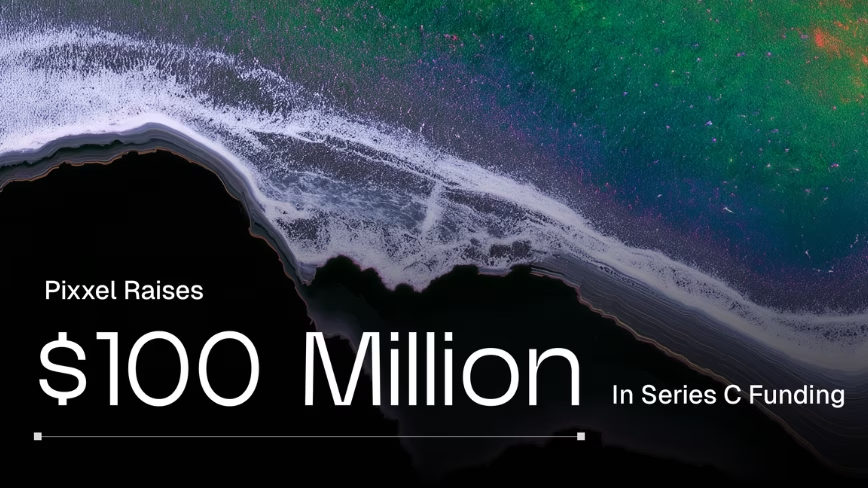
Indian hyperspectral imaging specialist Pixxel has achieved a significant milestone, raising $100 million in a Series C funding round. This landmark investment, led by Singapore's state investor Temasek and the London-listed Seraphim Space Investment Trust, marks the largest single funding round ever for an Indian space technology company.
The substantial capital infusion brings Pixxel's total funding to an impressive $195 million, underscoring growing confidence in its innovative Earth observation capabilities. The round, announced on September 7, 2026, also welcomed new investors, including 360 ONE Asset and South Korean firm IMM Investment, alongside continued support from existing backers Radical Ventures and growX Ventures. Notably, Google, an earlier investor, was not listed among the participants in this latest round, and no valuation was disclosed—a common practice for private funding rounds of this magnitude.
Seraphim Space's $25 million commitment to Pixxel is particularly significant for European investors. As one of the few publicly listed vehicles offering direct exposure to early-stage space ventures, Seraphim's substantial allocation to a non-European company highlights the global appeal and perceived potential of Pixxel's technology. This investment contrasts with the typically smaller cheques seen in the European Earth observation sector, such as the €27 million Series A recently secured by French satellite startup Univity.
Pixxel's core offering lies in its hyperspectral imagery, a technology that transcends conventional satellite imaging. Instead of capturing light in just three or four broad colour bands, Pixxel's satellites split reflected light into hundreds of narrow bands. This advanced capability transforms each pixel from a simple colour indicator into a rich chemical signature, allowing for detailed analysis that can detect crop disease, pinpoint methane leaks, assess mineral content, and monitor water quality with unprecedented precision.
Currently, Pixxel operates its Firefly constellation, consisting of six satellites launched over the past two years. The company proudly states that this constellation represents the highest-resolution commercial hyperspectral constellation currently in orbit, providing critical data for various applications worldwide.
The newly secured $100 million is strategically earmarked to fuel several ambitious initiatives. A significant portion will go towards developing the successor to the Firefly constellation, named Honeybee, with its inaugural launch anticipated in 2027. Pixxel also plans to expand its imaging capabilities to include high-resolution optical satellites and, eventually, synthetic aperture radar (SAR) to complement the areas hyperspectral technology cannot cover. Further investment will enhance Aurora, Pixxel's browser-based analysis platform that interprets the vast amounts of imagery data, and establish Gigapixxel, a dedicated manufacturing facility to scale production.
Awais Ahmed, founder and chief executive of Pixxel, articulated the company's grand vision: “Years ago, we set out to build a health monitor for the planet. This new investment gives us the scale to turn that vision into planetary infrastructure.” This statement underscores Pixxel's commitment to leveraging its technology for global environmental and resource monitoring.
Pixxel's market validation is robust, backed by a compelling list of customers and strategic partnerships. The company holds contracts with major US government agencies, including NASA and the US National Reconnaissance Office (NRO), which awarded Pixxel a five-year hyperspectral data agreement in 2023. Domestically, Pixxel leads a consortium—which includes Dhruva Space, PierSight, and SatSure—selected by IN-SPACe, India's space regulator, to construct a 12-satellite national Earth observation constellation under a pioneering public-private partnership model.
This blend of commercial constellation development, contracts with American intelligence entities, and involvement in a sovereign national program exemplifies a model that European operators have long sought to emulate. The success of companies like Open Cosmos, which is developing Greece's first flagship constellation on similar public-private terms, illustrates the global shift towards this collaborative approach in space technology.
The Indian space regulator, IN-SPACe, has actively cultivated an environment conducive to such investment rounds. Established to enable private companies to own and operate space assets, moving beyond their traditional role as state agency suppliers, IN-SPACe's policy has found its purest expression in this startup-led national constellation consortium. The $100 million private funding round, landing in the same year, serves as a powerful testament to the efficacy of these forward-thinking policies.
The next crucial milestone for Pixxel will be the maiden launch of its Honeybee constellation. Until then, the company's proposition to governments hinges on its current six Firefly satellites and advanced software platform. This significant funding not only propels Pixxel's expansion but also solidifies India's burgeoning presence on the global space technology stage.
FAQ
Q: What is hyperspectral imaging and how does Pixxel use it?
A: Hyperspectral imaging involves splitting reflected light into hundreds of narrow bands, rather than the few broad bands used in conventional imaging. Pixxel uses this technology to detect chemical signatures from Earth's surface, allowing for applications like identifying crop disease, methane leaks, mineral content, and water quality.
Q: Who were the lead investors in Pixxel's $100 million Series C round?
A: The Series C round was led by Singapore's state investor Temasek and the London-listed Seraphim Space Investment Trust. New investors included 360 ONE Asset and IMM Investment, with continued participation from Radical Ventures and growX Ventures.
Q: What are Pixxel's plans for the newly acquired $100 million?
A: The funding is earmarked for the development and launch of the next-generation Honeybee constellation (first launch 2027), expansion into high-resolution optical and synthetic aperture radar satellites, further development of its Aurora analysis platform, and the construction of a manufacturing facility called Gigapixxel.
Related articles
Xi pitches open-source AI to BRICS amid domestic curb debates
Chinese President Xi Jinping proposed a China-led open-source AI community and invited BRICS nations to join the World AI Cooperation Organization (WAICO) at the recent BRICS summit. This push for global collaboration contrasts sharply with Beijing's ongoing internal debates about restricting its own advanced AI models. Meanwhile, the EU's comprehensive AI Act, with its clear, enforceable rules for open-source AI, highlights a significant divergence in global AI governance approaches.

StarCraft Returns in 2030 as Open-World Shooter
Blizzard Entertainment announced a new StarCraft game, an open-world shooter, set to release in 2030. Unveiled at BlizzCon by VP Dan Hay, this marks the series' return after over a decade and a significant genre shift from its real-time strategy roots. The cinematic trailer showcased a gritty human-Zerg conflict, with many fans hoping for a traditional RTS follow-up.

Tesla Set to Finally Unveil Second-Generation Roadster on October 1
The much-anticipated second generation of the Tesla Roadster, a halo vehicle promising revolutionary performance, is finally slated for a public unveiling on October 1. After years of delays and a protracted development

Seattle Warned on Big Tech Reliance; Microsoft/OpenAI Sued; Apple's
A new City of Seattle study warns of the city's risky economic over-reliance on a few dominant tech companies. Simultaneously, the Seattle Times and Newsday are suing Microsoft and OpenAI for alleged AI training data theft, while Apple's new foldable iPhone Duo evokes memories of Microsoft's defunct Surface Duo.

in-depth: The Best 3-in-1 Apple Charging Stations After Testing 30
Wired has released its top picks for 3-in-1 Apple charging stations, extensively tested for iPhone, Apple Watch, and AirPods. The guide highlights six leading models, from premium speedy options to budget-friendly and compact designs, all focused on decluttering and optimizing charging for Apple users.

Nscale Adds Former OpenAI Exec Fidji Simo to Board Ahead of IPO
Nscale, the U.K.-based AI data center startup, has appointed former OpenAI, Meta, and Instacart executive Fidji Simo to its board of directors. This high-profile addition comes as Nscale prepares for a potential IPO this fall, leveraging Simo's extensive experience in scaling major tech platforms and guiding a company through a successful public offering.