
Engineer's Post-Layoff Project Tracks Seattle Transit in Real Time
Software engineer Michael Benedict, recently laid off from Amazon, transformed a personal gift into "Seattle Transit Live." This innovative LED circuit board map tracks real-time movement of Puget Sound-area trains, ferries, and water taxis. The $219 open-source device has garnered significant interest, quickly selling out initial production runs.
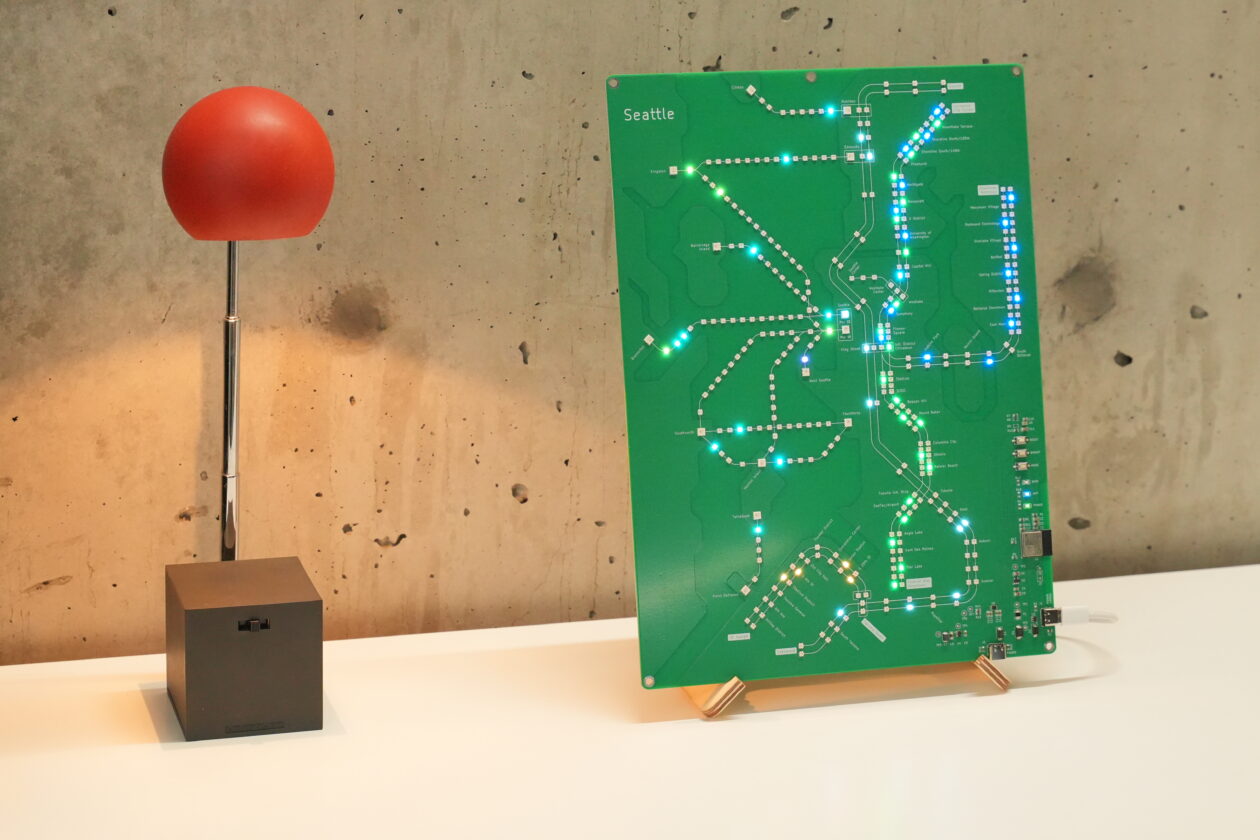
All a circuit board! Tech engineer tracks trains, ferries and more in real time with a post-layoff project
A recent layoff from Amazon gave software engineer Michael Benedict the unexpected freedom to transform a personal gift into "Seattle Transit Live," an interactive LED circuit board map. This innovative device tracks the real-time movement of Puget Sound-area trains, ferries, and water taxis, quickly selling out its initial pre-order runs after captivating local tech enthusiasts.
From Personal Project to Public Demand
The genesis of Seattle Transit Live began when Sound Transit's 2 Line across Lake Washington opened in March. Benedict, a transit enthusiast himself, crafted a unique birthday present for his wife: a circuit board map of Seattle featuring tiny lights that illuminated moving trains. Following his Amazon layoff, he seized the opportunity to dedicate significant time to this passion project, delving deep into CAD design, custom hardware, and prototyping.
Benedict candidly admitted to GeekWire, "I put way more time than is ever going to be economic into this. I really kind of luxuriated in it because I didn’t have a job and I could just go deep." This period of intense focus allowed the personal gift to evolve into a refined product. An early prototype shared on Reddit garnered immediate and enthusiastic responses, prompting Benedict to scale up production to meet demand from fellow transit geeks.
A Live Look at Regional Transit
Priced at $219, the 8.6-by-11.8-inch device is a testament to intricate design and functionality. It features a custom fiberglass circuit board with copper etchings that outline Seattle's waterways and transit routes. The board connects to Wi-Fi to pull public transit data, enabling its blinking LED lights to display the live positions of various vehicles, including Sound Transit trains, Washington State Ferries, the Sounder, and the Monorail.
Beyond real-time tracking, Seattle Transit Live offers an ambient light sensor to adjust brightness and three distinct software modes. Users can switch to a schedule replay mode or a fascinating fast-forward option that compresses a full 24-hour transit schedule into mere minutes, playing at 400 times normal speed. Benedict has also made the hardware design open-source, promoting community engagement and further development.
Craftsmanship and Local Partnerships
While the printed circuit boards are manufactured in Shenzhen, China—a common practice for small-batch electronics—Benedict prioritized local collaboration for another crucial component. He partnered with Oxbow Fabrication in Seattle's Georgetown neighborhood to CNC-machine the custom wooden stands that accompany each board, ensuring a portion of the production remains local.
The rapid success of the project is evident in its sales: the initial run of 50 pre-orders quickly sold out, leading Benedict to order another 150 units to fulfill demand through the end of the year. This venture into independent hardware entrepreneurship has brought its own unique pressures, as Benedict humorously noted, "Putting 75,000 LEDs on your personal credit card is enough to make you think, ‘Maybe I should send some emails.'"
Vision and Future Prospects
Benedict views Seattle's unique geography and expanding light rail network as an ideal canvas for this type of functional art. While not intended to replace navigation apps like OneBusAway, the board offers a tangible, artistic representation of the region's dynamic movement. He recently showcased the project at the Seattle Design Festival and is exploring retail opportunities within the city, such as the Seattle Art Museum's gift shop.
Originally from Queens, N.Y., Benedict’s professional background includes data science roles at 98point6 and Modernist Cuisine, alongside his tenure at Amazon. His embrace of the Pacific Northwest and its transit systems has been deepened by this project, especially living adjacent to the new Judkins Park station. "Transit is just a really cool subject matter for it," Benedict reflected. "It’s on a schedule, the data’s there, and it feels very Seattle — how the boats and trains move around."
FAQ
Q: What is Seattle Transit Live? A: Seattle Transit Live is an interactive LED circuit board map created by engineer Michael Benedict. It tracks the real-time movement of trains, ferries, and other public transit vehicles in the Puget Sound area using public data and displays their locations with blinking lights.
Q: How did the project begin? A: The project started as a birthday gift for Benedict's wife. After being laid off from Amazon, he used the extra time to develop it further into a full-fledged product, driven by an enthusiastic response from the public after sharing an early prototype online.
Q: What are the key features of the Seattle Transit Live board? A: The board, priced at $219, measures 8.6-by-11.8 inches and connects to Wi-Fi for live data. It includes an ambient light sensor and three software modes: real-time tracking, schedule replay, and a 400x fast-forward mode to visualize a full day's transit in minutes. The hardware design is also open-source.
Related articles
Xi pitches open-source AI to BRICS amid domestic curb debates
Chinese President Xi Jinping proposed a China-led open-source AI community and invited BRICS nations to join the World AI Cooperation Organization (WAICO) at the recent BRICS summit. This push for global collaboration contrasts sharply with Beijing's ongoing internal debates about restricting its own advanced AI models. Meanwhile, the EU's comprehensive AI Act, with its clear, enforceable rules for open-source AI, highlights a significant divergence in global AI governance approaches.

StarCraft Returns in 2030 as Open-World Shooter
Blizzard Entertainment announced a new StarCraft game, an open-world shooter, set to release in 2030. Unveiled at BlizzCon by VP Dan Hay, this marks the series' return after over a decade and a significant genre shift from its real-time strategy roots. The cinematic trailer showcased a gritty human-Zerg conflict, with many fans hoping for a traditional RTS follow-up.

Tesla Set to Finally Unveil Second-Generation Roadster on October 1
The much-anticipated second generation of the Tesla Roadster, a halo vehicle promising revolutionary performance, is finally slated for a public unveiling on October 1. After years of delays and a protracted development

Seattle Warned on Big Tech Reliance; Microsoft/OpenAI Sued; Apple's
A new City of Seattle study warns of the city's risky economic over-reliance on a few dominant tech companies. Simultaneously, the Seattle Times and Newsday are suing Microsoft and OpenAI for alleged AI training data theft, while Apple's new foldable iPhone Duo evokes memories of Microsoft's defunct Surface Duo.

in-depth: The Best 3-in-1 Apple Charging Stations After Testing 30
Wired has released its top picks for 3-in-1 Apple charging stations, extensively tested for iPhone, Apple Watch, and AirPods. The guide highlights six leading models, from premium speedy options to budget-friendly and compact designs, all focused on decluttering and optimizing charging for Apple users.

Nscale Adds Former OpenAI Exec Fidji Simo to Board Ahead of IPO
Nscale, the U.K.-based AI data center startup, has appointed former OpenAI, Meta, and Instacart executive Fidji Simo to its board of directors. This high-profile addition comes as Nscale prepares for a potential IPO this fall, leveraging Simo's extensive experience in scaling major tech platforms and guiding a company through a successful public offering.