
Dacia's New Spring EV Shifts Production to Slovenia, Stays Under €20K
Dacia's new Spring EV production shifts from China to Slovenia. This strategic move avoids EU tariffs and unlocks subsidies, ensuring the affordable electric car remains under €20,000.
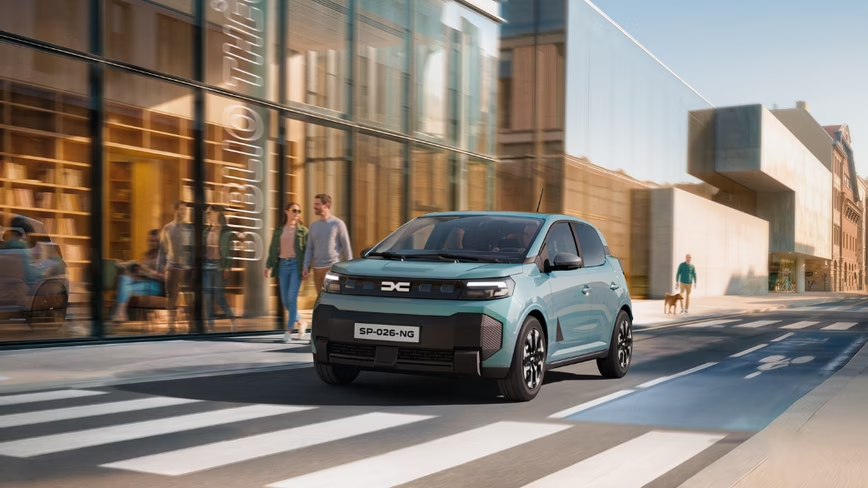
Dacia has announced a significant strategic shift for its popular Spring electric vehicle, moving production of the second-generation model from China to Renault’s Novo Mesto plant in Slovenia. This critical relocation allows Dacia to position the new Spring, redesigned on Renault Group’s RG-EV small architecture, with an entire range priced under €20,000 before government subsidies, directly addressing the evolving landscape of European EV tariffs and incentives.
Strategic Shift to European Production
The decision comes as the European Commission imposed countervailing duties on Chinese-built battery EVs in October 2024, prompting several national subsidy schemes to prioritize vehicles assembled within Europe. By producing the Spring in Slovenia, Dacia bypasses these new duties and qualifies for various European purchase incentives, making the EV a more economically viable option for consumers. The choice of Slovenia also leverages lower labor costs compared to countries like France or Germany, a crucial factor for maintaining the aggressive sub-€20,000 price point.
While Dacia's official press materials only state the Spring is "made in Europe," the underlying motivation is clear. The Novo Mesto plant has decades of experience building small Renault Group models and operates within the EU customs union, ensuring the Spring faces none of the tariffs a Chinese-built counterpart would.
Introducing the Second-Generation Spring
The second-generation Spring marks a fresh start for the model, being the first Dacia to utilize Renault Group's new RG-EV small architecture. This new platform, combined with an accelerated development program, has reportedly cut the design cycle to under two years and significantly reduced overall development costs. The new model is more substantial than its predecessor, growing by 15cm in length and 18cm in width, reaching dimensions of 3.85m by 1.74m. It also boasts a larger 337-litre boot, a capacity that Dacia claims surpasses some vehicles in segments above.
Performance and Efficiency for Urban Driving
Underpinning its efficiency, the new Spring is equipped with a modest yet capable 60kW motor, delivering 80 horsepower and 175Nm of torque. This setup allows the EV to accelerate from 0 to 100 km/h in 12.1 seconds and reach a top speed of 130 km/h, making it well-suited for urban and suburban driving. Its 27.5kWh LFP (Lithium Iron Phosphate) battery provides a usable capacity for up to 250km on the WLTP combined cycle. The choice of LFP chemistry is strategic, avoiding the more expensive and supply-chain-vulnerable nickel and cobalt found in higher-density cells, aligning with broader industry trends for entry-level EVs. With a starting weight of 1,212kg, the Spring achieves an impressive consumption figure of 12.7kWh per 100km, among the lowest on the market.
Charging Capabilities and Features
While designed for affordability, the Spring’s charging capabilities are tailored for typical daily use. A 6.6kW onboard AC charger is standard, taking approximately nine hours to charge from 15% to 80% on a domestic socket, or under three hours with a 7kW wallbox. For those requiring faster charging, an optional "Charge Pack" introduces an 11kW AC charger and a 50kW DC fast charger, cutting DC charging time (15% to 80%) to just 28 minutes. This pack also includes vehicle-to-load (V2L) functionality, allowing the car to power external devices like coffee machines or e-bikes.
Market Positioning and Dacia's EV Future
Dacia anticipates that the new Spring will continue to serve its primary customer base, whose first-generation owners averaged 34km of daily driving and charged at home three-quarters of the time. Available in two trim levels, Expression and Journey, both share the core powertrain. The Journey trim enhances the experience with a 10.1-inch touchscreen, wireless CarPlay, Android Auto, and connected navigation for eight years. In a European market seeing record penetration from Chinese EV brands offering aggressive pricing, the Dacia Spring's move to European production allows it to effectively undercut its predecessor's price while leveraging tariff protection and subsidies. This move solidifies the Spring's role as the first of four all-electric Dacia models planned by 2030, signaling the brand's commitment to affordable European-built EVs.
FAQ
Q: Why did Dacia move Spring production from China to Slovenia? A: Dacia relocated Spring production to Slovenia primarily to circumvent new European Commission countervailing duties imposed on Chinese-built battery EVs and to qualify for national EV purchase incentives that favor European-assembled vehicles. This strategic move helps Dacia keep the Spring's price competitive in the European market.
Q: How does the new Dacia Spring maintain its under €20,000 price point despite moving production to Europe? A: The affordability of the new Spring is maintained through several factors: utilizing a new, cost-efficient Renault Group platform designed for small EVs, reduced development costs due to a shorter design cycle, the use of more affordable LFP battery chemistry, and leveraging lower labor costs in Slovenia compared to other Western European countries.
Q: What are the key improvements in the second-generation Dacia Spring? A: The second-generation Dacia Spring features a new dedicated EV platform, an increase in size (15cm longer, 18cm wider), a larger 337-litre boot, and an updated 60kW motor. It also offers an optional "Charge Pack" for faster DC charging and vehicle-to-load (V2L) capabilities, while strategically using LFP batteries for cost-effectiveness and supply chain stability.
Related articles
Xi pitches open-source AI to BRICS amid domestic curb debates
Chinese President Xi Jinping proposed a China-led open-source AI community and invited BRICS nations to join the World AI Cooperation Organization (WAICO) at the recent BRICS summit. This push for global collaboration contrasts sharply with Beijing's ongoing internal debates about restricting its own advanced AI models. Meanwhile, the EU's comprehensive AI Act, with its clear, enforceable rules for open-source AI, highlights a significant divergence in global AI governance approaches.

StarCraft Returns in 2030 as Open-World Shooter
Blizzard Entertainment announced a new StarCraft game, an open-world shooter, set to release in 2030. Unveiled at BlizzCon by VP Dan Hay, this marks the series' return after over a decade and a significant genre shift from its real-time strategy roots. The cinematic trailer showcased a gritty human-Zerg conflict, with many fans hoping for a traditional RTS follow-up.

Tesla Set to Finally Unveil Second-Generation Roadster on October 1
The much-anticipated second generation of the Tesla Roadster, a halo vehicle promising revolutionary performance, is finally slated for a public unveiling on October 1. After years of delays and a protracted development

Seattle Warned on Big Tech Reliance; Microsoft/OpenAI Sued; Apple's
A new City of Seattle study warns of the city's risky economic over-reliance on a few dominant tech companies. Simultaneously, the Seattle Times and Newsday are suing Microsoft and OpenAI for alleged AI training data theft, while Apple's new foldable iPhone Duo evokes memories of Microsoft's defunct Surface Duo.

in-depth: The Best 3-in-1 Apple Charging Stations After Testing 30
Wired has released its top picks for 3-in-1 Apple charging stations, extensively tested for iPhone, Apple Watch, and AirPods. The guide highlights six leading models, from premium speedy options to budget-friendly and compact designs, all focused on decluttering and optimizing charging for Apple users.

Nscale Adds Former OpenAI Exec Fidji Simo to Board Ahead of IPO
Nscale, the U.K.-based AI data center startup, has appointed former OpenAI, Meta, and Instacart executive Fidji Simo to its board of directors. This high-profile addition comes as Nscale prepares for a potential IPO this fall, leveraging Simo's extensive experience in scaling major tech platforms and guiding a company through a successful public offering.